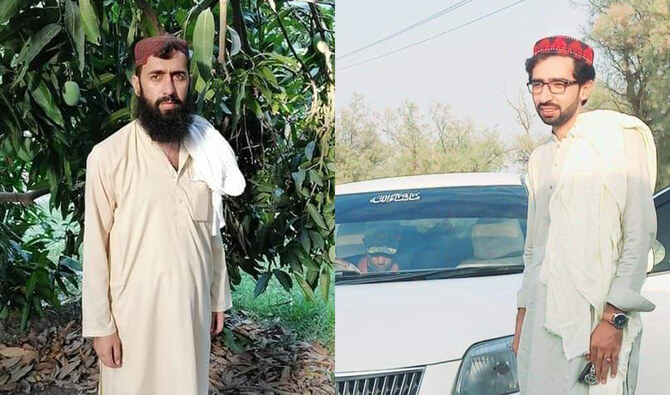
PESHAWAR: Unidentified gunmen killed two brothers of a police official in Pakistan’s northwestern Lakki Marwat district, confirmed a spokesperson for the law enforcement agency on Sunday, as the country grapples with a surge in militant violence in its western region, including Khyber Pakhtunkhwa province.
Pakistani authorities say attacks on security forces and police personnel have significantly increased since the US-led coalition forces left Afghanistan in August 2021 and the Taliban took power in Kabul.
Pakistan has repeatedly claimed that militants have been using Afghan soil to carry out attacks on civilians and security forces, even blaming the Afghan Taliban for facilitating them.
However, the administration in Kabul denies this, asserting that Pakistan’s security problems are Islamabad’s internal issue.
Asked about the Lakki Marwat attack, local police spokesperson Shahid Hameed confirmed the incident and provided details.
“Last night [Saturday], at around 9:30 PM, unidentified terrorists opened fire in front of the residence of Station House Officer [SHO] Shafi Ullah in the village of Abakhel, which is within the jurisdiction of Lakki City Police Station,” he said.
He explained that the SHO’s brothers were outside the house after offering their night prayers when the gunmen, riding a motorbike, opened fire, killing them instantly.
When asked if they had received threats from militants, Hameed maintained no one in the region was safe, and everyone faced threats.
So far, no group has claimed responsibility for the attack, though the proscribed Tehreek-e-Taliban Pakistan (TTP) has remained active in the region in such violent activities.
Last month, militants targeted a convoy of local judges in Tank district. Prior to that, an attack on a police station in February claimed the lives of 10 officers and injured six others in Dera Ismail Khan.
Pakistani officials say TTP militants have been using night vision devices and advanced weaponry left behind by US-led forces in Afghanistan.


Two brothers of police official killed in northwestern Pakistan amid rising militant violence
https://arab.news/rwmp6
Two brothers of police official killed in northwestern Pakistan amid rising militant violence

- Incident took place in the volatile Lakki Marwat district in Pakistan’s Khyber Pakhtunkhwa province
- The brother of a station house officer in the region were killed in front of their residence on Saturday

Pakistan says defense pact with Saudi Arabia elevated brotherly ties to ‘new heights’
- Pakistan, Saudi Arabia signed strategic defense pact last year pledging aggression against one will be treated as attack on both
- Deputy PM Ishaq Dar says enduring bonds with Islamic and Arab nations form vital pillar of Pakistan’s foreign policy
ISLAMABAD: Deputy Prime Minister Ishaq Dar said on Wednesday that Pakistan’s defense pact with Saudi Arabia elevated its brotherly ties with the Kingdom to “new heights,” stressing that close ties with Arab and Islamic nations form a key pillar of Islamabad’s foreign policy.
Pakistan and Saudi Arabia signed a Strategic Mutual Defense Agreement on Sept. 17 last year, pledging that aggression against one country would be treated as an attack on both, enhancing joint deterrence and formalizing decades of military and security cooperation.
Both nations agreed in October 2025 to launch an economic cooperation framework to strengthen trade and investment ties.
“In the Middle East, our landmark Strategic Mutual Defense Agreement with Saudi Arabia has elevated our brotherly ties to new heights,” Dar said while speaking at the Pakistan Governance Forum 2026 event in Islamabad.
The Pakistani deputy prime minister was speaking on the topic “Navigating International Relations Amidst Changing Geo-Politics.”
Dar noted that Pakistan has reinforced partnerships with other Middle Eastern nations such as the UAE, Qatar, Jordan, Oman, Egypt and Bahrain. He said these partnerships have yielded “concrete agreements” in investment, agriculture, infrastructure, and energy sectors.
“Our enduring bonds with Islamic and Arab nations form a vital pillar of our foreign policy, and we will continue to expand our partnerships across Asia, Latin America, and Africa,” he said.
Dar pointed out that the presidents of Kazakhstan, Uzbekistan and Kyrgyzstan have undertaken visits to Pakistan in recent months, reflecting Central Asian nations’ desire to boost cooperation with Islamabad.
On South Asia, the Pakistani deputy PM said Pakistan has successfully transformed its fraternal ties with Bangladesh into “a substantive partnership.”
“Similarly, the trilateral mechanism involving China, Pakistan, and Bangladesh has been launched with a view to expanding and deepening regional cooperation and synergy,” the Pakistani minister said.
He said Islamabad has strengthened its “all-weather” partnership with China via the second phase of the multi-billion-dollar China-Pakistan Economic Corridor agreement and “unwavering support” from both sides for each other’s core interests.
Dar said Pakistan had also reinvigorated its partnership with the US, advancing cooperation in trade, technology, investment, and regional stability.
“This calibrated approach has enhanced our ability to navigate complexity with skill and confidence, ensuring that our national interests are served without compromising our core foreign policy principles,” he said.


