



ALGIERS, Algeria: Less than half of Algeria’s eligible voters cast a ballot in the country’s presidential poll, preliminary figures from electoral authorities showed early Sunday, despite incumbent Abdelmadjid Tebboune’s hopes for a high turnout.
Tebboune, 78, is heavily favored to secure a second term, seeing off moderate Islamist Abdelaali Hassani, 57, and socialist candidate Youcef Aouchiche, 41.
His main challenge was to increase the voter participation level in Saturday’s vote after a historic abstention rate of over 60 percent in 2019, the year he became president.
More than 24 million Algerians were registered to vote this year, with about a third under the age of 40.
Electoral board ANIE announced early Sunday an “average turnout” rate of 48 percent, but did not provide the total number of people who cast a ballot.
ANIE said the figure was “provisional,” adding that it would give an official turnout rate later on Sunday along with the election’s results.
The announcement came three hours behind schedule after the election board said on Saturday evening that it was extending voting by one hour, expecting more voters to show up.
“Voters wondered what was the point of voting when all predictions are in favor of the president,” said analyst Hasni Abidi, calling the candidates’ bids “mediocre.”
He said Tebboune “barely did four rallies,” while his challengers “weren’t up to the task.”
“Not voting does not mean political opposition,” he added. “Rather, it means people did not see themselves as part of the electoral game.”
Both of Tebboune’s challengers had called for a large turnout Saturday morning.
“Today we start building our future by voting for our project and leaving boycott and despair behind us,” Aouchiche said on national television after voting.
Hassani told journalists he hoped “the Algerian people will vote in force” because “a high turnout gives greater credibility to these elections.”
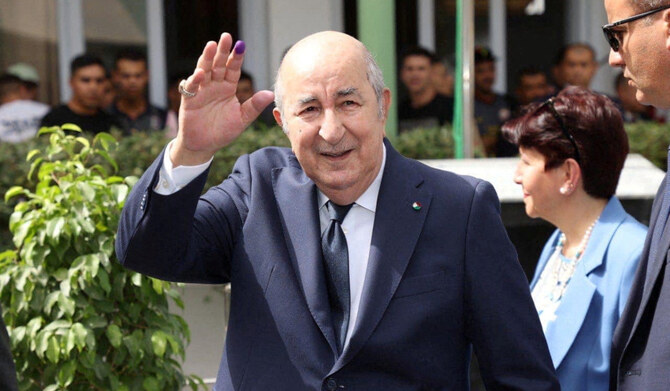
But Tebboune did not mention voter numbers, saying only that he hoped “Algeria will win in any case” after voting in Algiers.
He said that whoever wins “will continue the project” of what he often calls the New Algeria — the country that emerged following mass pro-democracy protests.
“I came early to exercise my duty and choose the president of my country in a democratic manner,” Sidali Mahmoudi, a 65-year-old early voter, told AFP.
Seghir Derouiche, 72, told AFP that not voting was “ignoring one’s right.” Two women, Taous Zaiedi, 66, and Leila Belgaremi, 42, said they were voting to “improve the country.”
Algerians abroad have been able to vote since Monday.
ANIE is set to announce the official results on Sunday.
Yet the winner was “known in advance,” political commentator Mohamed Hennad posted on Facebook before voting began, referring to Tebboune.
Tebboune’s opponents stood little chance because of low support and the “conditions in which the electoral campaign took place, which is nothing more than a farce,” Hennad wrote.
The 2019 low turnout had followed the Hirak pro-democracy protests, which toppled former president Abdelaziz Bouteflika before they were quashed with ramped-up policing and the jailing of hundreds of people.
This year’s election still failed to enthuse Algerians, and campaign rallies have struggled to generate interest in the nation of 45 million, partly because of the summer heat.
With young people making up more than half the population, all three candidates have courted their votes with promises to improve living standards and reduce dependence on hydrocarbons.
Tebboune has touted economic successes during his first term, including more jobs and higher wages in Africa’s largest exporter of natural gas.
His challengers have vowed to grant the people more freedoms.
Aouchiche says he is committed “to release prisoners of conscience through an amnesty and to review unjust laws,” including on media and terrorism.
Hassani has advocated “freedoms that have been reduced to nothing in recent years.”
Political analyst Abidi said Tebboune should address the major deficit in political and media freedoms, with Algerians having “divorced from current politics” after the Hirak protests ended.
Five years later, rights group Amnesty International said Algerian authorities were “committed to maintaining a zero-tolerance approach toward dissenting opinions.”


