

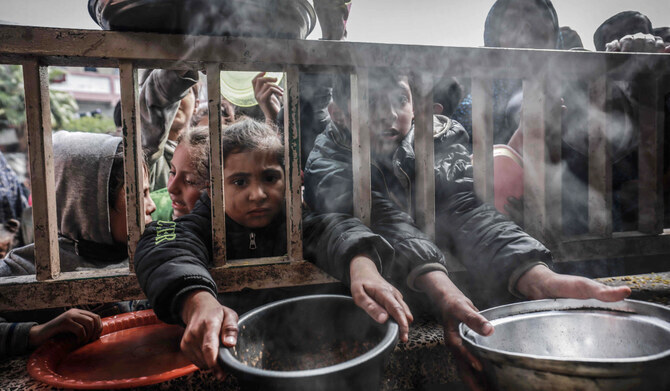

UNITED NATIONS: The UN independent investigator on the right to food accused Israel of carrying out a “starvation campaign” against Palestinians during the war in Gaza, an allegation that Israel vehemently denies.
In a report this week, investigator Michael Fakhri claimed it began two days after Hamas’ surprise attack in southern Israel that killed some 1,200 people, when Israel’s military offensive in response blocked all food, water, fuel and other supplies into Gaza.
Israeli Prime Minister Benjamin Netanyahu said accusations of Israel limiting humanitarian aid were “outrageously false.”
“A deliberate starvation policy? You can say anything — it doesn’t make it true,” he said in a press conference Wednesday.

Palestinians are storming trucks loaded with humanitarian aid brought in through a new U.S.-built pier, in the central Gaza Strip, May 18, 2024. (AP)
Following intense international pressure — especially from close ally the United States — Netanyahu’s government gradually has opened several border crossings for tightly controlled deliveries. Fakhri said limited aid initially went mostly to southern and central Gaza, not to the north where Israel had ordered Palestinians to go.
A professor at the University of Oregon School of Law, Fakhri was appointed by the Geneva-based UN Human Rights Council as the investigator, or special rapporteur, on the right to food and assumed the role in 2020.
“By December, Palestinians in Gaza made up 80 percent of the people in the world experiencing famine or catastrophic hunger,” Fakhri said. “Never in post-war history had a population been made to go hungry so quickly and so completely as was the case for the 2.3 million Palestinians living in Gaza.”
Fakhri, who teaches law courses on human rights, food law and development, made the allegations in a report to the UN General Assembly circulated Thursday.

This image grab from an AFPTV video shows Palestinians running toward parachutes attached to food parcels, air-dropped from US aircrafts on a beach in the Gaza Strip on March 2, 2024. (AFP)
He claims it goes back 76 years to Israeli’s independence and its continuous dislocation of Palestinians. Since then, he accused Israel of deploying “the full range of techniques of hunger and starvation against the Palestinians, perfecting the degree of control, suffering and death that it can cause through food systems.”
Since the war in Gaza began, Fakhri said he has received direct reports of the destruction of the territory’s food system, including farmland and fishing, which also has been documented and recognized by the UN Food and Agriculture Organization and others.
“Israel then used humanitarian aid as a political and military weapon to harm and kill the Palestinian people in Gaza,” he claimed.
Israel insists it no longer places restrictions on the number of aid trucks entering Gaza, including food.
At Wednesday’s press conference, Netanyahu cited figures from COGAT, Israel’s military body overseeing aid entry into Gaza, that 700,000 tons of food items had been allowed into Gaza since the war began 11 months ago.
Nearly half of that food aid in recent months has been brought in by the private sector for sale in Gaza’s markets, according to COGAT figures. However, many Palestinians in Gaza say they struggle to afford enough food for their families.
Israel allows trucks of aid through two small crossings in the north and one main crossing in the south, Kerem Shalom. However, since Israel’s invasion of the southern city of Rafah in May, the UN and other aid agencies say they struggle to reach the Gaza side of Kerem Shalom to retrieve the aid for free distribution because Israel’s military operations make it too dangerous.
UN spokesman Stephane Dujarric called the humanitarian situation in Gaza “beyond catastrophic,” with more than 1 million Palestinians not receiving any food rations in August and a 35 percent drop in people getting daily cooked meals.
The UN humanitarian office attributed the sharp reduction in cooked meals partly to multiple evacuation orders from Israeli security forces that forced at least 70 of 130 kitchens to either suspend or relocate their operations, he said Thursday. The UN’s humanitarian partners also lacked sufficient food supplies to meet requirements for the second straight month in central and southern Gaza, Dujarric added.
He said critical shortages of supplies in Gaza are stem from hostilities, insecurity, damaged roads, and Israeli obstacles and access limitations.


