

Saudi Arabia takes major strides in cloud seeding to combat water scarcity

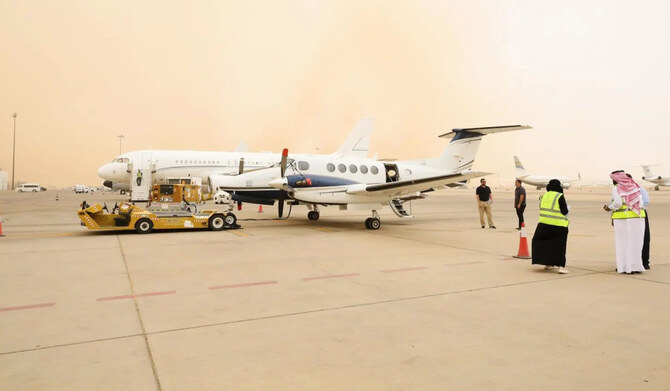
The process involves aircraft and drones dispersing environmentally safe materials into clouds over carefully selected areas, official said. (SPA)
Short Url
Updated 06 September 2024
Follow

Saudi Arabia takes major strides in cloud seeding to combat water scarcity

  • Plan for more aircraft and local pilots for cloud-seeding operations
  • Need better ‘quantity and quality’ rainfall, says meteorology official

RIYADH: The Kingdom has taken significant strides in its cloud-seeding program to increase rainfall, expand green areas, and combat desertification across the Kingdom, according to the Saudi Press Agency.

Ayman Al-Bar, executive director of the Regional Cloud Seeding Program, told the SPA on Thursday that the process involves aircraft and drones dispersing environmentally safe materials into clouds over carefully selected areas.
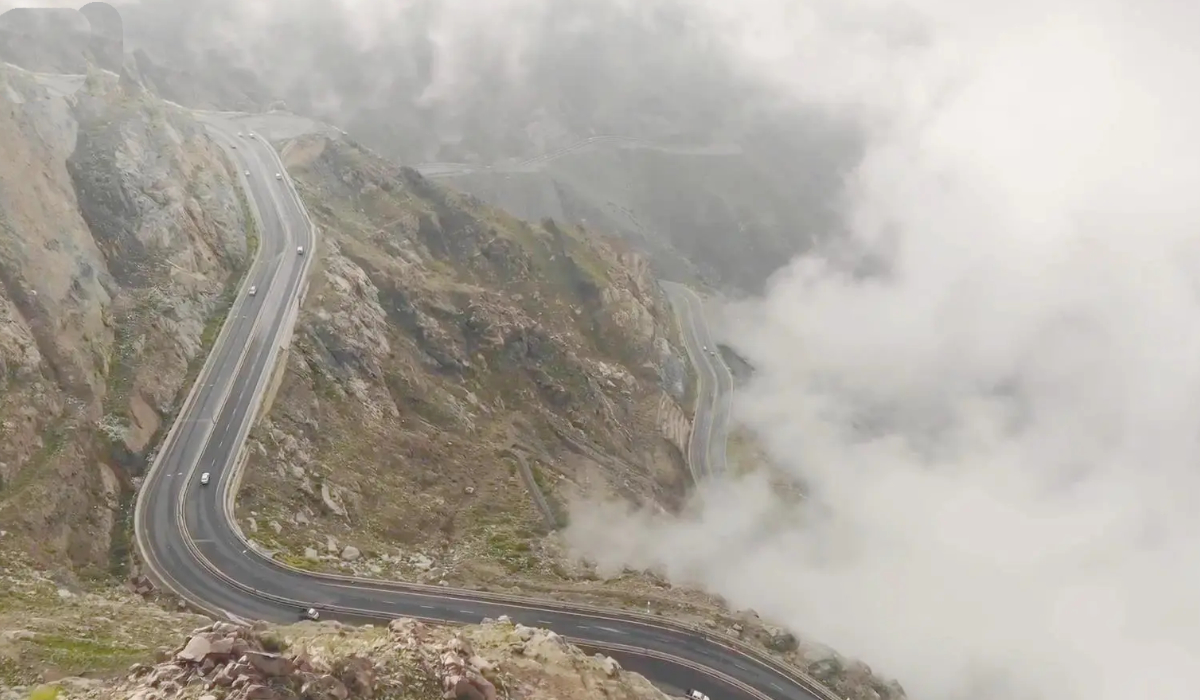


The process involves aircraft and drones dispersing environmentally safe materials into clouds over carefully selected areas, official said. (SPA)

By targeting specific areas, a single cloud can increase its rainfall by up to 20 percent under ideal conditions, said Al-Bar.

In 2023, the program targeted six regions in Saudi Arabia, conducting 415 cloud-seeding flights, and dispersing 7,876 flares with four aircraft for over 1,300 hours.

Research on the operations was conducted by a separate aircraft for over 110 hours.

FASTFACTS

• Plan for more aircraft and local pilots for cloud-seeding operations.

• Need better ‘quantity and quality’ rainfall, says meteorology official.

Al-Bar added: “The initiative has now entered its fifth phase, marking a new milestone in the country’s efforts to enhance water security. Our approach is tailored to enhance both the quantity and quality of rainfall from specific cloud types.”

Hussein bin Mohammed Al-Qahtani, spokesperson for the National Center of Meteorology, told the SPA that last year’s total rainfall was an estimated 4 billion cubic millimeters.

Al-Qahtani also highlighted the center’s efforts to localize cloud-seeding expertise, with 18 Saudi Arabia pilots joining the program.

According to the SPA, Saudi Arabia began its cloud-seeding initiative in 2004 and partnered with Weather Modification Inc. under the scientific oversight of the National Center for Atmospheric Research.

This collaboration focused on conducting cloud-seeding experiments in the Asir region, coupled with a comprehensive feasibility study.

Building on its initial findings, the Kingdom expanded its efforts in 2006-2007. During this period, a six-month cloud-seeding trial was conducted across central Saudi Arabia, encompassing the regions of Riyadh, Qassim, and Hail.

The program reached a new milestone in 2009 with a contract involving the WMI. This phase saw the deployment of 10 specialized aircraft for cloud-seeding operations, involving several elite Saudi Arabia scientists.

It takes about 30 minutes for the effects of cloud seeding to be seen, depending on the delivery method, which includes direct injection at the cloud top, base seeding or releasing the agent in the updraft below the cloud base.

Materials used vary based on temperature conditions, including solid carbon dioxide, or dry ice, used at low temperatures, and calcium chloride particles used at higher temperatures to form condensation nuclei.


Wrapping up Year of Handicrafts at AlUla’s Winter at Tantora

Updated 9 sec ago
Follow

Wrapping up Year of Handicrafts at AlUla’s Winter at Tantora

  • Annual festival takes place until Jan. 10

ALULA: AlUla’s Old Town has sprung into life with Winter at Tantora — the annual festival which runs until Jan. 10 — as cooler temperatures settle over the region.

The three-week event contains workshops, concerts and gastronomic experiences which have transformed the historic landscape into a vibrant cultural gathering point, catering to locals and visitors alike.

Winter at Tantora takes its name from the traditional sundial, or the tantora, once used to mark the agricultural calendar.

The actual tantora is still perched atop what is now Dar Tantora The House Hotel, which was named as one of Time magazine’s “World’s Greatest Places” in 2024.

One of the festival’s most atmospheric offerings is Shorfat Tantora, where live music fills Al-Jadidah Arts District as musicians perform from balconies, blending traditional rhythms with contemporary beats.

The open-air experience invites audiences to gather and witness music’s unifying power on Thursday and Friday nights between 8:30 p.m. and 10:30 p.m. It ends on Jan. 2.

Since this year’s festival also highlights Saudi Arabia’s rich artisanal heritage — in line with the Ministry of Culture’s designation of 2025 as the Year of Handicrafts — there are plenty of crafts to be seen.

The festival spirit was also reflected this week at the outdoor Thanaya venue, a short drive from Old Town, where Emirati superstar Ahlam Al-Shamsi, who is known as Ahlam, took to the stage.

Her name, which means “dream” in Arabic, felt particularly fitting as the audience was immersed in her craft on the crisp, cool night with AlUla’s ancient rock formations as a backdrop. With wind billowing over the sky, she was perhaps the brightest star of the night.

Ahlam told the crowd: “In the Year of Handicrafts we celebrate human creativity through the hands that craft and the spirit that creates.

“The weather has been chilly over the last two days, but you (the audience) radiate warmth.”

With craft stations and food trucks nearby, Ahlam represented a modern twist weaved into the ongoing oral storytelling tradition.

Back in Old Town, people enjoyed the Art Walk tour and snaked through the labyrinth of painted mudbrick homes, murals and traditions while being guided by a local storyteller.

The Old Town Culinary Voyage merges storytelling and tasting. It spotlights traditional flavors and culture through aromas, spices and tastings.

Walking through the dusty, uneven rocky ground, visitors come across the ancient “Incense Road,” a well-known trade route central to pre-Islamic history and a main stage for global exchange.

A key stop in a network of ancient caravan routes, the road connected southern parts of Arabia, where frankincense and myrrh were produced, to the Mediterranean world.

These routes made incense one of the most valuable commodities of the ancient world. Parts of the route are now UNESCO World Heritage Sites.