

Thailand’s king swears in new government after turmoil

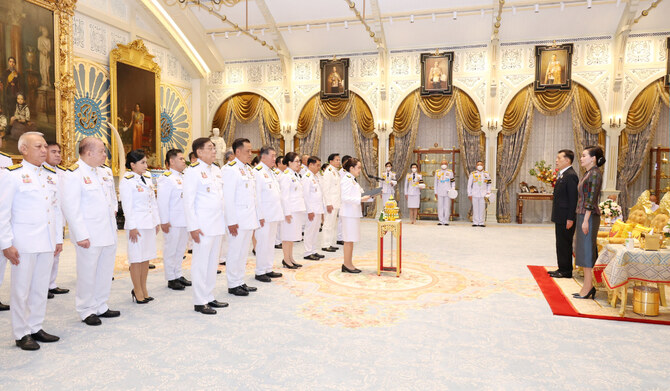
Thailand's Prime Minister Paetongtarn Shinawatra stands with her cabinet members in front of Thailand's King Maha Vajiralongkorn during a royal oath-taking at the Palace in Bangkok, Thailand, September 6, 2024. (REUTERS)
Short Url
Updated 06 September 2024
Follow

Thailand’s king swears in new government after turmoil

  • Dressed in official uniform, Paetongtarn and her Cabinet ministers swore their allegiance in front of King Vajiralongkorn and Queen Suthida in a ceremony at Bangkok’s Dusit Palace

BANGKOK: Thailand’s King Maha Vajiralongkorn swore in Prime Minister Paetongtarn Shinawatra and 35 Cabinet ministers in Bangkok on Friday, ushering in a new government in Southeast Asia’s second largest economy after a period of political turmoil.
Paetongtarn, 38, leader of the ruling Pheu Thai party, was elected by parliament last month to become Thailand’s youngest prime minister after her predecessor Srettha Thavisin was dismissed by a court order over an ethics violation.
The Cabinet, which was formally endorsed by the king on Wednesday, comprises 17 members from Pheu Thai, including the premier, and another 19 positions divided among coalition partners.
Dressed in official uniform, Paetongtarn and her Cabinet ministers swore their allegiance in front of King Vajiralongkorn and Queen Suthida in a ceremony at Bangkok’s Dusit Palace.
“I want to wish, with gladness, that the Cabinet will have the encouragement and determination to perform your duties as you have sworn for the benefit of the country and people,” the king said after the Cabinet’s oath of allegiance.
Paetongtarn and the Cabinet ministers bowed after the king’s remark.
The youngest daughter of the divisive former premier Thaksin Shinawatra, Paetongtarn has not served in government previously and will face challenges on multiple fronts, including a floundering economy.
She is also the second woman and fourth member of the Shinawatra clan to hold Thailand’s top elected position, with three previous premiers removed by coups or court decisions.
Paetongtarn’s government will deliver its policy statement to parliament next Thursday and Friday, marking the formal start of her administration.


India rolls out strictest anti-pollution curbs as toxic smog engulfs Delhi

Demonstrator wearing an oxygen mask and holding oxygen tanks takes part in protest.
Updated 14 December 2025
Follow

India rolls out strictest anti-pollution curbs as toxic smog engulfs Delhi

  • Private monitors in several parts of northern Delhi recorded AQI spikes between 550 and 700s
  • Authorities invoked stage four of the capital region’s emergency pollution-control framework

NEW DELHI: India’s capital choked under a thick blanket of smog on Sunday, with the government imposing anti-pollution curbs after monitoring stations in some areas recorded extremely hazardous air quality.

Home to 30 million people, Delhi has not recorded a single “clean air” day in 2025, with Air Quality Index readings hitting high above the 50 score throughout the year.

On the AQI scale from 0 to 500, good air quality is represented by levels below 50, while levels above 300 are dangerous.

Worsening since late October, official records over the weekend were in the severe to severe-plus range of 400–500, but as 24-hour averages, they did not capture the peaks. Private monitors in several parts of North and North West Delhi recorded AQI spikes above 550 and even into the 700s in real-time.

On Saturday evening, the Ministry of Environment’s Commission for Air Quality Management invoked stage four — the highest level — of the Graded Response Action Plan for Delhi and surrounding areas.

To “prevent further deterioration of air quality in the region,” the commission suspended all non-essential construction, shut stone crushers and mining operations, stopped entry of trucks into the capital region, and ordered schools to shift to hybrid classes or online, where possible.

While authorities blamed the pollution on “adverse meteorological conditions,” residents have been demanding more government action.

“The situation is so bad in Delhi that we don’t have any option but to force kids to do online classes. The government has failed us; it has not done anything to address the issue,” said Nabanita Nayak, who decided for her teenage children to attend school online only, despite concerns over their screen addiction.

“If the kids are too much in front of laptops, that’s also an issue. As a mother, I am worried.” 

Delhi’s pollution has been worsening since Diwali in late October, when the average AQI has been above 370, or “very poor.” Since mid-November, it has been over 400, which means “severe” air quality, with certain areas recording 500 and above, which is classified as a “hazardous” level.

“I don’t feel proud living in Delhi. It’s the capital city of the country … We talk about being a developed nation by 2047 — we have deadlines,” said Jagriti Arora, who is keeping her 7-year-old daughter at home to prevent allergy flare-ups caused by air pollution.

“The government has to do something … China had a big problem with pollution, but now they’ve managed to bring it down.”

Delhi’s air quality deteriorates in winter due to local emissions and seasonal weather conditions. Cold temperatures and low wind speeds result in a temperature inversion, which traps pollutants close to the ground instead of letting them disperse. This allows emissions from millions of vehicles, ongoing construction, and nearby industrial activity to accumulate in the air. Urban waste burning and dust from construction sites further add to it.

“This is not a new thing. This has been happening now for over 10 years,” Arora said. “You can see it. You don’t need to actually look at an AQI meter to see how bad the pollution is these days.”