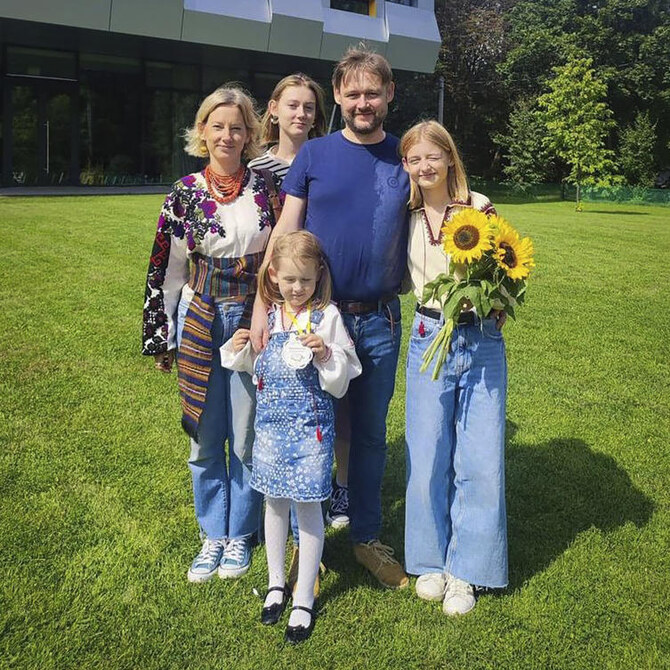
LVIV: Thousands of mourners gathered Friday for funeral services in the western Ukrainian city of Lviv for victims of a Russian missile attack that killed seven people, including a mother and her three daughters.
The pre-dawn blasts earlier this week in the historic center of the city also injured dozens of civilians and shocked Ukrainians as the country endures a renewed round of Russian bombardment.
The city came to a virtual standstill as the mourners, many wiping away tears and some holding single sunflowers or bouquets, gathered outside a church in central Lviv where the funeral services were held in succession.
The deaths have left a profound impact on the city, which had largely been spared the worst of the attacks that typically target infrastructure and are focused with greater intensity in the east of the country.
As hundreds of mourners looked on, Yaroslav Bazylevych, who lost his wife and three daughters, attended the funeral at the Garrison Church of the Holy Apostles Peter and Paul.
Dressed in black, his face still marked by blast injuries, he was supported by another man as he walked to the church and stood over the open white caskets of his wife, Yevgenia, 43, and daughters Emilia, 7, Daryna, 18, and Yaryna, 21, who were clothed in traditional dress with wreaths of flowers on their heads. Mourners filed past the caskets, some leaving flowers and others stopping to hug the father. Residents lined the streets of Lviv as hearses and other vehicles carried the victims to a nearby cemetery, followed by more than a dozen black-clad priests and students carrying white wooden crosses.
At a nearby roadside memorial, candles flickered next to a teddy bear and personal mementos beneath a banner with black-and-white photographs of the blast victims.
The blasts damaged scores of buildings, including several classified as national heritage sites. Survivors described receiving little warning from air raid sirens before the missiles hit.
“The scariest part was that the explosions were happening both behind and in front of our house. I didn’t know what to do,” local resident Tamara Ponomarenko told The Associated Press. “I thought about running to the bomb shelter, but it wasn’t nearby. The school was close, should I run there instead?”
Another survivor, Yelyzaveta Harapko, added: “I went to close the window, to lower the blinds. And as I was doing that, there was an explosion. Sparks flew everywhere, and the window was gone. After that, I heard someone scream, and later I heard cries: ‘Help, people are trapped under the rubble!’”
The deaths of children in the missile attack were seen by many as an attack on an emerging generation that has known nothing but war.
“In the center of Europe, Russia is exterminating whole families of Ukrainians. The Russians are killing our children, our future,” Lviv Mayor Andriy Sadovyi wrote in an online post.
Marta Kuzii, an associate professor at the Ukrainian Catholic University, where 18-year-old Daryna Bazylevych was a student, shared the sentiment.
“Daryna represents the generation that has been given the mission to rebuild Ukraine. She was a child who grew up with the war; it has been part of her entire conscious life,” Kuzii said.
“She was raised in a family with deep values and a clear understanding of what Ukraine stands for. It was an intelligent, highly educated, artistic, and cultured family.”


![]()

In Ukraine, a city grieves for a family killed in a deadly Russia missile attack
Short Url
https://arab.news/7numc
In Ukraine, a city grieves for a family killed in a deadly Russia missile attack
- The pre-dawn blasts earlier this week in the historic center of the city also injured dozens of civilians
- As hundreds of mourners looked on, Yaroslav Bazylevych, who lost his wife and three daughters, attended the funeral at the Garrison Church of the Holy Apostles Peter and Paul

Latest updates


© 2026 SAUDI RESEARCH & PUBLISHING COMPANY, All Rights Reserved And subject to Terms of Use Agreement.