

Tech giant Google announces more investment in Pakistan, support for youth training — PM

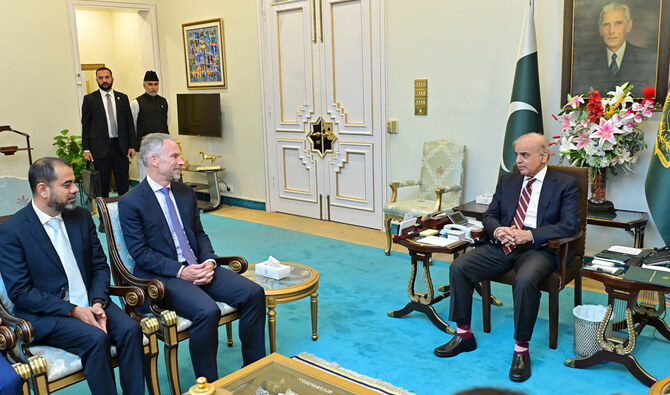
Pakistan Prime Minister Shehbaz Sharif (R) gestures during a meeting with a four-member Google delegation led by the company’s president for the Asia Pacific region, Scott Beaumont (2L), in Islamabad on September 5, 2024. (Photo courtesy: PMO)
Short Url
Updated 06 September 2024
Follow

Tech giant Google announces more investment in Pakistan, support for youth training — PM

  • PM meets Google delegation, shares plans to achieve IT export target of $25 billion in five years
  • Google to produce half a million Chromebooks in Pakistan by 2026, presents first to PM Sharif

ISLAMABAD: Pakistani Prime Minister Shehbaz Sharif said on Thursday tech giant Google had decided to increase its investments in Pakistan and support youth skill training initiatives in the South Asian nation.
A four-member Google delegation led by the company’s president for the Asia Pacific region, Scott Beaumont, called on Sharif on Thursday in Islamabad. 
At a ceremony earlier in the day, Sharif had announced. an IT export target of $25 billion in the next five years, saying the government would allocate funds for training of the youth and improvement in IT infrastructure and the regulatory environment.
“Apprising the prime minister of its plans of future engagement, Mr. Scott said Google has decided to further increase its investment footprint in Pakistan and support the Government’s initiatives of Youth’s skills training,” Pakistani news agency APP reported. 
“In order to maximize the economic benefits of technology, the large youth population and expanding economy are important factors for a value-driven tech giant like Google, he added.”
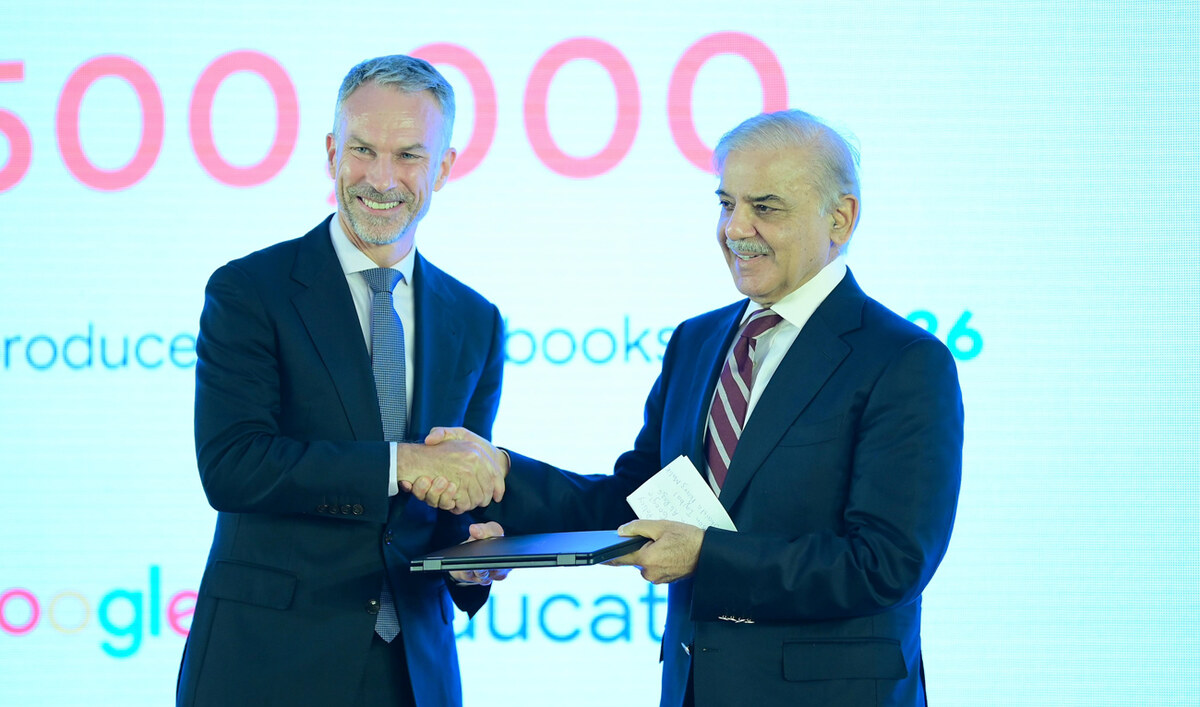


Pakistan Prime Minister Shehbaz Sharif (R) receives Chromebook by Google’s president for the Asia Pacific region, Scott Beaumont (L), during a launch event of an initiative to manufacture 500,000 Chromebooks in Pakistan, in Islamabad on September 5, 2024. (Photo courtesy: PMO)

At a ceremony on Thursday, Google launched an initiative to produce half a million Chromebooks in Pakistan by 2026, marking the occasion by presenting the first locally manufactured device to Sharif. 
“The target is simple and we have to touch the figure of $25 billion in the next five years,” PM Sharif said on Thursday while addressing the ceremony. “Give me a pathway on how to achieve this figure.”
Pakistan is banking on its nascent but growing IT industry to increase its exports and generate critical foreign exchange revenue for a cash-strapped country. IT exports soared to $3.2 billion in the fiscal year 2023-2024, marking a robust 24 percent year-on-year increase from the previous fiscal’s $2.59 billion.
But the push to boost the sector is facing challenges as Internet speeds in Pakistan have dropped by 30-40 percent over the past few weeks, affecting millions of Pakistanis, adversely hitting businesses and drawing nationwide complaints. 
The telecommunications authority has attributed the slowdown to damaged underwater cables while IT Minister Shaza Khawaja has blamed a surge in VPN use, but digital advocacy groups and IT unions say the Internet slowdown may be linked to the government’s trial of an upgraded web management system or national firewall to control what it deems “anti-state propoganda.” The government says any firewall, if imposed, will not be used for censorship purposes.
Last month, the Pakistan Software Houses Association (P@SHA) said Pakistan’s economy could lose up to $300 million due to Internet disruptions caused by the imposition of a national firewall.


Pakistan reviews austerity measures amid Middle East crisis, urges strict nationwide implementation

Updated 11 March 2026
Follow

Pakistan reviews austerity measures amid Middle East crisis, urges strict nationwide implementation

  • Deputy Prime Minister Ishaq Dar chairs review meeting of austerity steps
  • Officials briefed on salary cuts, school closures, four‑day week, petrol conservation

ISLAMABAD: Pakistan’s government on Wednesday assessed progress on a sweeping set of austerity measures introduced to mitigate the country’s economic strain from sharply rising global oil prices and supply disruptions linked to the ongoing war in the Middle East.

Prime Minister Shehbaz Sharif this week announced a series of austerity steps, including a four‑day work week for government offices, requiring 50  percent of staff to work from home, cutting fuel allowances for official vehicles by half, grounding up to 60  percent of the government fleet and closing all schools for two weeks to conserve fuel amid the global oil crisis.

The measures were unveiled in response to global oil market volatility triggered by the conflict involving the United States, Israel and Iran, which has disrupted supply routes such as the Strait of Hormuz and pushed crude prices sharply higher, straining Pakistan’s heavily import‑dependent energy sector.

“The meeting stressed the importance of strict and transparent adherence to the austerity measures, promoting fiscal responsibility and prudent use of public resources,” Deputy Prime Minister and Foreign Minister Senator Mohammad Ishaq Dar said in a statement.

He was chairing a meeting of the Committee for Monitoring and Implementation of Conservation and Additional Austerity Measures, constituted under the directions of the PM, bringing together federal and provincial officials to review execution of the broad cost‑cutting plan. 

Dar emphasized the government’s commitment to enforcing the PM’s austerity steps nationwide. The committee’s review also covered reductions in departmental expenditure, deductions from salaries of senior officials earning over Rs. 300,000 ($1,120), and coordination with provincial administrations to ensure uniform implementation of the plan.

Participants at the meeting reiterated that all ministries and divisions must continue strict monitoring and reporting, with transparent oversight mechanisms, as Pakistan navigates the economic pressures from the prolonged Middle East crisis and its fallout on global energy and trade markets.