

Ahead of 2024 summit, Pakistan deputy PM discusses ‘shared priorities’ with Commonwealth chief

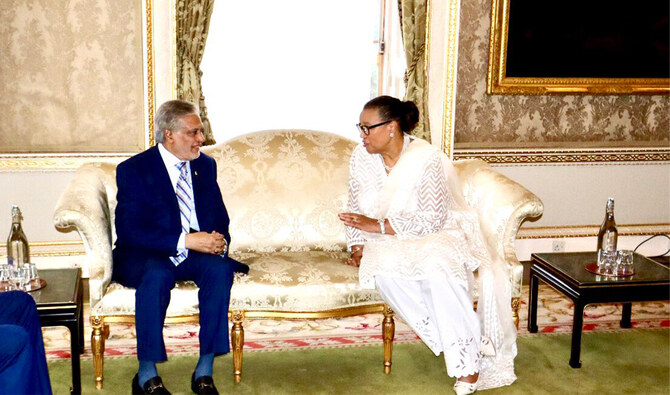
Pakistan's Deputy Prime Minister and Foreign Minister Ishaq Dar (left) calls on Commonwealth Secretary-General Patricia Scotland in London, UK, on September 5, 2024. (@ForeignOfficePk/X)
Short Url
Updated 05 September 2024
Follow

Ahead of 2024 summit, Pakistan deputy PM discusses ‘shared priorities’ with Commonwealth chief

  • 2024 Commonwealth Heads of Government Meeting is scheduled to be held in Samoa from October 21-25
  • Dar began a five-day visit to the UK on Wednesday with a meeting with British Foreign Secretary David Lammy 

ISLAMABAD: Pakistani Deputy Prime Minister Ishaq Dar on Thursday met Commonwealth Secretary-General Patricia Scotland in London and discussed “shared priorities” ahead of the 2024 Commonwealth Heads of Government Meeting scheduled to be held from October 21-25 in Apia, the capital and only city of the island nation of Samoa.

Dar, who is also the foreign minister of Pakistan, began a five-day visit to the UK on Wednesday with a meeting with British Foreign Secretary David Lammy in London. During his trip, Dar is also scheduled to engage with other UK officials and parliamentarians as well as representatives of the British-Pakistani community.

Pakistan and the UK, which is home to a large Pakistani diaspora, have trade, defense and education ties, among engagement in other areas. 

“Great pleasure to reconnect with Secretary-General Patricia Scotland at the Commonwealth Secretariat today,” Dar said in a post on social media site X. “I reiterated that Pakistan attaches high importance to the Commonwealth as an important forum for promoting peace and development.”

He said the two leaders also discussed “shared priorities” for CHOGM 2024. Scotland was last in Pakistan on a five-day visit in July and August. 

The theme for this year’s CHOGM is “One Resilient Common Future: Transforming our Common Wealth” with the aim to strengthen “resilient democratic institutions upholding human rights, democracy, and the rule of law” as well as combatting climate change.

The meeting will be the first full Commonwealth summit held since the death of Queen Elizabeth II in 2022 and the first presided over by King Charles III as Head of the Commonwealth. It will also be the first Commonwealth Heads of Government Meeting held in a Pacific Small Island Developing State.

According to former Jamaican prime minister PJ Patterson, reparations for slavery is one of the agenda items to be discussed at the summit.

There will be an election for a new Commonwealth Secretary-General as Scotland indicated in 2022 that she would only serve for two more years. Ghanian foreign minister Shirley Ayorkor Botchwey, Gambian foreign minister Mamadou Tangara, and Senator Joshua Septiba of Lesotho have announced their candidacies for the position.

On Wednesday, in his meeting with Lammy, Pakistan’s Dar said he looked forward to working with the British official on “tackling climate change, creating opportunities for young people, and boosting trade and investment.”

“He reiterated Pakistan’s desire for transforming the close, historic ties into an enhanced strategic partnership,” a statement from Dar’s office said. 

This is Dar’s first official visit to the UK since the election of the Labour government of UK PM Keir Starmer, who assumed office in July.

Pakistan law minister urges media caution on foreign policy debate amid Middle East tensions

Updated 10 sec ago
Follow

Pakistan law minister urges media caution on foreign policy debate amid Middle East tensions

  • Azam Nazeer Tarar says constitutional limits must be respected when discussing diplomatic matters
  • He says people can express themselves but sensitive external issues fall outside freedom of expression

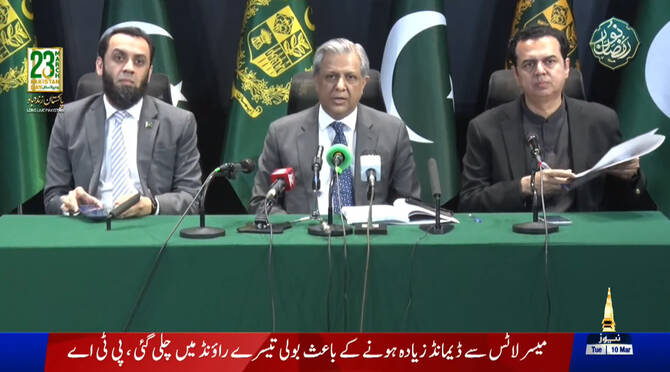
ISLAMABAD: Federal Minister for Law and Justice Azam Nazeer Tarar urged journalists on Tuesday to exercise caution when discussing the country’s foreign policy, saying constitutional limits must be respected as regional tensions rise following the escalating conflict in the Middle East.

Tarar said citizens have the right to receive accurate information and express their views, but warned that public debate on sensitive diplomatic matters could cross constitutional boundaries and trigger legal consequences.

His remarks come as tensions in the Gulf have intensified after coordinated strikes by the United States and Israel against Iran on Feb. 28, followed by retaliatory Iranian attacks targeting American bases and infrastructure in several Arab states.

The crisis has complicated diplomatic balancing for countries such as Pakistan that maintain ties across the region.

“Journalism is such a profession, and particularly given the way information flows today, it is the right of every person living in Pakistan that correct information should reach them, and every individual also has the right to express what is in their heart,” Tarar told the media.

“However, we cannot ignore constitutional limits and restrictions,” he said, adding that criticism often arises when authorities register criminal cases or initiate prosecution after those limits were crossed.

The minister said debate that frames Pakistan’s foreign policy choices in binary terms — such as whether the country stands with Iran or Gulf states — risks undermining delicate diplomatic relations.

He maintained even the Constitution of Pakistan does not permit people to casually comment on such issues, adding that the public should trust the state in managing these matters.

“Your constitution, which is the fundamental document and the social contract with the state, the agreement between the state and its citizens about how life is to be conducted here, also obliges you to exercise great caution in such discussions and commentary, as they do not fall within the bounds of freedom of expression,” he said.

The remarks come amid debate in the country about limits of online free speech, as authorities frequently invoked the Prevention of Electronic Crimes Act (PECA) to pursue cases related to digital content.

Critics say the law has been used to curb dissent and intimidate journalists and activists, while the government maintains it is necessary to combat misinformation, cybercrime and threats to national security.

Tarar said legal action should not automatically be viewed as excessive if authorities enforce constitutional limits.

“Every profession also has a basic responsibility to conduct itself within the limits of the law,” he added.