

Ukraine names new foreign minister, two deputy PMs in cabinet overhaul

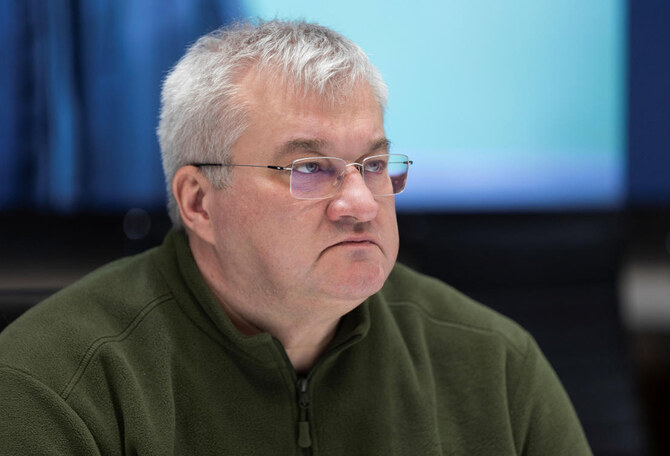
A first deputy Foreign Minister Andrii Sybiha is seen in Kyiv ON Feb. 4, 2023. Ukrainian parliament on Thursday appointed Sybiha as Ukraine’s new foreign minister. (Reuters)
Short Url
Updated 05 September 2024
Follow

Ukraine names new foreign minister, two deputy PMs in cabinet overhaul

  • Andrii Sybiha, 49, an experienced diplomat who does not have a prominent public profile, takes the reins of the foreign ministry, replacing Dmytro Kuleba
  • The new foreign ministry leadership is not expected to affect policy significantly

KYIV: Ukrainian lawmakers voted on Thursday to appoint a new foreign minister and two new deputy prime ministers, as President Volodymyr Zelensky carries out his biggest government shakeup since Russia’s Feb. 2022 invasion.
Andrii Sybiha, 49, an experienced diplomat who does not have a prominent public profile, takes the reins of the foreign ministry, replacing Dmytro Kuleba, who has been one of the best known public faces of Ukraine in the West in recent years.
The new foreign ministry leadership is not expected to affect policy significantly; Zelensky and his office have taken the leading role in foreign affairs during the war with Russia.
The Ukrainian leader, who travels to the United States this month and hopes to present a “victory plan” to President Joe Biden, has said that Ukraine needs “new energy” and that this autumn will be important for Ukraine in the war.
Dmytro Razumkov, an opposition lawmaker, predicted the new appointments would change little, saying most decisions were made in Zelensky’s office, which was conferred considerable new emergency powers under wartime martial law.
Parliament re-appointed 38-year-old Olha Stefanyshyna as deputy prime minister in charge of European integration, while also handing her a bigger portfolio that includes overseeing the justice ministry.
Stefanyshyna said in her speech to lawmakers ahead of her appointment that “hundreds and thousands” of legal changes were required as Ukraine seeks to become a member of the European Union.
Lawmakers also signed off on the appointment of Oleksiy Kuleba, a former deputy head of Zelensky’s office, as a deputy prime minister in charge of reconstruction, regions and infrastructure.
Parliament is expected to appoint other new ministers on Thursday as part of the government reset.

KYIV AIMS TO RECAPTURE WAR INITIATIVE
Russian forces are inching forward in the east and have stepped up their campaign of missile and drone attacks on Kyiv and other Ukrainian cities far from the frontline, hitting the power sector and other infrastructure in almost daily attacks.
Zelensky has said his team is preparing several important meetings with foreign partners in September to try to ensure Kyiv’s recaptures the initiative in the war.
In his latest evening address to the nation, he said the current priorities were securing supplies of air defenses from the West, improving the situation on the battlefield and getting foreign help to rebuild his country.
He is expected to take part on Friday in a meeting of the Ramstein group of nations which supplies arms to Ukraine, Germany’s Der Spiegel media outlet reported.
Zelensky has repeatedly called on allies to lift restrictions that ban Kyiv from using Western weapons for long-range strikes into Russia.


Guinea junta strongman headed for victory in presidential vote

Updated 6 sec ago
Follow

Guinea junta strongman headed for victory in presidential vote

CONAKRY: Guineans vote in a presidential election Sunday with victory all but assured for Mamady Doumbouya, a general who led the junta that seized power in the west African country four years ago.
By running, the strongman is reneging on a pledge not to stand for office and to hand the country back to civilian rule by the end of 2024.
Instead, he has sought to silence dissent. All the main opposition leaders have been barred from standing in the election.
UN human rights chief Volker Turk said Friday the campaign had been “marked by intimidation of opposition actors, apparently politically-motivated enforced disappearances, and constraints on media freedom.”
Guinea’s opposition has called for a boycott of the vote, in a country rich in minerals but where 52 percent of the population lives in poverty, according to World Bank figures.
While long blighted by coups, Guinea experienced a democratic transition with the November 2010 election of Alpha Conde, the country’s first freely elected president. Doumbouya overthrew him in September 2021.
Under Doumbouya, Guinea effectively “reverted to what it has essentially known since independence in 1958: authoritarian regimes, whether civilian or military,” Gilles Yabi, founder of the west African think tank Wathi, told AFP.
Some 6.8 million people are eligible to choose between the nine candidates, including 41-year-old Doumbouya, who is running as an independent. Polling closes at 1800 GMT.
With his remaining rivals relatively unknown, Doumbouya looks set to win in the first round of voting.
Provisional results could be announced within two days, according to Djenabou Toure, head of the General Directorate of Elections.
The vote, which falls on the same day as general elections in Central African Republic, caps a busy electoral year in Africa — marked by authoritarianism and oppression, as well as wins by several longstanding leaders, including in Cameroon and Ivory Coast where the main rivals were also barred.

- ‘Electoral charade’ -

With the main opposition absent, Guinea’s election “does not allow for a free choice among voters” and aims to consolidate Doumbouya’s power, Yabi said.
In September, Guinea approved a new constitution in a referendum, which the opposition called on voters to boycott.
The new document allowed junta members to stand for election, paving the way for Doumbouya’s candidacy.
It also lengthened presidential terms from five to seven years, renewable once.
Unlike its neighbors Mali, Burkina Faso and Niger, which are also under military rule, Guinea has maintained good relations with former colonial master France and other international partners.
Opposition leader and former Guinean prime minister Cellou Dalein Diallo has condemned the vote as “an electoral charade” aimed at giving legitimacy to “the planned confiscation of power.”
Diallo is one of three leading opposition figures barred from standing in the vote by the new constitution.
Diallo is excluded because he lives in exile and his primary residence is not in Guinea. Former president Conde and ex-prime minister Sidya Toure, who also live in exile, are not permitted to run because they are over the maximim age limit of 80.

- Economic record -

Without the opposition figures, the election’s key stakes will be participation and credibility, Kabinet Fofana, director of Conakry-based think tank Les Sondeurs, told AFP.
It is the first time since 2006 that the vote is being organized by a government ministry, whose head is appointed by Doumbouya, rather than an independent electoral body, Fofana said.
In a social media video, Doumbouya touted his infrastructure achievements, promised to fight corruption and expressed his ambition to “make Guinea an emerging country.”
He highlighted the recent start of operations at Simandou, one of the world’s biggest iron ore mines. Yabi said that while Guineans are enthusiastic about such projects, it is not clear what “economic governance will look like” after the election.