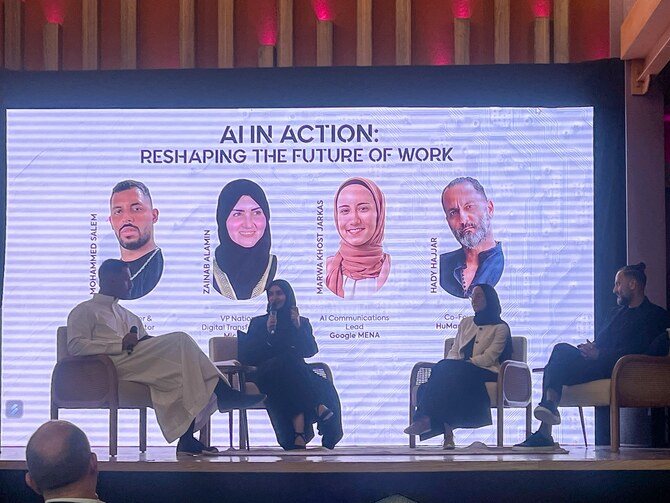

RIYADH: The American Embassy in Riyadh hosted the event “AI Summit for Content Creators” on Sept. 4 at Beast House, inviting social media influencers and YouTubers to engage with experts from Google and Microsoft with the aim of helping Saudi content creators understand artificial intelligence tools.
The event offered networking opportunities, followed by a discussion panel and training sessions led by Google and Microsoft, focusing on their AI programs such as Gemini and ChatGPT.
The discussion panel featured prominent speakers including Zainab Al Amin, vice president of national digital transformation at Microsoft; Marwa Khost Jarkas, AI communication lead at Google MENA; and Hady Hajjar, co-founder of HuManagment. The panel was moderated by YouTuber Mohammed Salem.
American Ambassador Michael Ratney opened the ceremony, sharing his experiences with social media and expressing his interest in AI’s role in content creation.
“It’s great to see everybody here. Thank you to Google and Microsoft for being our partners today. It’s truly wonderful to have you as part of this gathering of big, famous US companies. There are more out there eager to connect with Saudi Arabia as well,” he said.
He highlighted the numerous opportunities for US companies in Saudi Arabia, especially amid the burgeoning tech partnership between the two nations.
“Today, we’re discussing artificial intelligence, a force that’s becoming integral to our society and economy, especially in a dynamic place like Saudi Arabia. We thought it would be valuable to explore how AI impacts our lives, our work, and specifically, how it will influence your roles in social media and content creation,” Ratney added.
The discussion panel addressed AI’s presence in Saudi Arabia and the country’s initiatives to promote AI education among its citizens.

Al Amin said: “Saudi Arabia aims to become the leading hub for artificial intelligence in the region and globally. We are actively pursuing this goal by collaborating closely with the government sector. We have engaged with key organizations, including the Communications and Information Technology Commission, the Communications and Space Commission, the Ministry of Communications, and the Council of Chambers of Commerce, through an initiative called Advisory Groups.”
The groups consist of representatives from major companies and the government, focusing on identifying challenges related to modern technologies, including AI. “Our objective is to explore the barriers to AI adoption in the Kingdom and to develop initiatives that will enhance its integration and growth,” Al Amin said.
The panel also highlighted the importance of learning prompt engineering, noting that many free resources are available through Google, Microsoft, and LinkedIn.
Jarkas, of Google MENA, elaborated on the challenges of learning AI: “I view AI through three lenses — how to use it intelligently, safely, and responsibly. We often get emotionally drawn to new technologies and rush into using them, forgetting safety and responsibility. We must master prompt engineering and use requests thoughtfully, providing adequate detail.”
She advised caution, stating: “When interacting with AI, we should not disclose our entire identity. This is an essential part of using AI safely.”
HuManagement’s Hajjar discussed AI’s potential benefits for content creators, such as generating new video ideas. However, he cautioned: “We must adapt the content to align with our unique work; AI is merely a tool to assist us. Saudi Arabia is one of the highest consumers of content, making it crucial for creators to leverage AI tools to streamline their content creation process.”
He also noted the emergence of AI-generated social media influencers, presenting a challenge for human content creators and underscoring the importance of understanding AI in today’s landscape.