

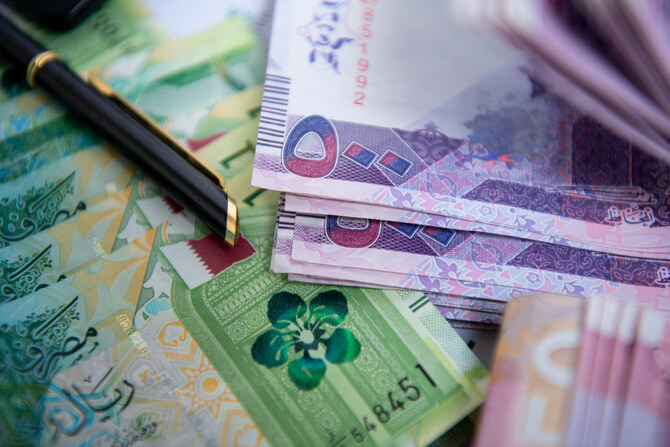
Qatar’s banking sector shows robust growth with assets hitting $550bn

The broad money supply also expanded by 6.4 percent, according to Qatar Central Bank. Shutterstock
Short Url
Updated 05 September 2024
Follow

Qatar’s banking sector shows robust growth with assets hitting $550bn

  • Key indicators showed a significant increase in domestic deposits, surging 11.4% year-on-year to 833.1 billion riyals
  • Total domestic credit climbed by 7.3%, reaching 1.3 trillion riyals

RIYADH: Qatar’s banking sector demonstrated a strong performance in July, with total assets of commercial banks rising by 6.4 percent year-on-year to reach 2 trillion Qatari riyals ($549.9 billion). 

The latest statistics were released in the central bank’s July Monthly Monetary Bulletin and shared through the institute’s official X account.

Key indicators showed a significant increase in domestic deposits, surging 11.4 percent year-on-year to 833.1 billion riyals. Similarly, total domestic credit climbed by 7.3 percent, reaching 1.3 trillion riyals during the same period.

The broad money supply also expanded by 6.4 percent, amounting to 727.4 billion riyals, further highlighting the sustained momentum in Qatar’s financial landscape.

This robust growth aligns with the goals outlined in Qatar’s Third National Development Strategy for 2024-2030. The approach emphasizes enhancing financial services to fuel national development and drive economic diversification, which are key priorities as the country seeks to strengthen its foundations.

Further supporting this transition, an analysis by Standard Chartered predicted that Qatar is on track to restore government revenues to pre-2014 oil price shock levels and double its economy by 2031. 

The report attributed this recovery to the Gulf country’s strategic positioning within the global energy market and its continuous efforts toward diversification.

The study underscored Qatar’s status as the world’s sixth-largest gas producer and holder of the third-greatest natural fuel reserves, which allows the country to benefit from rising hydrocarbon prices. 

In addition, Standard Chartered noted the steady growth of the country’s non-oil economy, which now contributes two-thirds of the nation’s gross domestic product.

Qatar’s international economic profile has been further elevated since hosting the FIFA World Cup in 2022.

According to the International Monetary Fund, the event boosted the country’s global presence, while the World Bank projects Qatar’s economy to grow by 2.1 percent in 2024, accelerating to 3.2 percent by 2025. 

Standard Chartered also anticipated continued growth in the liquefied natural gas sector, which will further bolster the country’s economic expansion in the years ahead.

Beyond its energy and banking sectors, Qatar is also making strides in the sukuk market. 

In August, Estithmar Holding, a Qatar-based company, issued a 500 million riyal sukuk, marking the first corporate issuance denominated in local currency under its 3.4 billion riyal program.

The firm’s group CEO Mohamad bin Badr Al-Sadah said: “The issuance of the first corporate Qatari-riyal-denominated sukuk is a historic milestone for Estithmar Holding.” 

On being listed on the London Stock Exchange’s International Securities Market, he said this issuance has garnered significant interest from diverse investors.


RLC Global Forum highlights role of Saudi youth in retail digital shift 

Updated 04 February 2026
Follow

RLC Global Forum highlights role of Saudi youth in retail digital shift 

RIYADH: Saudi Arabia’s young and highly digital population is reshaping how the Kingdom’s retail sector adopts new technologies and artificial intelligence, advancing faster than many global competitors, industry leaders told Arab News. 

Speaking on the sidelines of the RLC Global Forum in Riyadh, executives told Arab News that the intersection of a youthful population and strong investment in AI is driving a shift in the industry’s priorities. 

From understanding consumer behavior to leveraging the Kingdom’s growing status as a global AI leader, Saudi Arabia is becoming as a unique destination for the retail sector to thrive, learn, and evolve in the digital sphere. 

Abdullah Al-Tamimi, CEO of commercial real estate company Hamat Holding, told Arab News that the firm is keen to analyze and understand consumer behavior, with a particular focus on the younger generation as a key part of that insight. 

“Actually, it’s a big part of our day-to-day operation,” he said, adding that the company invests heavily in understanding customer needs and behavior and works to correct any missteps. 

Al-Tamimi emphasized paying close attention to small details, noting that younger consumers are especially sensitive to the overall experience and “deserve that we work around the clock in order to improve it.” 

He added that this focus “can be a competitive advantage for Saudi Arabia as well.” 

Al-Tamimi said that as the younger generation grows accustomed to new technology shaping retail customer experiences, Hamat Holding is leveraging AI to enhance them further. 

“We started a couple of initiatives improving digitalization,” he said, adding that the company sees digital tools as a way to enhance its work by automating day-to-day operations and allowing teams to focus on bigger-picture and more complex tasks. 

While the firm has expanded its use of technology, he stressed it has not replaced human workers, emphasizing the continued importance of human capital for creativity and interaction. “AI is a big part of our strategy,” Al-Tamimi added. 

Amit Keswani Manghnani, chief omnichannel and AI officer at luxury goods retailer and distributor Chalhoub Group, told Arab News that bridging a younger customer base with continuous digital development is key to advancing the Kingdom’s retail strategies. 

On Saudi Arabia’s demographics, he said: “We look at 2030 as really building products which serve especially the younger population, which is growing and very digitally savvy.” 

Manghnani underscored the unique characteristics of the Kingdom’s retail market as a tool for developing effective products and customer experiences. 

“So it’s very digitally savvy, much more than in other markets,” he said, noting that e-commerce penetration is rising not only through online purchases but also via digital catalogs that drive in-store visits. 

Manghnani said investment is focused on making products more digitally accessible and easier to use, while strengthening customer service to meet the expectations of what he described as a demanding but welcome consumer base. “Service excellence, digital — all these things together are how we are tapping into the younger population, which again is extremely savvy.” 

Manghnani reinforced Al-Tamimi’s point that the Kingdom holds a competitive advantage, citing the speed at which its retail and technology industries are aligning. 

“As a market, we’re tending to see the adoption of digital,” he said, referring to AI, data and other forms of digital interaction, adding that these tools are increasingly being combined. 

He noted that this market is moving “much quicker than the other markets.” 

The two-day RLC Global Forum brought together more than 2,000 global leaders, policymakers, and innovators from over 40 countries over the two-day event to define the next chapter of growth across retail, consumer, and lifestyle industries.