

UK government moves to oust hereditary peers from House of Lords

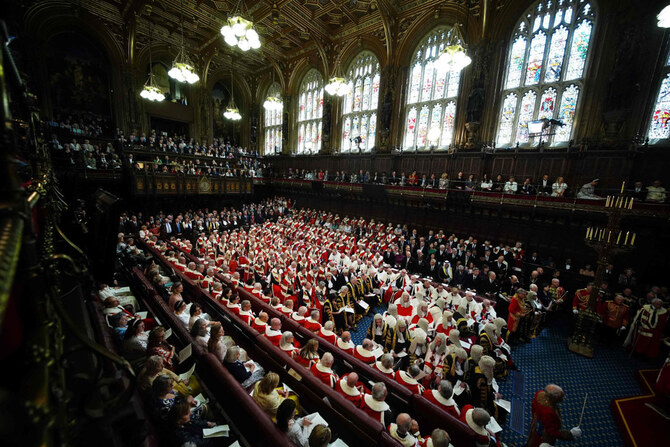
Members of Britain's so-called House of Lords and guests sit in the Lords Chamber, ahead of the State Opening of Parliament in London on July 17, 2024. (POOL/AFP)
Short Url
Updated 05 September 2024
Follow

UK government moves to oust hereditary peers from House of Lords

  • To be removed are 92 seats reserved for peers who inherited their position as a member of an aristocratic family
  • Britain is an anomaly among western governments in having such lawmakers, who hold titles such as duke, earl, viscount and baron

LONDON: The UK government will introduce legislation on Thursday to remove seats in the House of Lords retained for hereditary lawmakers as it moves to reform parliament's unelected upper chamber.
The bill will remove the 92 seats reserved for peers who inherited their position as a member of an aristocratic family.
They hold titles such as duke, earl, viscount and baron. Britain is an anomaly among western governments in having such lawmakers.
The move was a manifesto commitment of Prime Minister Keir Starmer's Labour party ahead of its landslide general election win in July, which returned it to power for the first time in 14 years.
It resurrects reform of the Lords that started under Tony Blair's Labour government in the late 1990s.
"This is a landmark reform to our constitution," constitution minister Nick Thomas-Symonds said in a statement.
"The hereditary principle in law-making has lasted for too long and is out of step with modern Britain.
"The second chamber plays a vital role in our constitution and people should not be voting on our laws in parliament by an accident of birth," he added.


Wikimedia Commons Infographic

The legislation will easily pass the House of Commons lower chamber due to Labour's massive majority before it will have to be approved by the Lords.
It is not clear when exactly it will become law.
Lesotho in southern Africa is the only other country in the world with a hereditary element in its legislature, according to UK officials.
The scrapping of the hereditary peers has been described by Labour as a "first step in wider reform".
The government says it wants to ultimately replace the Lords with an alternative second chamber that is more representative of the UK.
The Lords comprises around 800 members, most of whom are appointed for life.
They include former MPs, typically appointed by departing prime ministers, along with people nominated after serving in prominent public- or private-sector roles, and senior Church of England clerics, including the Archbishop of Canterbury.
The primary role of the centuries-old chamber is to scrutinise the government.
It cannot override legislation sent from the popularly elected House of Commons, but it can amend and delay bills and initiate new draft laws.
Blair's government had intended to abolish all the seats held by hundreds of hereditary members who sat in the chamber at that time.
But it ended up retaining 92 in what was supposed to be a temporary compromise.
Lords reform has proved a thorny issue for successive administrations, in part because officials have struggled to propose better alternatives.


Poland slow to counter Russia’s ‘existential threat’: general

Updated 4 sec ago
Follow

Poland slow to counter Russia’s ‘existential threat’: general

  • The general highlighted a low “pace of technical modernization,” compared to increases in the army’s size
  • Kukula said the Polish army should reach 500,000 soldiers by 2039

WARSAW: Russia poses an “existential threat” to Poland and its military is lagging, the country’s armed forces chief warned senior officials on Wednesday.
Poland, the largest country on NATO’s eastern flank and a neighbor of Russia, Belarus, and Ukraine, is the western alliance’s largest spender in relative terms.
This year, the country is allocating 4.8 percent of its GDP to defense, just shy of the alliance’s five percent target to be met by 2035.
However, that record defense spending was not enough to “make up for nearly three decades of chronic underfunding of the armed forces,” General Wieslaw Kukula, chief of the general staff, argued at the meeting, which included top officers, the defense minister and Poland’s president.
The general highlighted a low “pace of technical modernization,” compared to increases in the army’s size.
Kukula said the Polish army should reach 500,000 soldiers by 2039, compared with around 210,000 at present.
As a result of a lack of updates, some new Polish units “are not achieving combat readiness,” due to insufficient equipment, rather than a personnel shortage, the general argued.
Meanwhile, he added, “the Russian Federation remains an existential threat to Poland.”
Russia “is constantly reorganizing its forces, drawing on the lessons from its aggression in Ukraine, and building up the capacity for a conventional conflict with NATO countries,” he stressed.
Poland is to receive 43.7 billion euros ($51,5 billion) in loans under the European Union’s Security Action For Europe (SAFE) scheme, designed to strengthen Europe’s defensive capabilities.
Warsaw plans to use these funds to boost domestic arms production.
The Polish government claims that Poland will be able to access SAFE finance even if President Karol Nawrocki — backed by Poland’s conservative-nationalist opposition — vetos a law setting out domestic arrangements for its implementation.
Law and Justice (PiS) — the main opposition party — argues that SAFE could become a new tool for Brussels to place undue pressure on Poland, thanks to a planned mechanism for monitoring the funds, which they claim risks undermining Polish sovereignty.