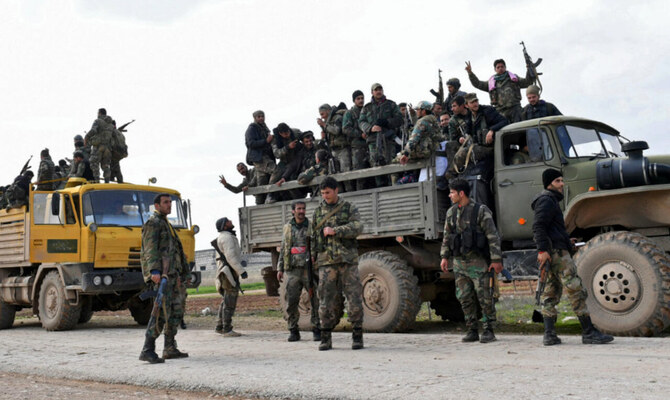
BEIRUT, Lebanon: Twelve Syrian soldiers were killed on Wednesday by an Al-Qaeda linked group in northwest Syria, according to a war monitoring organization, the highest such death toll in the region this year.
The Britain-based Syrian Observatory for Human Rights said “12 members of the regime forces, including an officer, were killed following suicide attacks carried out by special forces from the Hayat Tahrir Al-Sham group (HTS), targeting regime forces positions in the north of Latakia province” adjacent to Idlib, the last major rebel stronghold in the northwest.
The death toll is the “highest among the regime forces in the region since last September,” according to the observatory.
Rami Abdel Rahman, head of the Observatory, told AFP that the attack was part of “an escalation by HTS since Monday, which included attacks on regime forces on several fronts.”
The Idlib region is subject to a ceasefire brokered by Russia and Turkiye after a regime offensive in March 2020. Despite being repeatedly violated, the ceasefire is still largely holding.
HTS controls swathes of Idlib province and parts of neighboring Aleppo, Hama and Latakia.
More than five million people, most of them displaced, live in areas outside government control in the Idlib region.
HTS, considered a terrorist organization by Damascus, the United States and the European Union, regularly clashes with Syrian and allied Russian forces.
It is the main rebel organization active in northwest Syria, but there are other groups, some backed by Turkiye.
Syria’s war broke out after President Bashar Assad repressed anti-government protests in 2011, and has killed more than 500,000 people, displaced millions and battered the country’s infrastructure and industry.

12 Syrian soldiers killed in suicide attacks: war monitor
Short Url
https://arab.news/cv8en
12 Syrian soldiers killed in suicide attacks: war monitor
- The death toll is the “highest among the regime forces in the region since last September,” according to the observatory
Turkiye’s foreign minister says the US and Iran showing flexibility on nuclear deal, FT reports
- Hakan Fidan: “It is positive that the Americans appear willing to tolerate Iranian enrichment within clearly set boundaries”
- Washington has until now demanded Iran relinquish its stockpile of uranium enriched to up to 60 percent fissile purity
The United States and Iran are showing flexibility on a nuclear deal, with Washington appearing “willing” to tolerate some nuclear enrichment, Turkish Foreign Minister Hakan Fidan told the Financial Times in an interview published Thursday.
“It is positive that the Americans appear willing to tolerate Iranian enrichment within clearly set boundaries,” Fidan, who has been involved in talks with both Washington and Tehran, told the FT.
“The Iranians now recognize that they need to reach a deal with the Americans, and the Americans understand that the Iranians have certain limits. It’s pointless to try to force them.”
Washington has until now demanded Iran relinquish its stockpile of uranium enriched to up to 60 percent fissile purity, a small step away from the 90 percent that is considered weapons grade.
Iranian President Masoud Pezeshkian has said Iran would continue to demand the lifting of financial sanctions and insist on its nuclear rights including enrichment.
Fidan told the FT he believed Tehran “genuinely wants to reach a real agreement” and would accept restrictions on enrichment levels and a strict inspection regime, as it did in the 2015 agreement with the US and others. US and Iranian diplomats held talks through Omani mediators in Oman last week in an effort to revive diplomacy, after President Donald Trump positioned a naval flotilla in the region, raising fears of new military action. Trump on Tuesday said he was considering sending a second aircraft carrier to the Middle East, even as Washington and Tehran prepared to resume negotiations.
The Turkish foreign minister, however, cautioned that broadening the Iran-US talks to ballistic missiles would bring “nothing but another war.”
The US State Department and the White House did not respond to a request for comment outside regular business hours.
“It is positive that the Americans appear willing to tolerate Iranian enrichment within clearly set boundaries,” Fidan, who has been involved in talks with both Washington and Tehran, told the FT.
“The Iranians now recognize that they need to reach a deal with the Americans, and the Americans understand that the Iranians have certain limits. It’s pointless to try to force them.”
Washington has until now demanded Iran relinquish its stockpile of uranium enriched to up to 60 percent fissile purity, a small step away from the 90 percent that is considered weapons grade.
Iranian President Masoud Pezeshkian has said Iran would continue to demand the lifting of financial sanctions and insist on its nuclear rights including enrichment.
Fidan told the FT he believed Tehran “genuinely wants to reach a real agreement” and would accept restrictions on enrichment levels and a strict inspection regime, as it did in the 2015 agreement with the US and others. US and Iranian diplomats held talks through Omani mediators in Oman last week in an effort to revive diplomacy, after President Donald Trump positioned a naval flotilla in the region, raising fears of new military action. Trump on Tuesday said he was considering sending a second aircraft carrier to the Middle East, even as Washington and Tehran prepared to resume negotiations.
The Turkish foreign minister, however, cautioned that broadening the Iran-US talks to ballistic missiles would bring “nothing but another war.”
The US State Department and the White House did not respond to a request for comment outside regular business hours.
© 2026 SAUDI RESEARCH & PUBLISHING COMPANY, All Rights Reserved And subject to Terms of Use Agreement.


