Sabalenka demolishes Zheng to reach fourth US Open semifinal

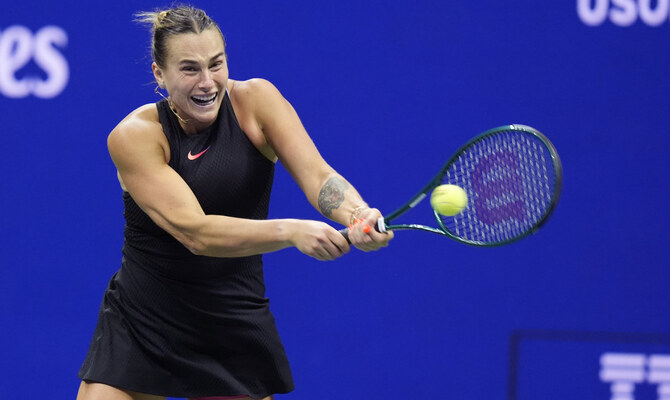
Aryna Sabalenka, of Belarus, returns to Zheng Qinwen, of China, during the quarterfinals of the U.S. Open tennis championships, Tuesday, Sept. 3, 2024, in New York. (AP)
Short Url
Updated 04 September 2024
Follow

Sabalenka demolishes Zheng to reach fourth US Open semifinal

  • It will be a ninth career semifinal at the Slams for the 26-year-old from Belarus

NEW YORK: World number two Aryna Sabalenka demolished Olympic gold medallist Zheng Qinwen to reach a fourth successive US Open semifinal on Tuesday.
Australian Open champion Sabalenka, runner-up to Coco Gauff in New York last year, triumphed 6-1, 6-2 and will take on Emma Navarro of the United States for a place in the final.
It will be a ninth career semifinal at the Slams for the 26-year-old from Belarus.
She also defeated the Chinese star at the same stage of the US Open in 2023 before going on to beat the 21-year-old again in the Australian Open final in January.
“It was important that I got the early break, that was an advantage because it’s tough to face her,” said Sabalenka after her 73-minute win which saw Zheng hit just nine winners.
The 13th-seeded Navarro reached her maiden Slam semifinal earlier Tuesday with a straight-sets victory over Paula Badosa of Spain.
Sabalenka and Navarro are 1-1 in their head-to-head meetings with both clashes coming this season.
The American won at Indian Wells before Sabalenka came out on top at the French Open.
“The drinks are on me if you cheer for me,” Sabalenka told the Arthur Ashe Stadium crowd in an effort to drum up backing for the semifinal against the New York-born Navarro.
“She’s a really good player. We had two battles, they were really close.”


A journey to Cambridge reveals surprise cricket heritage

Updated 43 min 36 sec ago
Follow

A journey to Cambridge reveals surprise cricket heritage

  • Fenner’s, a pitch famed for generating high-aggregate first-class match scores, has been left behind by shifts in the game’s geography, structure and power base

After attending eight T20 World Cup matches in Sri Lanka, I traveled to the UK to join a conference on cricket organized by the Cricket Research Network, or CRN.

It was held on Feb. 25 at one of the University of Cambridge colleges, Hughes Hall, sited next to Fenners, historically the university’s cricket ground. In 1846, Francis Fenner leased land from Gonville and Caius College. Two years later, he sub-let the newly constructed ground to the University Cricket Club, which, together with the Athletics Club, bought the freehold in 1894.

One of the conference presentations was on the topic of “town versus gown,” covering the history of cricket in Cambridge at both university and club level. I was aware that Fenners once had a reputation as a pitch that favored batting. When I mentioned this to the presenter, he asked if I knew that the highest aggregate number of runs scored in a first-class match, in which both sides only batted once, had occurred there. My interest was piqued. A quick search revealed that 1,324 runs were scored in a three-day match between May 17 and May 19, 1950, when the University of Cambridge hosted the West Indian touring team.

On winning the toss, the university chose to bat first, amassing 507 for the loss of only three wickets on the first day, declaring on the second day, having reached 594 for the loss of four wickets. By the end of day two, the West Indies had responded with 379 for two. They continued to bat throughout the third day, ending with 730 for three wickets, Frank Worrell scoring 160 and Everton Weekes, an unbeaten 304, at an average of four runs per over.

In today’s world of instant T20 cricket, in which the average number of runs scored per over is typically eight or more, the scoring frequency at Fenners would be regarded as pedestrian. However, in the context of the times, four runs per over was almost double that which was achieved in the four Test matches between England and the West Indies in 1950. The University of Cambridge team contained five players who would go on to represent England. One of them, Peter May, captained England on 41 occasions. Neither Weekes nor Worrell were impressed by the match, calling it “a farce of a game, just a bore, a little match practice,” adding that “unless you have to work for your runs, there is no fun making them.” 

Away from the local Cambridge topic, the other themes at the conference were wide-ranging. The CRN is a group of researchers and writers working on cricket-related matters, having an aim to inform change in the game with critical and empirical research.

Five main themes were covered. The first was gender, the second was history, both weighted toward the women’s game, while the third looked forward to the 2026 Women’s T20 World Cup, which is to be held in England and Wales in June. Inclusion was the fourth theme, which included fandom and using AI to identify talent. This was followed by representations of cricket, including its defining stories. The final session dealt with governance and sustainability, covering illegal betting, climate justice and cricket in the public interest.

As regular readers will know, the last subject area has been addressed a number of times in this column, usually with a level of despair about the unsatisfactory standards and practices displayed by those who are vested with the responsibility for cricket’s governance. These have been in evidence before and during the current T20 World Cup, centring on Pakistan, India and Bangladesh. The day after my visit to Cambridge, Pakistan failed to qualify for the semifinals and rumors circulated that the Pakistan Cricket Board, or PCB, was proposing to fine all members of the squad the equivalent of $18,000. If true, this would be an egregious example of misguided management, effectively fining players for losing matches.

Allegedly, the fines were imposed after Pakistan’s defeat by India in a group-stage match, with a rider that the fines might be waived if semifinal qualification was achieved. Although the PCB’s action is unusual in professional cricket, it is not the first time that the PCB has imposed punitive measures. After a narrow defeat by India in the Asia Cup Final on Sept. 28, 2025, the board briefly blocked its players from playing in T20 franchise leagues. There have been past fines for indiscipline and insurrection. This latest action runs the risk of alienating players and further impacting their desire to perform well. How the players who performed well are going to respond is unknown. Remarkably, there have been later rumors that not all players will be fined or that different levels will apply.   

It would seem grossly unfair to fine Sahibzada Farhan, who broke the record for the most runs scored at a T20 World Cup, as well as becoming the only player to score two hundreds in the same tournament. Farhan and Fakhar Zaman, who played in only two games, constructed the highest opening partnership in men’s T20 World Cup history. Two players were not selected at all. What have they done to deserve being fined? Media and social media reactions have focussed on the board, administrators, selectors, coaches, advisers, domestic structures and inadequate development pathways. There has been churn in all of these areas for years. The outcome is a failure to reach the semifinals in four successive ICC tournaments and a loss of patience among the country’s hierarchy. 

There is a world of difference between the high pressure, politically charged international game of today and the metronomically compiled 1,324 runs on a placid Fenners pitch in Cambridge, 76 years ago. Yet cricket’s social tensions are a common theme throughout these years, albeit with variations. The West Indian team of 1950 was led by a white Barbadian, John Goddard, born into a family that controlled a leading trading company on the island. His leadership abilities were praised as the West Indies won its first Test match and series in England, but his star fell in the following series in Australia. Throughout the 1950s, white men continued to be chosen as captains. It was not until 1960 that a black man, Frank Worrell, was appointed to lead a series. This heralded an era in which the West Indies came to dominate international cricket for three decades, at times relishing their defeats of England.

One of the presentations at the CRN conference revealed the struggle and obstacles that women’s cricket faced in trying to establish itself in the West Indies. This was also a feature in other countries during the past 76 years, certainly as far as equality of opportunity and treatment was concerned. Research undertaken by members of the CRN has explored this, and the conference panel discussions at Cambridge focussed on the progress that has been made leading into the 2026 Women’s World Cup.

Inevitably, change is accompanied by casualties. One of these appears to be Fenners. In July 2024, Hughes Hall acquired two pieces of land at the edge of Fenner’s, leading to concerns about access to facilities. The number of matches being played there has fallen, along with the quality of pitches, now maintained on a shoestring budget. It is a sign of changing times in cricket that a ground and a pitch famed for generating high-aggregate first-class match scores has been left behind by shifts in the game’s geography, structure and power base.