

Norway wealth fund may divest companies that aid Israel in Gaza war, occupied territories

1 / 4
A Palestinian man lifts a national flag and flashes the victory sign as Israeli armoured vehicles including a bulldozer drive on a street during a raid in Tulkarem on September 3, 2024, amid a large-scale military offensive launched a week earlier in the occupied West Bank. (AFP)
2 / 4
An Israeli soldier takes position next to an army vehicle on a street damaged by bulldozers during a raid in the centre of Jenin in the occupied West Bank on September 3, 2024. (AFP)
3 / 4
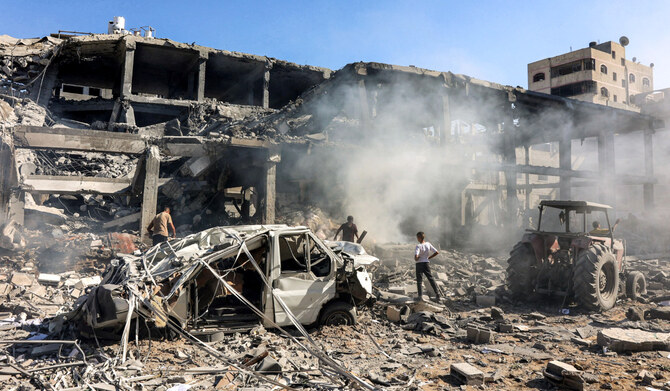
Men walk through debris in a building that was hit by Israeli bombardment in the Sheikh Radwan neighbourhood in the north of Gaza City on September 3, 2024 amid the ongoing war in the Palestinian territory between Israel and Hamas. (AFP)
4 / 4
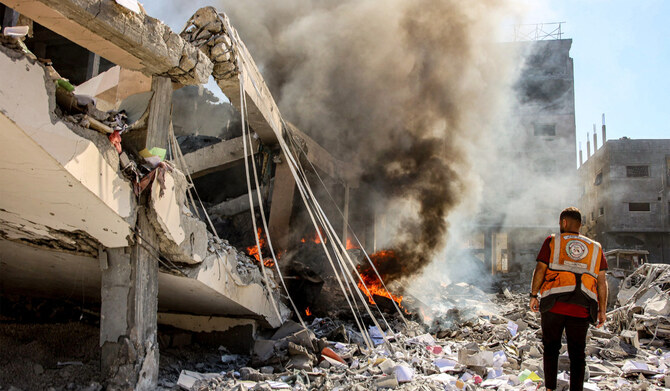
A Palestinian civil defence member stands near a building on fire that was hit by Israeli bombardment in the Sheikh Radwan neighbourhood in the north of Gaza City on September 3, 2024 amid the ongoing war in the Palestinian territory between Israel and Hamas. (AFP)
Short Url
Updated 04 September 2024
Follow

Norway wealth fund may divest companies that aid Israel in Gaza war, occupied territories

  • According to nongovernmental organizations, they make weapons used by Israel in Gaza, where its military offensive has killed nearly 41,000 Palestinians
  • The new definition of ethical breaches is based on the ICJ finding that “the occupation itself, Israel’s settlement policy and the way Israel uses the natural resources in the areas are in conflict with international law,” the letter said

OSLO: Norway’s $1.7 trillion wealth fund may have to divest shares of companies that violate the fund watchdog’s new, tougher interpretation of ethics standards for businesses that aid Israel’s operations in the occupied Palestinian territories.
The Council on Ethics for the world’s largest sovereign wealth fund sent an Aug. 30 letter to the finance ministry, seen by Reuters, that summarises the recently expanded definition of unethical corporate behavior. The change has not previously been reported.
The letter did not specify how many nor name companies whose stocks might be sold but suggested it would be a small number, should the board of the central bank, which has the final say, follow recommendations that the council makes.

HIGHLIGHTS

• Norway fund is world's largest sovereign wealth fund

• Companies active in occupied West Bank under review

• US arms producers being probed over Gaza war

• Watchdog expects to recommend "a few" companies for divestment

One company has already been identified for disinvestment under the new definition, it said. “The Council on Ethics believes the ethical guidelines provide a basis for excluding a few more companies from the Government Pension Fund Global in addition to those already excluded,” the watchdog wrote, giving the formal name for Norway’s sovereign wealth fund.
The fund has been an international leader in the environmental, social and governance (ESG) investment field. It owns 1.5 percent of the world’s listed shares across 8,800 companies, and its size carries influence.
Since the start of the war in Gaza in October, the fund’s ethics watchdog has been investigating whether more companies fall outside its permitted investment guidelines. The letter said that the scope of exclusions was “expected to increase somewhat” under the new policy.
Among the companies that the watchdog could be looking at are RTX Corp, General Electric and General Dynamics. According to nongovernmental organizations, they make weapons used by Israel in Gaza, where its military offensive has killed nearly 41,000 Palestinians. The companies did not immediately reply to requests for comment.
The fund held investments worth 16 billion crowns ($1.41 billion) in Israel as of June 30, across 77 companies, according to fund data, including companies involved in real estate, banks, energy and telecommunications. They represented 0.1 percent of the fund’s overall investments.

NEW LEGAL OPINION
On Gaza, the council is focusing on weapon producers in countries not participating in the Arms Trade Treaty, a 2014 agreement on conventional weapons trade. “This mainly concerns American companies,” the letter said, without naming any.
It added, “There are very few relevant companies remaining in the fund” partly because many US defense manufacturers were already barred for producing nuclear weapons or cluster munitions.
The fund’s ethical rules are set by Norway’s parliament. The updated ethics definition by the watchdog results partly from a July opinion by the International Court of Justice regarding Israel’s occupation of Palestinian territories.
The court took positions on “several new facts and legal issues” that could make “companies with a less direct connection to violations of norms” in breach of the ethics rules, the letter said without providing examples.
The new definition of ethical breaches is based on the ICJ finding that “the occupation itself, Israel’s settlement policy and the way Israel uses the natural resources in the areas are in conflict with international law,” the letter said.
The fund previously divested from nine companies operating in the occupied West Bank under its prior policy. Their operations include building roads and homes in Israeli settlements in East Jerusalem and the West Bank and providing surveillance systems for an Israeli wall around the West Bank.
The Council on Ethics makes recommendations to the board of the central bank, which operates the fund. The bank often follows the watchdog’s advice to exclude firms, but not always.
The bank can also put a company on notice to change its behavior or ask the fund’s management to engage with it directly. Companies designated for disinvestment are not named until the fund has sold the shares.



Trump administration labels 3 Muslim Brotherhood branches as terrorist organizations

Updated 5 sec ago
Follow

Trump administration labels 3 Muslim Brotherhood branches as terrorist organizations

  • The State Department designated the Lebanese branch a foreign terrorist organization
  • “These designations reflect the opening actions of an ongoing, sustained effort to thwart Muslim Brotherhood chapters’ violence,” Rubio said

WASHINGTON: President Donald Trump’s administration has made good on its pledge to label three Middle Eastern branches of the Muslim Brotherhood as terrorist organizations, imposing sanctions on them and their members in a decision that could have implications for US relationships with allies Qatar and Turkiye.
The Treasury and State departments announced the actions Tuesday against the Lebanese, Jordanian and Egyptian chapters of the Muslim Brotherhood, which they said pose a risk to the United States and American interests.
The State Department designated the Lebanese branch a foreign terrorist organization, the most severe of the labels, which makes it a criminal offense to provide material support to the group. The Jordanian and Egyptian branches were listed by Treasury as specially designated global terrorists for providing support to Hamas.
“These designations reflect the opening actions of an ongoing, sustained effort to thwart Muslim Brotherhood chapters’ violence and destabilization wherever it occurs,” Secretary of State Marco Rubio said in a statement. “The United States will use all available tools to deprive these Muslim Brotherhood chapters of the resources to engage in or support terrorism.”
Rubio and Treasury Secretary Scott Bessent were mandated last year under an executive order signed by Trump to determine the most appropriate way to impose sanctions on the groups, which US officials say engage in or support violence and destabilization campaigns that harm the United States and other regions.
Muslim Brotherhood leaders have said they renounce violence.
Trump’s executive order had singled out the chapters in Lebanon, Jordan and Egypt, noting that a wing of the Lebanese chapter had launched rockets on Israel after Hamas’ Oct. 7, 2023, attack in Israel that set off the war in Gaza. Leaders of the group in Jordan have provided support to Hamas, the order said.
The Muslim Brotherhood was founded in Egypt in 1928 but was banned in that country in 2013. Jordan announced a sweeping ban on the Muslim Brotherhood in April.
Nathan Brown, a professor of political science and international affairs at George Washington University, said some allies of the US, including the United Arab Emirates and Egypt, would likely be pleased with the designation.
“For other governments where the brotherhood is tolerated, it would be a thorn in bilateral relations,” including in Qatar and Turkiye, he said.
Brown also said a designation on the chapters may have effects on visa and asylum claims for people entering not just the US but also Western European countries and Canada.
“I think this would give immigration officials a stronger basis for suspicion, and it might make courts less likely to question any kind of official action against Brotherhood members who are seeking to stay in this country, seeking political asylum,” he said.
Trump, a Republican, weighed whether to designate the Muslim Brotherhood a terrorist organization in 2019 during his first term in office. Some prominent Trump supporters, including right-wing influencer Laura Loomer, have pushed his administration to take aggressive action against the group.
Two Republican-led state governments — Florida and Texas — designated the group as a terrorist organization this year.