

Saudis take steps to prevent public-sector contracts crimes, says anti-corruption chief

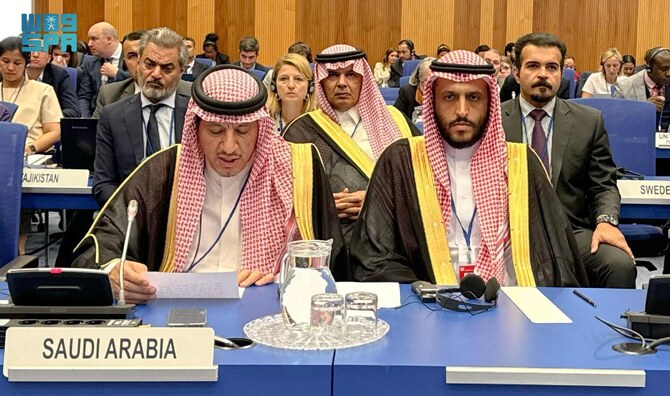
The President of the Oversight and Anti-Corruption Authority Mazin Al-Kahmous speaks at the UN in Vienna on Tuesday. (SPA)
Short Url
Updated 03 September 2024
Follow

Saudis take steps to prevent public-sector contracts crimes, says anti-corruption chief

  • UN meeting hears Kingdom developed electronic portal for government procurement to increase transparency and ensure more efficient public spending

RIYADH: Saudi authorities are working on several initiatives to prevent illegal activity in government procurement, the president of the Oversight and Anti-Corruption Authority, also known as Nazaha, said on Tuesday.

Speaking at the UN in Vienna during an international meeting of government officials to discuss prevention of corruption, Mazin Al-Kahmous said the Kingdom has established a unified electronic portal for government procurement, called Etimad, with the aim of increasing transparency in government procurement activities, improving the efficiency of public spending, and reducing opportunities for corruption at all stages of public tenders.

He highlighted what he described as ongoing and fruitful cooperation between Nazaha and the Ministry of Finance to apply safeguards within Etimad for activities that carry a high risk of corruption, to help reduce the risk of collusion or fraud among businesses applying for government tenders.

Al-Kahmous also welcomed the support of authorities in the Kingdom for a collaboration between Nazaha and the UN Development Program on the launch of a global initiative to measure corruption and promote integrity in public procurement.


Riyadh to host final of Global Minerals Innovation Competition

Updated 23 sec ago
Follow

Riyadh to host final of Global Minerals Innovation Competition

  • 350 people in 70 teams to attend ‘boot camp’ next month
  • Competition attracted more than 1,800 people from 57 countries

JEDDAH: More than 350 people will take part in the final stage of the inaugural Global Minerals Innovation Competition, to be held next month in Riyadh.

The closing event, titled Future Minerals Pioneers, marks the end of a nationwide tour that began in October to find the best talent in the industry, the Saudi Press Agency reported.

The tour was sponsored by Saudi Mining Services Co. and attracted more than 1,800 people from 57 countries. Just over two-thirds of the members of the 70 teams that made it through to the final stage are from Saudi Arabia.

The so-called final boot camp will take place from Jan. 8-10, with the winners announced during the fifth edition of the Future Minerals Forum on Jan. 14.

The camp will comprise workshops and mentoring sessions, after which the teams will make their final presentations to the judges.

Held under the patronage of Minister of Industry and Mineral Resources Bandar Alkhorayef and led by Vice Minister for Mining Affairs Khalid bin Saleh Al-Mudaifer, the contest was organized by the National Industrial Development and Logistics Program in partnership with the Ministry of Industry and Mineral Resources and Saudi Arabian Mining Co.

It features three main tracks: smart technologies, security and safety, and resource sustainability, with the focus on creating practical solutions to challenges across the mining value chain and fostering an integrated innovation ecosystem, the report said.

According to a report by the Canada-based Fraser Institute, the Kingdom rose to 23rd place on the Mining Investment Attractiveness Index in 2024, up from 104th a year earlier. It also rose to 20th (from 82nd) on the Policy Perceptions Index and to 24th (from 58th) on the Geological Potential Index, indicating growing global confidence in the sector.

The indicators also align with national efforts to unlock the country’s vast mineral wealth, estimated at SR9.4 trillion ($2.5 trillion).

That work is being driven by the General Program for Geological Surveying, which aims to stimulate investment and enhance competitiveness through the creation of a national geological database. About two-thirds of the first phase of the program, covering 630,000 sq. km. of the Arabian Shield, has been completed.