

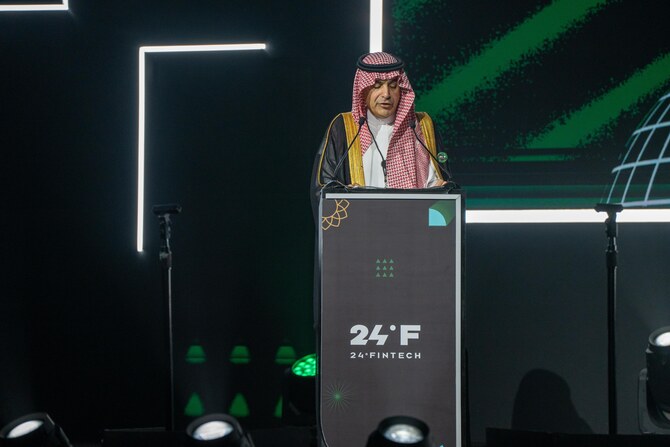

RIYADH: The 24 Fintech Conference commenced today in Riyadh, marking a pivotal moment for Saudi Arabia’s burgeoning financial technology sector.
The landmark event has drawn global leaders, industry experts, and policymakers to explore the Kingdom’s transformative journey and prospects in the financial technology landscape.
The Saudi fintech sector has witnessed a remarkable trajectory since 2018, attracting $1.84 billion in venture capital investments, according to the General Authority for Small and Medium Enterprises, or Monsha’at. Over this period, 216 Saudi-based startups have received funding, directly employing more than 6,500 people.
Saudi Central Bank Gov. Ayman Al-Sayari opened the conference with a keynote address highlighting the profound changes in the Kingdom’s financial system.
Al-Sayari said that the emergence of a thriving fintech sector has been driven by technological innovation and national initiatives through Vision 2030. The sector’s growth has led to notable benefits, including expanded access to the financial system, improved transaction speed, and cost efficiency.
He added that the central bank focuses on stabilizing growth while fostering an environment conducive to innovation through its risk-based supervision framework.
Al-Sayari elaborated on the evolution of the financial system in Saudi Arabia, saying: “Over the past few decades, the financial system has evolved significantly from its early days characterized by the concentration of traditional banks.”
He detailed how the first wave of transformation brought a broader range of institutions and financial services, while the second surge saw an expansion into fintech and non-bank companies, spurred by private sector growth and innovation.
In a significant announcement at the conference, SAMA unveiled a new agreement with Samsung to launch Samsung Pay in Saudi Arabia by the fourth quarter of 2024. This partnership is part of SAMA’s broader efforts to enhance the digital payments ecosystem, aligning with the Financial Sector Development Program, a key initiative of Vision 2030.
The Samsung Pay service aims to offer an advanced and secure payment experience, enabling users to easily store and manage their digital payment cards within the Samsung Wallet application, according to SAMA.
The agreement is part of the central bank’s strategy to expand the use of fintech solutions across the Kingdom and promote financial inclusion.
Saudi Finance Minister Mohammed Al-Jadaan also addressed the conference, underscoring the Kingdom’s significant strides in the fintech sector.
“By the end of the second quarter of 2024, the number of fintech companies in the Kingdom reached 224, surpassing the Financial Sector Development Program’s target of 168 companies for the same quarter,” Al-Jadaan said.
He added that Saudi Arabia’s goal is to increase the number of fintech companies to 525 by 2030, contributing $3.5 billion to the economy and creating 18,000 jobs. Al-Jadaan also said that venture capital investment in fintech companies reached SR7.1 billion by the end of the second quarter of this year.
Presently, the Kingdom boasts 224 active fintech companies, with the first half of 2024 alone seeing $186 million raised across 50 deals, according to Dubai-based data analytics platform MAGNiTT.
This marks a significant leap from the $66 million in fintech funding secured during the same period last year, and a substantial increase from the previous year’s $13 million.
The minister highlighted Saudi Arabia’s advanced payment infrastructure, with electronic operations accounting for 70 percent of total retail transactions in 2023, up from 62 percent the previous year.
“This achievement meets the Financial Sector Development Program’s target for 2025. We aim to increase this share to 80 percent by 2030,” Al-Jadaan said.
Al-Sayari also touched on the substantial growth in digital monetary operations, saying: “The share of cashless transactions has reached 70 percent of total payments last year.” He credited this progress to extensive infrastructure developments and collaborative efforts by various stakeholders over the past few decades.
“Our focus as a central bank remains on stabilizing growth,” he added.
Al-Sayari also reflected on the broader impact of the Kingdom’s fintech advancements, saying: “The fintech sector’s growth has led to notable benefits, including expanded access to the financial system and improved speed and reduction of transaction costs.”
SAMA aims to stabilize growth while fostering innovation through its risk-based supervision framework.
The governor added that these efforts have led to a 57 percent increase in Saudi fintech companies since 2023, now totaling 230, and have the potential to further boost the nation’s financial sector and economic growth.
The 24 Fintech Conference serves as a platform for startups, academics, and industry leaders to collaborate on shaping the future of the industry.
With its National Fintech Strategy and Vision 2030 objectives advancing, Saudi Arabia is investing in the 24 Fintech Conference to showcase its commitment to leading global fintech innovation.
The event marks a pivotal step in Saudi Arabia’s journey toward a more technologically advanced and economically diverse financial sector.




