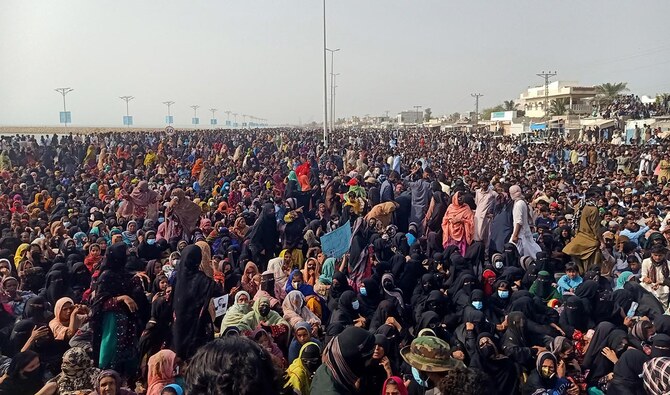
QUETTA: Maulana Hidayat-ur-Rehman, a provincial lawmaker in Pakistan’s Balochistan, on Monday announced a sit-in in Gwadar on Sept. 5 to protest prolonged power outages, illegal trawling and border trade restrictions in the deep-sea port city.
The announcement of fresh protest in Gwadar, which lies at the heart of the $65 billion China-Pakistan Economic Corridor, comes a week after a string of deadly attacks killed more than 50 people in Balochistan and is likely to pile on troubles for the central government.
Pakistan’s largest province of Balochistan, which borders Iran and Afghanistan, has been the site of a decades-long separatist insurgency by ethnic Baloch militants. The separatists say they are fighting what they see as unfair exploitation of the province’s mineral wealth by the federation. The state denies it.
In Gwadar, residents have long complained that Chinese investment in the region has done little to improve their lives and many of them do not have access to safe drinking water and lack employment opportunities, demanding an end to illegal trawling and removal of unnecessary security checkpoints in the area.
“We will protest at Surbandar cross from where we had started the Gwadar’s rights movement [in August 2021],” Rehman told Arab News. “We would block all highways connecting Gwadar with Karachi and other parts of the country.”
Rehman, who has led protests in Gwadar since Aug. 2021 under the banner of “Give Gwadar its Rights,” lamented that there had been a “lack of seriousness” on the part of the federal and provincial governments to address the basic issues of Gwadar.
He said Gwadar had been facing prolonged power outages because the Iranian government was not providing 100 megawatts of electricity to the coastal city as per an agreement with Pakistan.
“We receive 100MW from Iran but over the past several months, Iran reduced the supply to 10MW which is not enough to fulfill our electricity demand,” Rehman told Arab News. “I have requested the federal and provincial governments to raise the issue with the Iranian government, but no one is serious.”
He expressed grave concerns over illegal fishing along the Gwadar coast by “trawlers coming from the Sindh province to exploit the share of local fishermen.”
“Dozens of illegal trawlers have been fishing in our sea, but the Coast Guards and local administration are not able to take action against the illegal trawler mafia,” he said.
“The fisheries department is not capable of taking action either, hence we have decided to give a call for a sit-in against the blatant exploitation.”
Citing a visit of Prime Minister Shehbaz Sharif to Balochistan last week, Rehman said the federal and provincial governments had decided at a recent meeting to put more restrictions on informal border trade with Iran, which would impact the people of Balochistan.
“We don’t have any industry or other business opportunities,” he said, calling for the authorities to remove the curbs on border trade.
Last month, Gwadar also witnessed days-long protests by ethnic Baloch people against what they describe as a pattern of enforced disappearances and other human rights abuses by security forces, who deny the charge.


![]()

Troubles pile on for Pakistan government as fresh protest announced in volatile Balochistan
Short Url
https://arab.news/87r2a
Troubles pile on for Pakistan government as fresh protest announced in volatile Balochistan
- The sit-in in Gwadar has been announced over prolonged power cuts, illegal trawling and restrictions on informal border trade with Iran
- Last week, Balochistan witnessed a string of coordinated attacks by separatist militants that killed over 50 people in multiple districts
Latest updates


© 2026 SAUDI RESEARCH & PUBLISHING COMPANY, All Rights Reserved And subject to Terms of Use Agreement.