

Heritage Commission launches archaeological study to uncover Riyadh’s ancient past

The discovery of several ancient sites has put Saudi Arabia on the list of countries that have a rich history and are home to archeological wonders. (File/SPA)
Short Url
Updated 02 September 2024
Follow

Heritage Commission launches archaeological study to uncover Riyadh’s ancient past

  • From 2024 to 2028, the commission will explore and excavate parts of the capital and adjacent areas

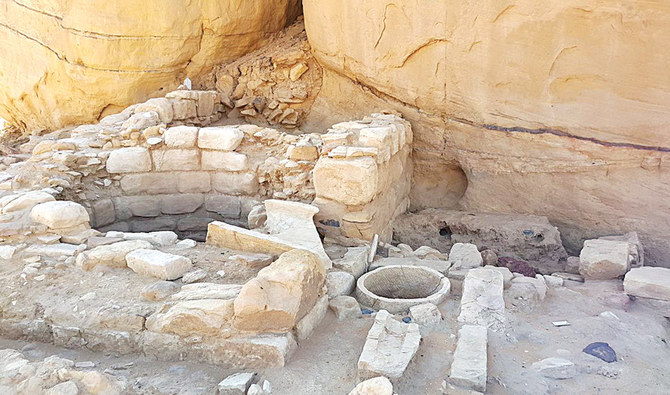
RIYADH: Saudi Arabia’s Heritage Commission has launched a study, the Al-Yamamah Archaeological Project, to expand research on Riyadh and its surrounding areas.

From 2024 to 2028, the commission will explore and excavate parts of the capital and adjacent areas, the Saudi Press Agency reported.

The aim is to enhance the national archaeological record, showcase the capital’s rich history, and study cultural heritage.

The project includes a comprehensive survey of Riyadh, Wadi Hanifah and surrounding areas, as well as excavations in Dhurma, Al-Hani and Al-Masane.

The commission posted on X the statistics of registered cultural heritage sites in Riyadh. There are 1,812 sites in the National Register of Urban Heritage, 1,514 in the National Antiquities Register, and 425 recognized for their rock art and ancient inscriptions.

For the study, the commission plans to employ geographic information systems, ground-penetrating radar, 3D modeling, magnetic surveying, low-altitude aerial photography, and artificial intelligence for mapping.

Their strategy involves collaborating with historians, academics, students from local universities, and international institutions.


Saudi Arabia plans Riyadh-Jeddah railway by 2034

Updated 21 January 2026
Follow

Saudi Arabia plans Riyadh-Jeddah railway by 2034

  • Saudi Railway Co. CEO speaks to media on future transport plans

JEDDAH: Saudi Railway Co. CEO Bashar Al-Malik announced that a new railway linking Riyadh and Jeddah is planned to be completed in phases by 2034.

In an interview with Rotana Khalejia broadcaster Abdullah Al-Mudaifer, Al-Malik discussed the Kingdom’s rail network, its history, and major current and future projects. 

He confirmed that the Riyadh-Jeddah line forms part of the Saudi Landbridge project, one of the most ambitious transport initiatives in the Kingdom.

Minister of Transport and Logistics Saleh Al-Jasser had said in an interview in 2022 that the Landbridge is being developed with an international consortium led by a Chinese company. He estimated the project could be completed within five to seven years.

According to Al-Jasser, the route, cost, and seven logistics hubs have already been identified. The railway will extend from Yanbu to King Abdullah Economic City, then to Jeddah and Riyadh, before linking with the Eastern Railway and the Northern Railway. 

The project includes upgrading the existing Riyadh–Eastern Province line to meet modern technical standards. The total cost could reach SR100 billion ($26.67 billion), making it a transformative project for the Kingdom’s logistics sector.

Al-Malik said contracts have not yet been signed, emphasizing that the railway company will proceed only once an agreement is reached that fully meets Saudi Arabia’s needs and ambitions. A ministerial committee has been formed to oversee the project, which is scheduled for completion by 2034.

The railway project connecting Riyadh and Jeddah will be implemented in phases and is expected to be completed before 2034. (X/@almodifer)

Al-Malik also highlighted the proposed Riyadh-Doha railway, describing it as the region’s first high-speed rail link between two neighboring countries. 

The 785 km network will serve Riyadh, Hofuf, Dammam, and Doha, with five stations in total, including two in the Qatari capital. Trains are expected to operate at speeds of at least 300 kph.

He added that Saudi Arabia aims to increase rail’s share of transport to 30 percent following completion of the Landbridge and future GCC-wide rail connections. 

Under the National Transport and Logistics Strategy, railways are receiving the largest share of investment through 2030.

After a long pause in railway development after the opening of the Riyadh-Dammam line in 1950, the Kingdom now operates about 4,000 km of railways and plans to add at least 2,000 km more.

Currently, SAR trains serve ports in Dammam, Ras Al-Khair, Jubail (commercial and industrial), and the Riyadh Dry Port. Future plans include extending rail connections to Jeddah Islamic Port, King Abdullah Economic City Port, and Yanbu Port. 

Al-Malik said up to 10 additional trains could be added to the Northern Railway, which currently operates six trains and is considered among the world’s most advanced rail routes. The tender is expected in the third quarter of this year. 

Discussing the Haramain High-Speed Railway, Al-Malik described it as “a unique, passenger-only system” connecting Islam’s two holiest cities. 

The service operates at speeds of up to 300 kph, making it one of the world’s 10 fastest trains. It runs 35 trains and links Makkah with stations in Jeddah, King Abdulaziz International Airport, King Abdullah Economic City, and Madinah.

Responding to user feedback, Al-Malik said the railway company will launch a new unified mobile application before the end of the year, providing a single platform for all intercity train services in the Kingdom.

He also highlighted training programs for high-speed train drivers, noting strong participation from Saudi women — a rare trend globally — and praising their outstanding performance.