Mpox patients lack medicine, food, in east DR Congo hospital

1 / 2
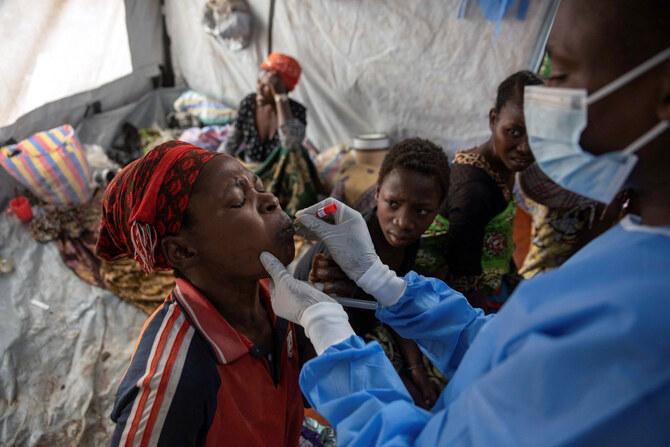
A Congolese nurse takes a sample from Nsimire Nakaziba, a suspected case of mpox in the treatment centre at the Kavumu hospital in Kabare territory. (Reuters)
2 / 2
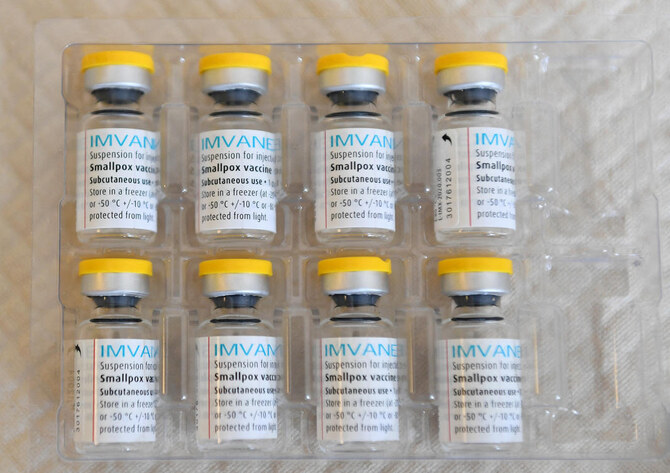
Doses of Bavarian Nordic's Imvanex vaccine, used to protect against mpox virus, at the Edison municipal vaccination centre in Paris, France July 27, 2022. (Reuters)
Short Url
Updated 02 September 2024
Follow

Mpox patients lack medicine, food, in east DR Congo hospital

KAVUMU, Democratic Republic of Congo: Dozens of feverish patients lay on thin mattresses on the floor of a makeshift mpox isolation ward in east Democratic Republic of Congo, as overstretched hospital workers grappled with drug shortages and lack of space to accommodate the influx.
Congo is the epicenter of an mpox outbreak that the World Health Organization declared to be a global public health emergency last month.
Vaccines are set to arrive within days to fight the new strain of the virus, while Congo’s President Felix Tshisekedi has allowed a first $10 million disbursement to fight the outbreak.
But at the hospital complex in the town of Kavumu, where 900 symptomatic patients have been taken in over the past three months, health workers are desperate for support.
“We run out of medicine every day,” said head doctor Musole Mulamba Muva.
“There are many challenges we struggle to overcome with our local means,” he said, noting that donations from international organizations rapidly dwindled.
Last week there were 135 patients in the mpox ward, children and adults combined, crammed between three large plastic tents pitched into damp earth without a floor cover.
Relatives that usually provide the bulk of meals in underfunded public facilities such as the Kavumu hospital were banned from visiting the mpox ward to avoid contamination. “We do not have anything to eat,” said Nzigire Lukangira, the 32-year-old mother of a hospitalized toddler.
“When we ask for something to lower our children’s temperature, they do not give us anything,” she said, coaxing honey into her daughter’s mouth.
The head of Congo’s mpox response team, Cris Kacita, acknowledged that parts of the vast central African country lacked medicine and that dispatching donations, including 115 tons of medicine from the World Bank, was a priority.

TRADITIONAL REMEDIES
Mpox causes flu-like symptoms and pus-filled lesions and, while usually mild, it can kill. Children, pregnant women and people with weakened immune systems are all at higher risk of complications.
Like other mothers in the Kavumu mpox ward, Lukangira had started improvising with traditional remedies to ease her baby’s pain. They dipped their fingers in potassium bicarbonate or salty lemon juice and popped their children’s blisters. Adult patients did the same to themselves.
Most cases came from the town itself and surrounding villages. Two other makeshift mpox wards have been set up in the area.
Local health ministry representative, doctor Serge Munyau Cikuru, called on the government to continue pushing for vaccines.
Kacita said high-risk contacts and nine priority areas had already been identified for the first vaccination stage.
There were 19,710 suspected cases of mpox reported since the start of the year in Congo by Aug. 31, according to the health ministry. Of those, 5,041 were confirmed and 655 were fatal.


US warns UK to stop arresting Palestine Action supporters

Updated 19 January 2026
Follow

US warns UK to stop arresting Palestine Action supporters

  • Undersecretary of state for diplomacy: Arrests doing ‘more harm than good’ and ‘censoring’ free speech
  • Group was banned in July 2025 after series of break-ins

LONDON: UK authorities should stop arresting protesters showing support for banned group Palestine Action, the White House has warned.

The US undersecretary of state for diplomacy said arrests are doing “more harm than good” and are “censoring” free speech.

Sarah Rogers told news site Semafor: “I would have to look at each individual person and each proscribed organization. I think if you support an organization like Hamas, then depending upon whether you’re coordinating, there are all these standards that get applied.

“This Palestine Action group, I’ve seen it written about. I don’t know what it did. I think if you just merely stand up and say, ‘I support Palestine Action’, then unless you are really coordinating with some violent foreign terrorist, I think that censoring that speech does more harm than good.”

So far, more than 2,000 people have been arrested in the UK for showing support for the group.

It was banned in July 2025 after a series of break-ins nationwide, including at a facility owned by a defense manufacturer and a Royal Air Force base, during which military aircraft were damaged.

Last year, Swedish climate activist Greta Thunberg was among those arrested while protesting for Palestine Action.

The group is challenging its ban, saying it should not be compared to terrorist organizations such as the Irish Republican Army, Daesh or Al-Qaeda.

The ban has been criticized by numerous bodies, with Amnesty International calling it a case of “problematic, overly broad and draconian restrictions on free speech.”

In Scotland, prosecutors have been offering to drop charges against some protesters in return for accepting a fine of £100 ($134.30). 

Adam McGibbon, who was arrested at a demonstration in Edinburgh last year, refused the offer, saying: “The fact that the authorities are offering fines equivalent to a parking ticket for a ‘terrorism offence’ shows just how ridiculous these charges are. Do supporters of (Daesh) get the same deal?

“I refuse to pay this fine, as has everyone else I know who has been offered one. Just try and put all 3,000 of us who have defied this ban so far in jail.”

Rogers said the UK is also wrong to arrest people using the phrase “globalize the intifada” while demonstrating in support of Palestine, after police in Manchester said in December that it would detain people chanting it.

“I’m from New York City where thousands of people were murdered by jihadists,” she said. referring to the terror attacks of Sept. 11, 2001. “I don’t want an intifada in New York City, and I think anyone who does is disgusting, but should it be legal to say in most contexts? Yes.”