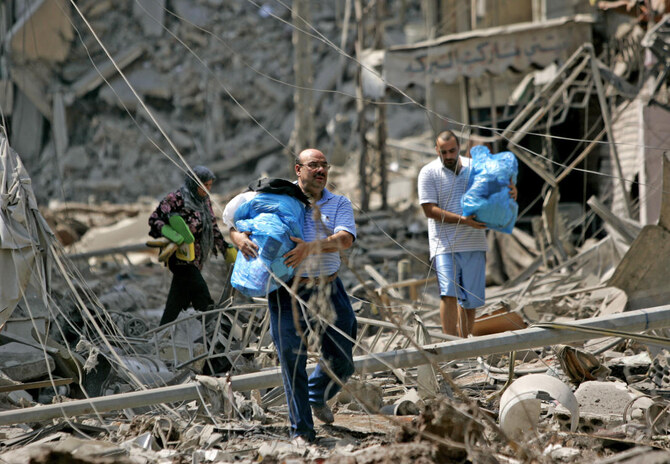
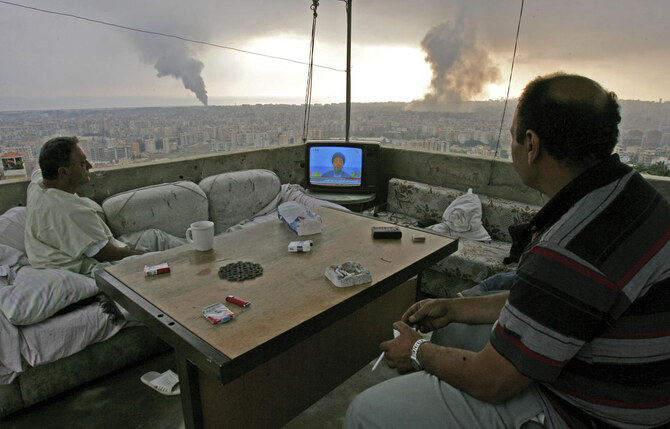
BEIRUT: Residents of Beirut’s southern suburbs have been scrambling to make contingency plans since an Israeli airstrike on an apartment building in a busy neighborhood killed a top Hezbollah commander and touched off fears of a full-scale war.
For most, that means moving in with relatives or renting homes in Christian, Druze or Sunni-majority areas of Lebanon that are generally considered safer than the Shiite-majority areas where the Hezbollah militant group has its main operations and base of support.
But for a small number, plan B is a move to neighboring Syria.
Although Syria is in its 14th year of civil war, active fighting has long been frozen in much of the country. Lebanese citizens, who can cross the border without a visa, regularly visit Damascus. And renting an apartment is significantly cheaper in Syria than in Lebanon.
Zahra Ghaddar said she and her family were shaken when they saw an apartment building reduced to rubble by the July 30 drone strike in her area, known as Dahiyeh. Along with Hezbollah commander Fouad Shukur, two children and three women were killed and dozens more were injured in the targeted Israeli attack.
Previously, the Lebanese capital had been largely untouched by the near-daily cross-border clashes that have displaced around 100,000 people from southern Lebanon and tens of thousands more in Israel since Oct. 8. That’s when Hezbollah began firing rockets into northern Israel in support of its ally Hamas, which a day earlier led a deadly raid in Israel that killed some 1,200 people and took another 250 hostage. Israel responded with an aerial bombardment and ground offensive in Gaza that has killed more than 40,000 Palestinians.
In recent weeks, the conflict in Lebanon appeared on the brink of spiraling out of control.
Ghaddar said her family first considered moving within Lebanon but were discouraged by social media posts blaming displaced civilians, along with Hezbollah, for the threat of all-out war. Also, surging demand prompted steep rent hikes.
“We found the rents started at $700, and that’s for a house we wouldn’t be too comfortable in,” she said. That amount is more than many Lebanese earn in a month.
So they looked across the border.
Ghaddar’s family found a four-bedroom apartment in Aleppo, a city in northwestern Syria, for $150 a month. They paid six months’ rent in advance and returned to Lebanon.
Israel periodically launches airstrikes on Syria, usually targeting Iranian-linked military sites or militants, but Bashar Assad’s government has largely stood on the sidelines of the current regional conflict.
Israel and Hezbollah fought a bruising monthlong war in 2006 that demolished much of southern Lebanon and Beirut’s southern suburbs. At the time, some 180,000 Lebanese took refuge in Syria, many taking shelter in schools, mosques and empty factories. Those who could afford it rented houses. Some put down permanent roots.
Rawad Issa, then a teenager, fled to Syria with his parents. They returned to Lebanon when the war ended, but Issa’s father used some of his savings to buy a house in Syria’s Hama province, just in case.
“That way, if another war happened, we would already have a house ready,” Issa said.
The house and surrounding area were untouched by Syria’s civil war, he said. A few weeks ago, his sister and her husband went to get the house ready for the family to return, in case the situation in Lebanon deteriorated.
Issa, who works in video production, said he initially planned to rent an apartment in Lebanon if the conflict expanded, rather than joining his family in Syria.
But in “safe” areas of Beirut, “they are asking for fantastic prices,” he said. One landlord was charging $900 for a room in a shared apartment. “And outside of Beirut, it’s not much better.”
Azzam Ali, a Syrian journalist in Damascus, told The Associated Press that in the first few days after the strike in Dahiyeh, he saw an influx of Lebanese renting hotel rooms and houses in the city. A Lebanese family — friends of a friend — stayed in his house for a few days, he said.
In a Facebook post, he welcomed the Lebanese, saying they “made the old city of Damascus more beautiful.”
After the situation appeared to calm down, “some went back and some stayed here, but most of them stayed,” he said.
No agency has recorded how many people have moved from Lebanon to Syria in recent months. They are spread across the country and are not registered as refugees, making tracking the migration difficult. Anecdotal evidence suggests the numbers are small.
Of 80 people displaced from southern Lebanon living in greater Beirut — including Lebanese, Syrians and Palestinian refugees — at least 20 said they were considering taking refuge in Syria if the war in Lebanon escalated, according to interviews conducted by researchers overseen by Jasmin Lilian Diab, director of the Institute for Migration Studies at the Lebanese American University.
Diab noted that the Lebanese considering this route were a niche group who had “existing networks in Syria, either business networks, family or friends.”
The threat of war has also not prompted a mass reverse migration of Syrians from Lebanon. Some 775,000 Syrians are registered with the UN Refugee Agency in Lebanon, and hundreds of thousands more are believed to be unregistered in the country.
While fighting in Syria has died down, many refugees fear that if they return they could be arrested for real or perceived ties to the opposition to Assad or forcibly conscripted to the army. If they leave Lebanon to escape war they could lose their refugee status, although some cross back and forth via smuggler routes without their movements being recorded.
Many residents of Dahiyeh breathed a sigh of relief when an intense exchange of strikes between Israel and Hezbollah on July 25 turned out to be short-lived. But Ghaddar said she still worries the situation will deteriorate, forcing her family to flee.
“It’s necessary to have a backup plan in any case,” she said.


![]()
![]()

Some Lebanese who fear war is coming have an unusual backup plan: Moving to Syria
Short Url
https://arab.news/jdh3p
Some Lebanese who fear war is coming have an unusual backup plan: Moving to Syria
- Although Syria is in its 14th year of civil war, active fighting has long been frozen in much of the country
- Renting an apartment is significantly cheaper in Syria than in Lebanon


Latest updates


© 2026 SAUDI RESEARCH & PUBLISHING COMPANY, All Rights Reserved And subject to Terms of Use Agreement.