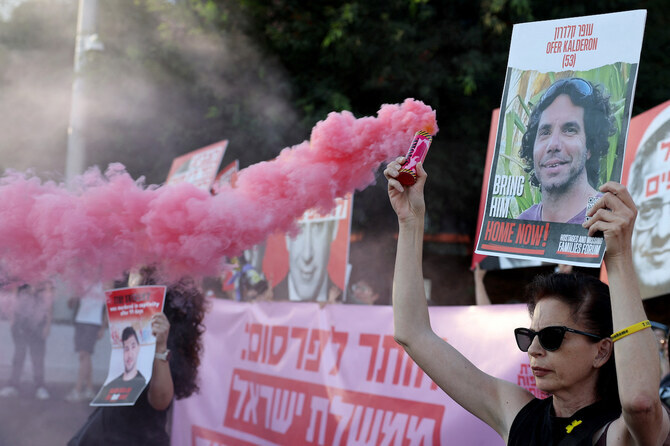
Israelis erupt in protest to demand a ceasefire after 6 more hostages die in Gaza

Protesters block a main road to show support for the hostages who were kidnapped during the deadly October 7 attack, in Tel Aviv, Israel September 1, 2024. (Reuters)
Short Url
Updated 02 September 2024
Follow

Israelis erupt in protest to demand a ceasefire after 6 more hostages die in Gaza

  • Protesters demand Prime Minister Benjamin Netanyahu reach a ceasefire with Hamas to bring the remaining captives home
  • Many blame Netanyahu for failing to reach a ceasefire during nearly 11 months of war with negotiations dragging on 

JERUSALEM: Grieving and angry Israelis surged into the streets Sunday night after six more hostages were found dead in Gaza, chanting “Now! Now!” as they demanded that Prime Minister Benjamin Netanyahu reach a ceasefire with Hamas to bring the remaining captives home.
Israel’s largest trade union, the Histadrut, also pressured the government by calling a general strike for Monday — the first since the Oct. 7 Hamas attack that started the war. The strike aims to shut down or disrupt major sectors of the economy, including banking, health care and the country’s main airport.
Tens of thousands of Israelis were expected to protest. Many blame Netanyahu for failing to reach a ceasefire during nearly 11 months of war. Negotiations have dragged on for months. Israel’s army has acknowledged the difficulty of rescuing dozens of remaining hostages and said a deal is the only way to bring a large-scale return.
“I’m crying the cry of humanity,” said one protester who gave his name as Amos as thousands, some of them weeping, gathered outside Netanyahu’s office in Jerusalem.
The military said all six hostages were killed shortly before Israeli forces arrived. Netanyahu blamed the Hamas militant group for the stalled negotiations, saying “whoever murders hostages doesn’t want a deal.”


Militants seized Israeli-American Hersh Goldberg-Polin, 23, and four other hostages at a music festival in southern Israel. The native of Berkeley, California, lost part of his left arm to a grenade in the attack. In April, a Hamas-issued video showed him alive, sparking new protests in Israel.
The army identified the other dead hostages as Ori Danino, 25; Eden Yerushalmi, 24; Almog Sarusi, 27; and Alexander Lobanov, 33; also taken from the festival. The sixth, Carmel Gat, 40, was abducted from the nearby farming community of Be’eri.
The army said the bodies were recovered from a tunnel in the southern Gaza city of Rafah, around a kilometer (half a mile) from where another hostage was rescued alive last week.
Lt. Col. Nadav Shoshani, a military spokesperson, said Israeli forces found the bodies several dozen meters (yards) underground as “ongoing combat” was underway, but that there was no firefight in the tunnel itself. He said there was no doubt Hamas had killed them.
Hamas has offered to release the hostages in return for an end to the war, the withdrawal of Israeli forces from Gaza and the release of a large number of Palestinian prisoners, including high-profile militants.
Izzat Al-Rishq, a senior Hamas official, said the hostages would still be alive if Israel had accepted a US-backed ceasefire proposal that Hamas said it had agreed to in July.
Funerals began for the hostages, with more outrage. Sarusi’s body was wrapped in an Israeli flag. “You were abandoned on and on, daily, hour after hour, 331 days,” his mother, Nira, said. “You and so many beautiful and pure souls. Enough. No more.”
Hostages’ families urge a ‘complete halt of the country’
Netanyahu has vowed to continue the war until Hamas is destroyed.
Critics have accused him of putting his personal interests over those of the hostages. The war’s end likely will lead to an investigation into his government’s failures in the Oct. 7 attacks, the government’s collapse and early elections.
“I think this is an earthquake. This isn’t just one more step in the war,” said Nomi Bar-Yaacov, associate fellow in the International Security Program at Chatham House, shortly before Sunday’s protests began.
Israel’s Channel 12 reported that Netanyahu got into a shouting match at a security Cabinet meeting Thursday with Defense Minister Yoav Gallant, who accused him of prioritizing control of a strategic corridor along the Gaza-Egypt border — a major sticking point in the talks — over the lives of the hostages.
An Israeli official confirmed the report and said three of the hostages — Goldberg-Polin, Yerushalmi and Gat — had been slated to be released in the first phase of a ceasefire proposal discussed in July. The official was not authorized to brief media about the negotiations and spoke on condition of anonymity.
“In the name of the state of Israel, I hold their families close to my heart and ask forgiveness,” Gallant said Sunday.
A forum of hostage families has demanded a “complete halt of the country” to push for a ceasefire and hostage release. “Were it not for the delays, sabotage and excuses, those whose deaths we learned about this morning would likely still be alive,” it said in a statement.
Even a mass outpouring of anger would not immediately threaten Netanyahu or his far right government. He still controls a majority in parliament. But he has caved in to public pressure before. Mass protests led him to cancel the dismissal of his defense minister last year, and a general strike last year helped lead to a delay in his controversial judicial overhaul.
A family’s high-profile campaign
Goldberg-Polin’s parents, US-born immigrants to Israel, became perhaps the most high-profile relatives of hostages on the international stage. They met with US President Joe Biden and Pope Francis and on Aug. 21, they addressed the Democratic National Convention — after sustained applause and chants of “bring him home.”
His mother, Rachel, who bowed her head during the ovation and touched her chest, said “Hersh, if you can hear us, we love you, stay strong, survive.”
Biden on Sunday said he was “devastated and outraged.” The White House said he spoke with Goldberg-Polin’s parents and offered condolences.
Some 250 hostages were taken on Oct. 7. Israel now believes 101 remain in captivity, including 35 who are thought to be dead. More than 100 were freed during a ceasefire in November in exchange for the release of Palestinians imprisoned by Israel. Eight have been rescued by Israeli forces. Israeli troops mistakenly killed three Israelis who escaped captivity in December.
Hamas-led militants killed some 1,200 people, mostly civilians, when they stormed into southern Israel on Oct. 7. Israel’s retaliatory offensive in Gaza has killed over 40,000 Palestinians, according to local health officials, who do not say how many were militants. It has displaced the vast majority of Gaza’s 2.3 million people, often multiple times, and plunged the besieged territory into a humanitarian catastrophe.


Gaza’s living conditions worsen as strong winds and hypothermia kill 5

Updated 14 January 2026
Follow

Gaza’s living conditions worsen as strong winds and hypothermia kill 5

  • Hundreds of tents and makeshift shelters were blown away or heavily damaged, the UN humanitarian office reported

DEIR AL-BALAH, Gaza Strip: Strong winter winds collapsed walls onto flimsy tents for Palestinians displaced by war in Gaza, killing at least four people, hospital authorities said Tuesday.
Dangerous living conditions persist in Gaza after more than two years of devastating Israeli bombardment and aid shortfalls. A ceasefire has been in effect since Oct. 10. But aid groups say that Palestinians broadly lack the shelter necessary to withstand frequent winter storms.
The dead include two women, a girl and a man, according to Shifa Hospital, Gaza City’s largest, which received the bodies.
The Gaza Health Ministry said Tuesday a 1-year-old boy died of hypothermia overnight, while the spokesman for the UN’s children agency said over 100 children and teenagers have been killed by “military means” since the ceasefire began.
Meanwhile, Israel’s military said it exchanged fire Tuesday with six people spotted near its troops deployed in southern Gaza, killing at least two of them in western Rafah.
Family mourns relatives killed by wall collapse
Three members of the same family — 72-year-old Mohamed Hamouda, his 15-year-old granddaughter and his daughter-in-law — were killed when an 8-meter (26-foot) high wall collapsed onto their tent in a coastal area along the Mediterranean shore of Gaza City, Shifa Hospital said. At least five others were injured.
Their relatives on Tuesday began removing the rubble that had buried their loved ones and rebuilding the tent shelters for survivors.
“The world has allowed us to witness death in all its forms,” Bassel Hamouda said after the funeral. “It’s true the bombing may have temporarily stopped, but we have witnessed every conceivable cause of death in the world in the Gaza Strip.”
A second woman was killed when a wall fell on her tent in the western part of the city, Shifa Hospital said.
Hundreds of tents and makeshift shelters were blown away or heavily damaged, the UN humanitarian office reported.
The UN and its humanitarian partners were distributing tents, tarps, blankets and clothes as well as nutrition and hygiene items across Gaza, said the UN Office for the Coordination of Humanitarian Affairs.
The majority of Palestinians live in makeshift tents since their homes were reduced to rubble during the war. When storms strike the territory, Palestinian rescue workers warn people against seeking shelter inside damaged buildings for fears of collapse. Aid groups say not enough shelter materials are entering Gaza during the truce.
In the central town of Zawaida, Associated Press footage showed inundated tents Tuesday morning, with people trying to rebuild their shelters.
Yasmin Shalha, a displaced woman from the northern town of Beit Lahiya, stood against winds that lifted the tarps of tents around her as she stitched hers back together with needle and thread. She said it had fallen on top of her family the night before, as they slept.
“The winds were very, very strong. The tent collapsed over us,” the mother of five told AP. “As you can see, our situation is dire.”
On the shore in southern Gaza, tents were swept into the Mediterranean. Families pulled what was left from the sea, while some built sand barriers to hold back rising water.
“The sea took our mattresses, our tents, our food and everything we owned,” Shaban Abu Ishaq said, as he dragged part of his tent out of the sea in the Muwasi area of Khan Younis.
Mohamed Al-Sawalha, a 72-year-old man from the northern refugee camp of Jabaliya, said the conditions most Palestinians in Gaza endure are barely livable.
“It doesn’t work neither in summer nor in winter,” he said of the tent. “We left behind houses and buildings (with) doors that could be opened and closed. Now we live in a tent. Even sheep don’t live like we do.”
Residents aren’t able to return to their homes in Israeli-controlled areas of the Gaza Strip.
Child death toll in Gaza rises
Gaza’s Health Ministry said the 1-year-old in the central town of Deir Al-Balah was the seventh fatality due to the cold conditions since winter started. Others included a baby just seven days old and a 4-year-old girl, whose deaths were announced Monday.
The ministry, part of the Hamas-run government, says more than 440 people were killed by Israeli fire and their bodies brought to hospitals since the ceasefire went into effect. The ministry maintains detailed casualty records that are seen as generally reliable by UN agencies and independent experts.
UNICEF spokesman James Elder said Tuesday at least 100 children under the age of 18 — 60 boys and 40 girls — have been killed since the truce began due to military operations, including drone strikes, airstrikes, tank shelling and use of live ammunition. Those figures, he said, reflect incidents where enough details have been compiled to warrant recording, but the total toll is expected to be higher. He said hundreds of children have been wounded.
While “bombings and shootings have slowed” during the ceasefire, they have not stopped, Elder told reporters at a UN briefing in Geneva by video from Gaza City. “So what the world now calls calm would be considered a crisis anywhere else,” he said.
Gaza’s population of more than 2 million people has been struggling to keep the cold weather and storms at bay while facing shortages of humanitarian aid and a lack of more substantial temporary housing, which is badly needed during the winter months. It’s the third winter since the war between Israel and Hamas started on Oct. 7, 2023, when militants stormed into southern Israel and killed around 1,200 people and abducted 251 others into Gaza.
Gaza’s Health Ministry says more than 71,400 Palestinians have been killed in Israel’s retaliatory offensive.