

If China wants Taiwan it should also take back land from Russia, President Lai Ching-te says

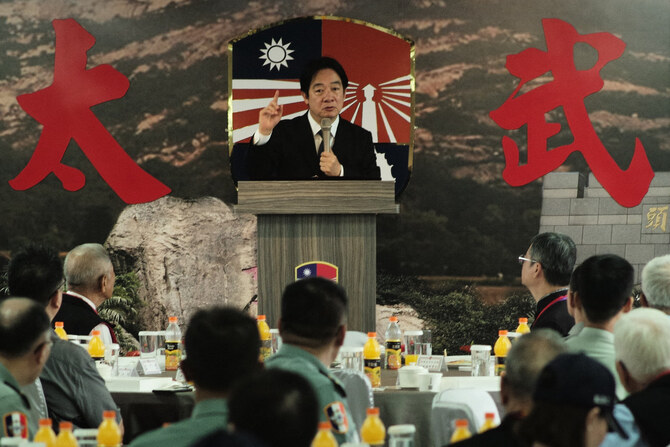
Taiwan President Lai Ching-te (C) speaks to the veterans during the 66th anniversary of the Kinmen artillery battle in Kinmen on August 23, 2024. (AFP)
Short Url
Updated 02 September 2024
Follow

If China wants Taiwan it should also take back land from Russia, President Lai Ching-te says

  • Lai brought up the 1858 Treaty of Aigun in which China signed over a vast tract of land in what is now Russia’s far east to the Russian empire
  • China views democratically governed Taiwan as its own territory and has never renounced the use of force to bring the island under its control

TAIPEI: If China’s claims on Taiwan are about territorial integrity then it should also take back land from Russia signed over by the last Chinese dynasty in the 19th century, Taiwan President Lai Ching-te said in an interview with Taiwanese media.
China views democratically governed Taiwan as its own territory and has never renounced the use of force to bring the island under its control. Taiwan’s government rejects those claims, saying only the island’s people can decide their future.
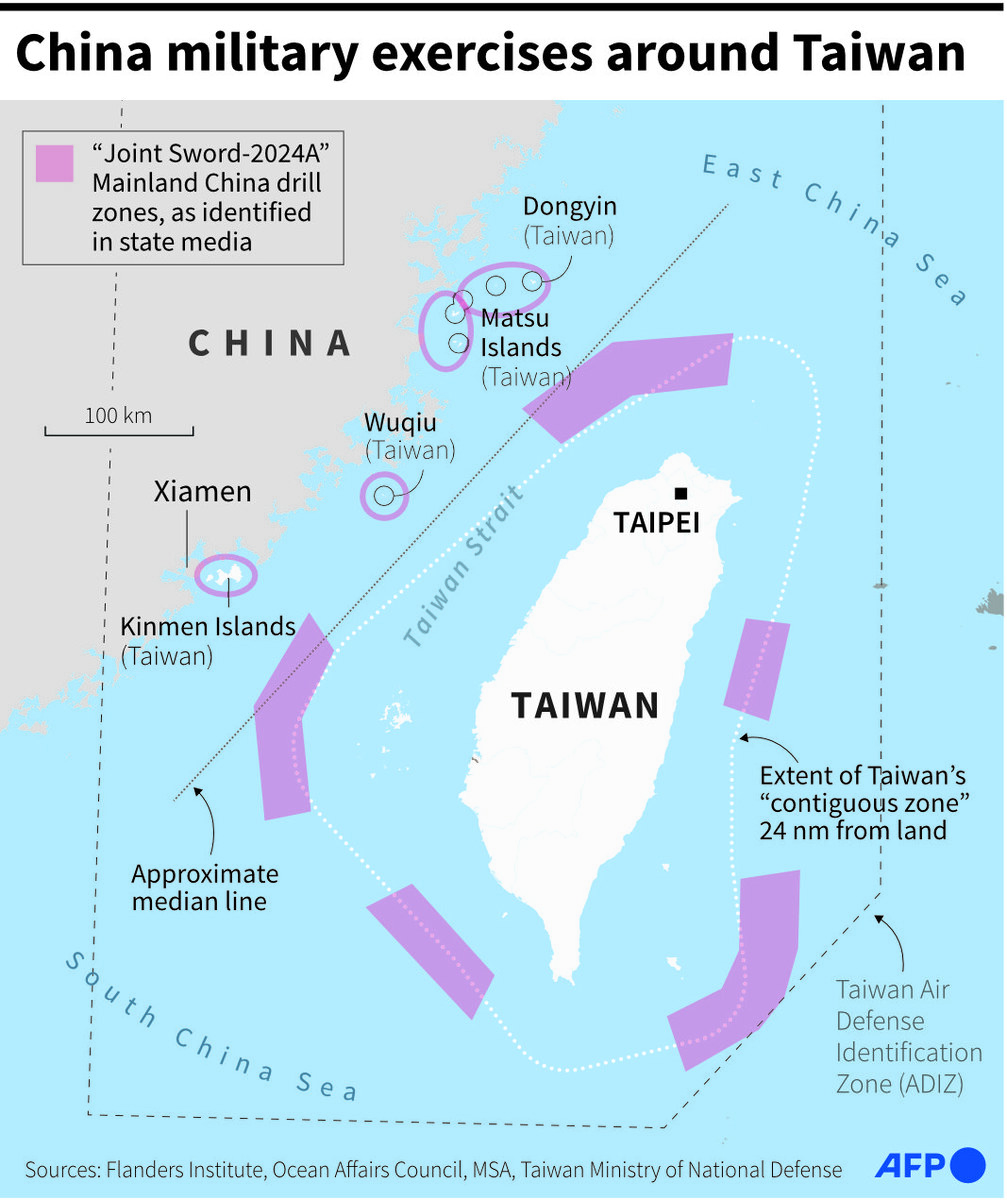


Map of Taiwan showing zones identified in Chinese military exercises around the island, according to mainland media. (AFP)

Speaking in an interview with a Taiwanese television station broadcast late on Sunday, Lai, who China calls a “separatist,” brought up the 1858 Treaty of Aigun in which China signed over a vast tract of land in what is now Russia’s far east to the Russian empire, forming much of the present day border along the Amur River.
China’s Qing dynasty, then in terminal decline, originally refused to ratify the treaty but it was affirmed two years later in the Convention of Peking, one of what China refers to as the “unequal” treaties with foreign powers in the 19th Century.

“China’s intention to attack and annex Taiwan is not because of what any one person or political party in Taiwan says or does. It is not for the sake of territorial integrity that China wants to annex Taiwan,” Lai said.
“If it is for the sake of territorial integrity, why doesn’t it take back the lands occupied by Russia that were signed over in the Treaty of Aigun? Russia is now at its weakest right?” he added.
“The Treaty of Aigun signed during the Qing — you can ask Russia (for the land back) but you don’t. So it’s obvious they don’t want to invade Taiwan for territorial reasons.”
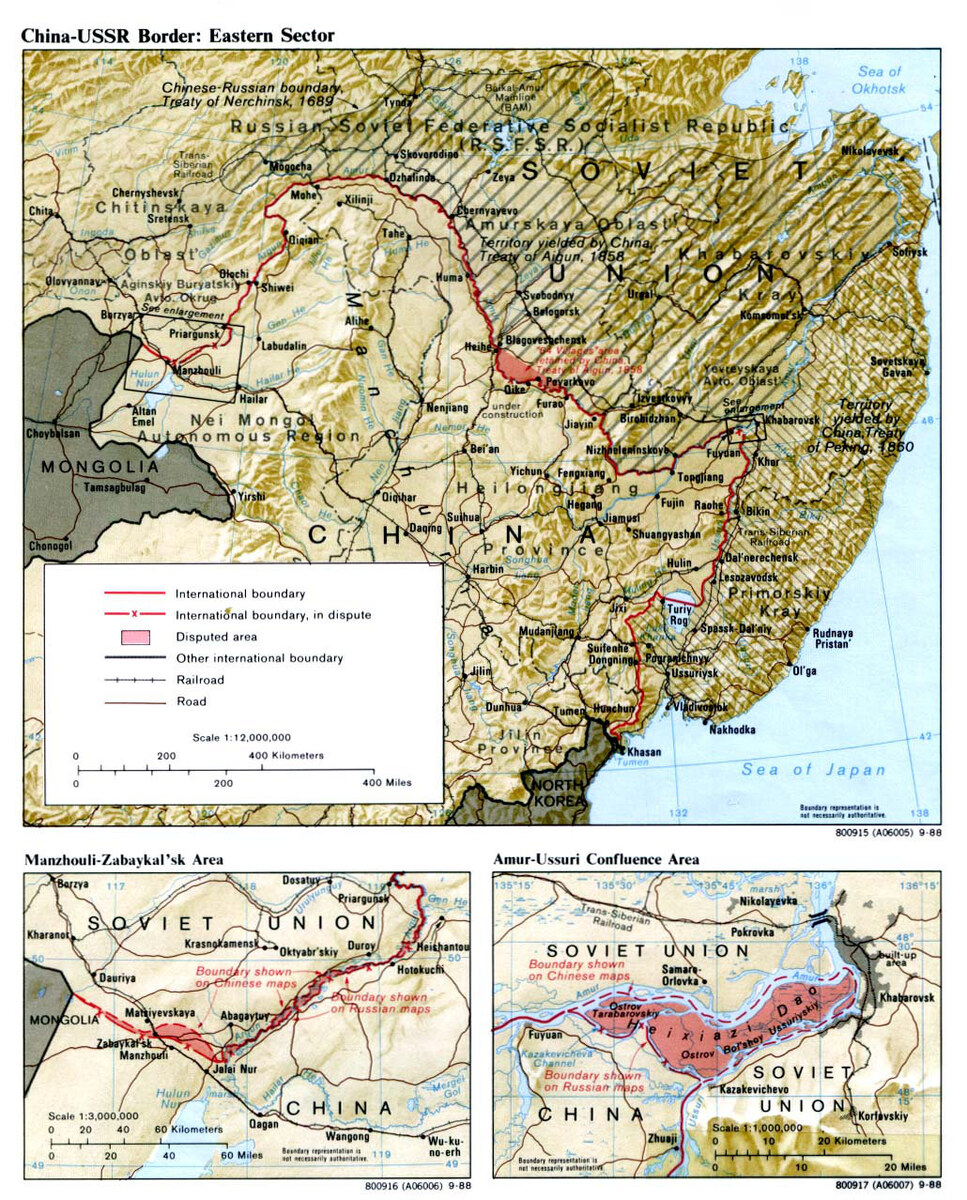


 Maps showing the disputed China-Russian territories. (Wikimedia Commons)

China’s Taiwan Affairs Office did not immediately respond to a request for comment. China’s government says Taiwan has been Chinese territory since ancient times.
The Qing signed over Taiwan to Japan in 1895 in another “unequal” treaty, and in 1945 at the end of World War Two it was handed over to the Republic of China government, which four years later fled to Taiwan after losing a civil war with Mao Zedong’s communists.
Lai said that what China really wants to do with its designs on Taiwan is to change the rules-based international order.
“It wants to achieve hegemony in the international area, in the Western Pacific — that is it’s real aim.”


Afghanistan says it thwarted Pakistani airstrike on Bagram Air Base as fighting enters fourth day

Updated 01 March 2026
Follow

Afghanistan says it thwarted Pakistani airstrike on Bagram Air Base as fighting enters fourth day

  • The fighting has been the most severe between the neighbors for years
  • Pakistan accuses Taliban government of harboring militant groups that stage attacks against it

KABUL: Afghanistan thwarted attempted airstrikes on Bagram Air Base, the former US military base north of Kabul, authorities said Sunday, while cross-border fighting between Pakistan and Afghanistan stretched into a fourth day.
The fighting has been the most severe between the neighbors for years, with Pakistan declaring that it’s in “open war” with Afghanistan.
The conflict has alarmed the international community, particularly as the area is one where other militant organizations, including Al-Qaeda and the Daesh group, still have a presence and have been trying to resurface.
Pakistan accuses Afghanistan’s Taliban government of harboring militant groups that stage attacks against it and also of allying with its archrival India.
Border clashes in October killed dozens of soldiers, civilians and suspected militants until a Qatari-mediated ceasefire ended the intense fighting. But several rounds of peace talks in Turkiye in November failed to produce a lasting agreement, and the two sides have occasionally traded fire since then.
On Sunday, the police headquarters of Parwan province, where Bagram is located, said in a statement that several Pakistani military jets had entered Afghan airspace “and attempted to bomb Bagram Air Base” at around 5 a.m.
The statement said Afghan forces responded with “anti-aircraft and missile defense systems” and had managed to thwart the attack.
There was no immediate response from Pakistan’s military or government regarding Kabul’s claim of attempted airstrikes on Bagram or the ongoing fighting.
Bagram was the United States’ largest military base in Afghanistan. It was taken over by the Taliban as they swept across the country and took control in the wake of the chaotic US withdrawal from the country in 2021. Last year, US President Donald Trump suggested he wanted to reestablish a US presence at the base.
The current fighting began when Afghanistan launched a broad cross-border attack on Thursday night, saying it was in retaliation for Pakistani airstrikes the previous Sunday.
Pakistan had said its airstrike had targeted the outlawed Pakistani Taliban, also known as Tehreek-e-Taliban Pakistan, or TTP. Afghanistan had said only civilians were killed.
The TTP militant group, which is separate but closely allied with Afghanistan’s ruling Taliban, operates inside Pakistan, where it has been blamed for hundreds of deaths in bombings and other attacks over the years.
Pakistan accuses Afghanistan’s Taliban government of providing a safe haven within Afghanistan for the TTP, an accusation that Afghanistan denies.
After Thursday’s Afghan attack, Pakistani Defense Minister Khawaja Mohammad Asif declared that “our patience has now run out. Now it is open war between us.”
In the ongoing fighting, each side claims to have killed hundreds of the other side’s forces — and both governments put their own casualties at drastically lower numbers.
Two Pakistani security officials said that Pakistani ground forces were still in control on Sunday of a key Afghan post and a 32-square-kilometer area in the southern Zhob sector near Kandahar province, after having seized it during fighting Friday. The captured post and surrounding area remain under Pakistani control, they added. The officials spoke on condition of anonymity, because they weren’t authorized to speak publicly.
In Kabul, the Afghan government rejected Pakistan’s claims. Deputy government spokesman Hamdullah Fitrat called the reports “baseless.”
Afghan officials said that fighting had continued overnight and into Sunday in the border areas.
The police command spokesman for Nangarhar province, Said Tayyeb Hammad, said that anti-aircraft missiles were used from the provincial capital, Jalalabad, and surrounding areas on Pakistani fighter jets flying overhead Sunday morning.
Defense Ministry spokesman Enayatulah Khowarazmi said that Afghan forces had launched counterattacks with snipers across the border from Nangarhar, Paktia, Khost and Kandahar provinces overnight. He said that two Pakistani drones had been shot down and dozens of Pakistani soldiers had been killed.
Fitrat said that Pakistani drone attacks hit civilian homes in Nangarhar province late Saturday, killing a woman and a child, while mortar fire killed another civilian when it hit a home in Paktia province.
There was no immediate response to the claims from Pakistani officials.