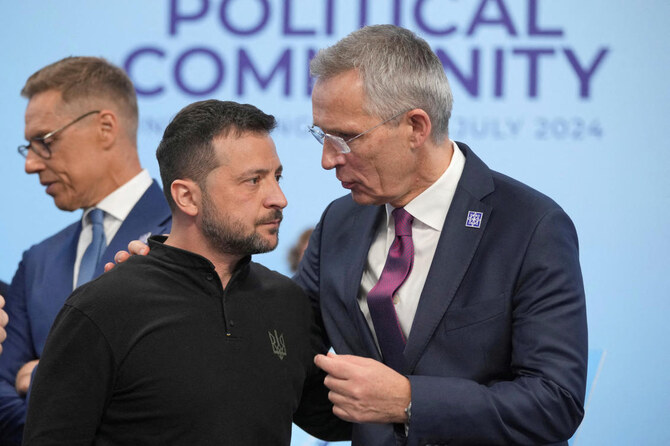
BERLIN: Ukraine was fully within its rights to launch its surprise offensive into Russia’s Kursk border region as an act of self-defense, NATO chief Jens Stoltenberg told German newspaper Die Welt.
The offensive launched on August 6 caught the Kremlin off guard, with Kyiv claiming to have captured dozens of settlements and more than 1,200 square kilometers (nearly 500 square miles) of territory.
“Ukraine has a right to defend itself. And according to international law, this right does not stop at the border,” Stoltenberg said in an interview with Die Welt published Saturday.
“The Russian soldiers, tanks and bases there (Kursk) are legitimate targets under international law.”
The offensive also surprised Kyiv’s allies, with Stoltenberg saying Ukraine “did not preview its planning” with NATO and that the Western military alliance “played no role.”
Stoltenberg also welcomed Germany’s commitment to remain Ukraine’s largest European military donor and second-largest worldwide, as Berlin prepares cuts to its aid to Kyiv in next year’s budget.
Chancellor Olaf Scholz’s government came under fierce criticism for the decision last week. He says Germany will continue to supply the outgunned and outmanned Ukrainian military with the equipment it needs.
The Kursk offensive has changed little on the front line in eastern Ukraine, where Russia continues to claim incremental gains, including three villages on Friday.
Ukrainian President Volodymyr Zelensky has acknowledged his army faces an “extremely difficult” situation near the strategic hub of Pokrovsk, in the Donetsk region, with Russian troops closing in.

NATO chief backs Ukraine offensive in Russia’s Kursk
https://arab.news/m8ax3
NATO chief backs Ukraine offensive in Russia’s Kursk
- The offensive launched on August 6 caught the Kremlin off guard
South Sudan officers face court martial over civilian massacre
- The increasingly unstable country is seeing a surge of fighting between government and opposition forces
JUBA: South Sudanese soldiers, including two officers, will face a court martial over a civilian massacre last month, the army spokesman said Wednesday.
The increasingly unstable country is seeing a surge of fighting between government and opposition forces, much of it in eastern Jonglei state where at least 280,000 people have been displaced since December according to the UN.
At least 25 civilians, including women and children, were killed in Ayod County in Jonglei state on February 21, according to the opposition.
Army spokesman Lul Ruai Koang said that two officers, including a major, and several non-commissioned officers, had been arrested and would face charges in the capital Juba, “before they are arraigned before a competent military court martial.”
He said the deaths were attributed to “some elements” under Gen. Johnson Olony, who was filmed in January ordering troops to “spare no lives” in Jonglei.
Koang said the soldiers had “moved out without the knowledge or authorization of the division commander.”
He also said they had been part of a militia group allied to opposition forces, parts of which had not yet been fully integrated into the army.
Military integration was among the core principles of a peace agreement that ended South Sudan’s five-year civil war in 2018 between President Salva Kiir and his long-time rival, Riek Machar, but it was never implemented.
Koang said the army regretted the loss of lives, adding: “We would like to once again remind our forces that their mandate is to protect civilians and their property, not to do the opposite.”
It followed an impassioned plea from the Sudan and South Sudan Catholic Bishops’ Conference on recent civilian killings — in Ayod, and also in Abiemnom County near the Sudan border where at least 169 people were killed on Sunday.
“We implore you to deploy resources to protect vulnerable populations and foster a climate of dialogue and reconciliation instead of violence and revenge, consoling the bereaved and supporting the afflicted,” it said in a statement.


