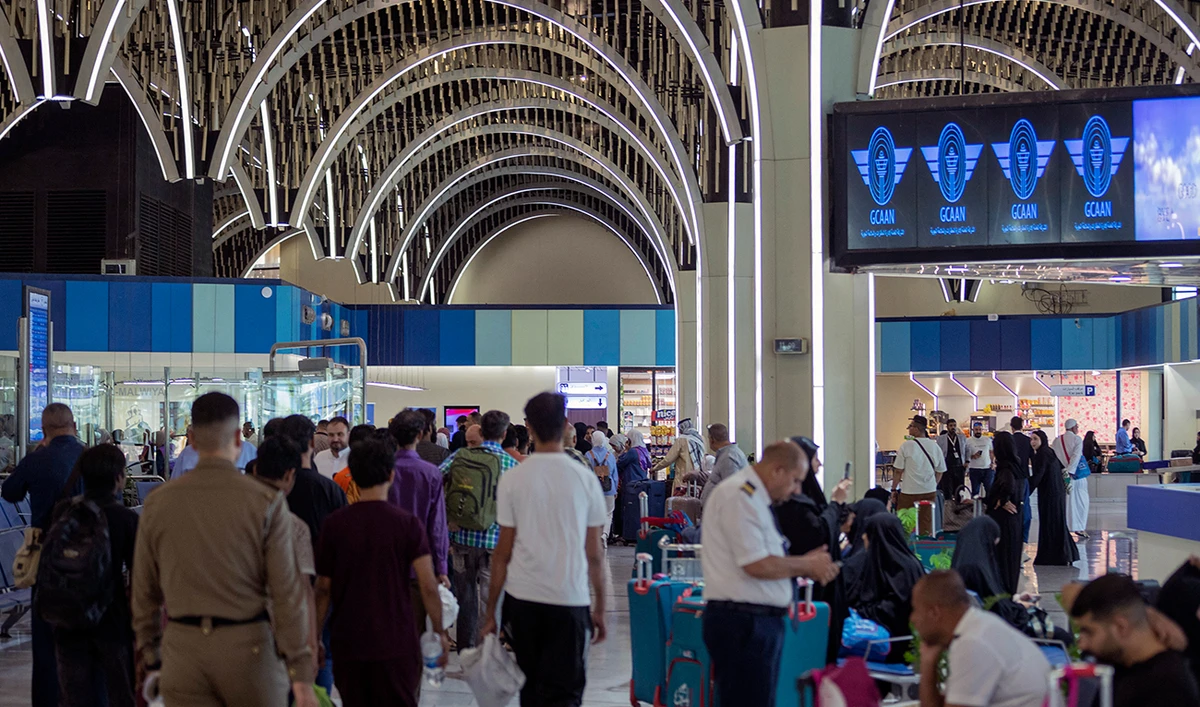
KARACHI: A second batch of around 300 Pakistani pilgrims, who were stranded in Baghdad due to unavailability of Iraq Airways flights, returned to the southern Pakistani city of Karachi on Saturday evening, authorities said, hours after a group of over 350 pilgrims returned home.
Most of these stranded Pakistanis had traveled to Iraq to participate in the Arbaeen pilgrimage, which marks the 40th day of mourning for the martyrdom of Imam Hussain, the grandson of Prophet Muhammad (PBUH), who, along with most of his family, was martyred in Karbala in 680 CE.
Of these pilgrims, 358 reached the southern port city of Karachi Saturday morning via Iraq Airways flight IA-2431, according to the Pakistani religious affairs ministry. Another flight, IA-1431, left Baghdad for Karachi on Saturday afternoon, with over 300 passengers.
“Flight carrying pilgrims from Iraq to Karachi landed at 5:20pm, with 306 passengers on board,” Saif Ullah, a spokesperson for the Pakistan Civil Aviation Authority (PCAA), told Arab News.
On Friday, Pakistan’s foreign office said 654 Pakistanis were stranded at the Baghdad airport because of technical fault with two aircraft of Iraq Airways.
“The Ministry of Foreign Affairs, Ministry of Aviation and Pakistan’s Embassy in Iraq are in contact with Iraqi authorities and Iraq Airways for early repatriation of the stranded Pakistanis,” it said in a statement.
In a separate statement, Pakistan’s Ambassador Muhammad Zeeshan Ahmed denied media reports that over 50 Pakistani nationals had lost their passports due to the mishandling of the immigration authorities.
“The news about missing passports is incorrect,” he was quoted in the statement circulated by the religious affairs ministry. “The entire situation arose due to the mismanagement of the tourism companies.”
Another batch of around 300 Pakistani pilgrims stranded in Baghdad returns home
https://arab.news/wwnxv
Another batch of around 300 Pakistani pilgrims stranded in Baghdad returns home
- Nearly 650 Pakistanis who traveled to Iraq to visit religious shrines were stranded due to unavailability of flights
- Pakistani authorities say the embassy provided them meals and made arrangements for their temporary stay in Baghdad
Pakistan to launch last 2025 anti-polio nationwide drive targeting 45 million children next week
- Over 400,000 frontline health workers will participate in Dec. 15-21 nationwide polio vaccination campaign, say authorities
- Pakistan is one of only two countries in the world, the other being Afghanistan, where wild poliovirus remains endemic
KARACHI: Pakistan will kick off the last nationwide anti-polio vaccination campaign of 2025 targeting 45 million children next week, the National Emergencies Operation Center (NEOC) said on Monday, urging parents to coordinate with health workers during the drive.
The campaign takes place days after Pakistan launched a nationwide vaccination drive from Nov. 17-29 against measles, rubella and polio. Pakistan said it had targeted 22.9 million children across 89 high-risk districts in the country with oral polio vaccination drops during the drive.
Over 400,000 health workers will perform their duties during the upcoming Dec. 15-21 nationwide polio vaccination campaign, the NEOC said in a statement.
“Parents are urged to cooperate with polio workers and ensure their children are vaccinated,” the NEOC said. “Complete the routine immunization schedule for all children up to 15 months of age on time.”
Health authorities aim to vaccinate 23 million children in Punjab, 10.6 million in Sindh, over 7.2 million in Khyber Pakhtunkhwa, over 2.6 million in Balochistan, more than 460,000 in Islamabad, over 228,000 in Gilgit-Baltistan and more than 760,000 children in Pakistan-administered Kashmir during the seven-day campaign, it added.
Pakistan is one of only two countries in the world where wild poliovirus remains endemic.
Polio is a highly infectious and incurable disease that can cause lifelong paralysis. The only effective protection is through repeated doses of the Oral Polio Vaccine for every child under five during each campaign, alongside timely completion of all routine immunizations.
Islamabad’s efforts to eliminate poliovirus have been hampered by parental refusals, widespread misinformation and repeated attacks on anti-polio workers by militant groups. In remote and volatile areas, vaccination teams often operate under police protection, though security personnel themselves have also been targeted and killed in attacks.