

DUBAI, United Arab Emirates: Yemen’s Houthi rebels released footage on Thursday showing their fighters boarded and placed explosives on a Greek-flagged tanker, setting off blasts that put the Red Sea at risk of a major oil spill. The vessel was abandoned earlier, after the Houthis repeatedly attacked it.
In the video, the Iran-backed Houthis chant their motto as the bombs detonated aboard the oil tanker Sounion: “God is the greatest; death to America; death to Israel; curse the Jews; victory to Islam.”
The blasts capped the most-serious attack in weeks by the Houthis in their campaign disrupting the $1 trillion in goods that pass through the Red Sea each year over the Israel-Hamas war in the Gaza Strip, as well as halting some aid shipments to conflict-ravaged Sudan and Yemen.

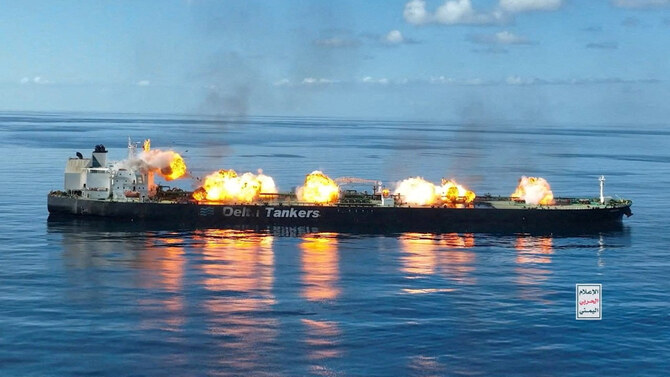
Flames and smoke rise from Greek-flagged oil tanker Sounion on the Red Sea, in this handout picture released August 29, 2024. (Houthi Military Media/Handout via REUTERS)
The Sounion carried some 1 million barrels of oil when the Houthis initially attacked it on Aug. 21 with small arms fire, projectiles and a drone boat. A French destroyer operating as part of the European Union’s Operation Aspides rescued the Sounion’s crew of 25 Filipinos and Russians, as well as four private security personnel, after they abandoned the vessel and took them to nearby Djibouti.
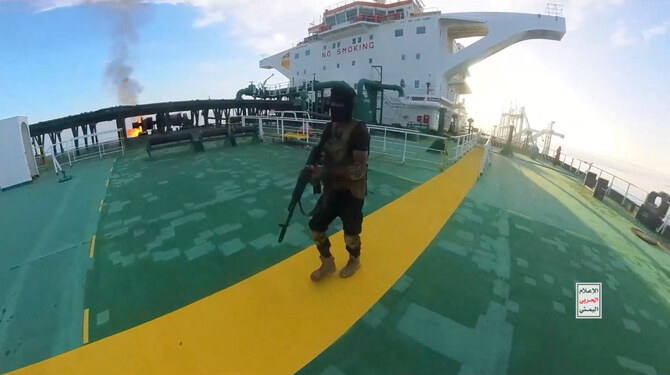
The footage released Thursday shows masked Houthi fighters carrying Kalashnikov-style rifles boarding the Sounion after it was abandoned. The bridge appeared ransacked. Fighters then rigged explosives over hatches on its deck leading to the oil tankers below. At least six simultaneous blasts could be seen in the footage.
The footage, as well as comments by the Houthi’s mysterious leader Abdul Malik Al-Houthi, confirmed an earlier analysis by The Associated Press that the Houthis boarded and planted explosives on the Sounion. The Houthi-controlled SABA news agency described Al-Houthi as saying the Sounion attack shows America “is lying in its claims regarding any deterrence of Yemeni operations supporting Palestine.”
“The effectiveness of our operations and their control of the situation is acknowledged by the enemies,” Al-Houthi said.
Western countries and the United Nations have warned any oil spill from the Sounion could devastate the coral reefs and wildlife around the Red Sea. However, the EU’s naval force in the region says it has yet to see any oil spill from the Sounion.
Operation Aspides “is preparing to facilitate any courses of action, in coordination with European authorities and neighboring countries, to avert a catastrophic environmental crisis,” the EU mission said. “Together, we can protect the environment and maintain stability in the region.”
UN spokesman Stephane Dujarric commended the efforts by the international community and the UN special envoy for Yemen, Hans Grundberg, “to secure the immediate access to the vessel and avert an environmental catastrophe.” The Houthis have agreed to allow the operation to proceed safely, he said.

A Yemen Houthi militant walks on the deck of the Sounion oil tanker on the Red Sea, in this screen grab picture released on August 29, 2024. (Houthi Military Media/Handout via REUTERS)
Dujarric did not offer any indication when it might start but added that the reports that “the salvage operations for the tanker can proceed with tugboats and rescue ships to access the incident area” are encouraging.
On Wednesday, the Houthis suggested they may allow the Sounion to be salvaged, though the rebels already once blocked crews trying to reach the abandoned vessel, the US military said.
The US State Department declined to directly comment on the video Thursday. It referred to earlier remarks in which spokesperson Matthew Miller warned “the Houthis’ continued attacks threaten to spill a million barrels of oil into the Red Sea, an amount four times the size of the Exxon Valdez disaster” in 1989 off Alaska.
This isn’t the first time the Houthis have used the threat of an oil spill to their advantage. It took years of negotiations before the rebels allowed the UN in 2023 to remove 1 million barrels from the oil tanker Safer off the coast of Yemen, which had been used as a floating storage and offloading facility.
“Experience has shown that the group is willing to interfere with salvage efforts if they can turn the situation into a political bargaining chip,” warned Noam Raydan, a senior fellow at the Washington Institute for Near-East Policy who has studied the ongoing Houthi attacks.
The Houthis have targeted more than 80 vessels with missiles and drones since the war in Gaza started in October. They seized one vessel and sank two in the campaign that also killed four sailors. Other missiles and drones have either been intercepted by a US-led coalition in the Red Sea or failed to reach their targets.
The rebels maintain that they target ships linked to Israel, the US or the UK to force an end to Israel’s campaign against Hamas in Gaza. However, many of the ships attacked have little or no connection to the conflict, including some bound for Iran.
Meanwhile Thursday, the US military’s Central Command said its forces destroyed a Houthi missile system and drone.