

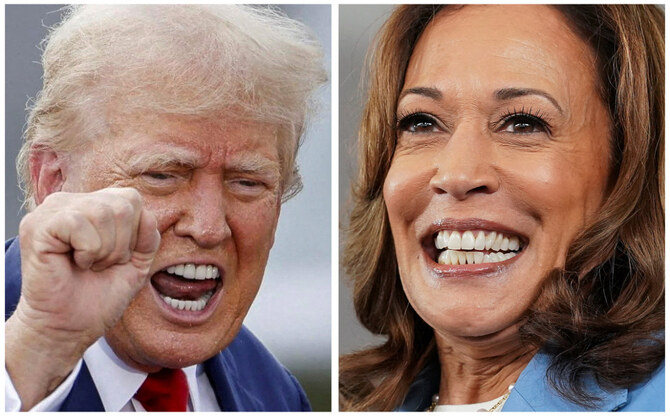

WASHINGTON: Democrat Kamala Harris leads Republican Donald Trump 45 percent to 41 percent in a Reuters/Ipsos poll published on Thursday that showed the vice president sparking new enthusiasm among voters and shaking up the race ahead of the Nov. 5 election.
The 4 percentage point advantage among registered voters was wider than a 1 point lead Harris held over the former president in a late July Reuters/Ipsos poll. The new poll, which was conducted in the eight days ended Wednesday and had a 2 percentage point margin of error, showed Harris picking up support among women and Hispanics.
Harris led Trump by 49 percent to 36 percent — or 13 percentage points — among both women voters and Hispanic voters. Across four Reuters/Ipsos polls conducted in July, Harris had a 9 point lead among women and a 6 point lead among Hispanics.
Trump led among white voters and men, both by similar margins as in July, though his lead among voters without a college degree narrowed to 7 points in the latest survey, down from 14 points in July.
The findings illustrate how the US presidential race has been shaken up over the summer. President Joe Biden, 81, folded his flailing campaign on July 21 after a disastrous debate performance against Trump sparked widespread calls from his fellow Democrats to abandon his re-election bid.
Since then, Harris has gained ground against Trump in national polls and those in critical swing states. While national surveys including Reuters/Ipsos’ give important signals on the views of the electorate, the state-by-state results of the Electoral College determine the winner, with a handful of battleground states likely to be decisive.

Survey screen grab courtesy of IPSOS
In the seven states where the 2020 election was closest — Wisconsin, Pennsylvania, Georgia, Arizona, North Carolina, Michigan and Nevada — Trump had a 45 percent to 43 percent lead over Harris among registered voters in the poll.
A separate Bloomberg News/Morning Consult poll published later on Thursday showed that Harris was either leading or tied with Trump in each of those states.
That poll showed Harris led Trump by 2 percentage points among registered voters across the seven states and was ahead by 1 point — a statistical tie — among likely voters. The margin of error was 1 percentage point across the seven states.
“It’s obvious that running against Harris is more challenging for Trump given the shift in these numbers, but it’s certainly not insurmountable,” Matt Wolking, a Republican campaign strategist who worked on Trump’s 2020 campaign, said in response to the Reuters/Ipsos poll results.
He said Trump needs to stay as focused as possible in his campaign “so he’s not scaring” away voters who were leaning his way because they didn’t like Biden.
Since formally accepting the Democratic nomination last week, Harris has embarked on a tour of battleground states including Georgia, where Biden had been hemorrhaging support before he ended his campaign.
Rising enthusiasm
Some 73 percent of Democratic registered voters in the Reuters/Ipsos poll said they were more excited about voting in November after Harris entered the race. And while a March Reuters/Ipsos poll found that 61 percent respondents who intended to vote for Biden were doing so mainly to stop Trump, 52 percent of Harris voters in the August poll were voting to support her as a candidate rather than primarily to oppose Trump.
“We see it in this poll that people are more motivated about the future than the past,” said Aimee Allison, founder of She the People, a liberal group that aims to grow the numbers of women of color in elected office. “They see Kamala Harris as the future, and Republicans see this election as just about Trump. Voters are more likely to be engaged when given the option of ‘more than’ beating Trump.”
But Trump voters also voiced enthusiasm about their candidate, with 64 percent saying their choice was more motivated by backing Trump than opposing Harris.
Voters picked Trump as having a better approach to managing the US economy, 45 percent to 36 percent, a wider margin than Trump had in another Reuters/Ipsos poll this week.
Harris, by contrast, had a 47 percent to 31 percent advantage on abortion policy. The issue is salient for Democrats after the conservative US Supreme Court in 2022 struck down women’s national right to abortion. Trump nominated three conservative justices to the court during his 2017-2021 presidency. Some 41 percent of voters in the poll — and 70 percent of Democrats — said they were worried the next president might sign a national ban on abortions.
The latest poll’s survey period partially overlapped with the Aug. 19-22 Democratic National Convention in Chicago where Harris formally accepted her party’s nomination, and it remains to be seen whether the same level of enthusiasm for Harris will continue.
The poll was conducted nationally and gathered responses from 4,253 US adults, including 3,562 registered voters.
Independent candidate Robert F. Kennedy Jr., who suspended his campaign on Aug. 23 while the poll was still being conducted, had the support of 6 percent of voters in the survey.


