LONDON: Days after gunmen killed 145 concert-goers at a venue near Moscow in March, as allegations emerged that the assailants had been recruited on Telegram, the Kremlin issued a stern warning to its founder.
“We would expect more attention from Pavel Durov, because this unique and phenomenal resource ... is increasingly becoming a tool in the hands of terrorists,” Kremlin spokesman Dmitry Peskov said.
Five months later, as French prosecutors pursue an investigation into Telegram founder and boss Durov over the use of the messaging app for fraud, drug trafficking, money laundering and other forms of organized crime, Moscow has changed its public stance on the tech entrepreneur.
With some Russians now hailing Durov as a hero of free speech, Peskov said on Thursday that the case against him should “not turn into political persecution.”
Briefing reporters, he added: “We know that the president of France (Emmanuel Macron) has denied any connection with politics, but on the other hand, certain accusations are being made. We will see what happens next.”
Some Russian lawmakers have alleged, without providing evidence, that the case against Durov has been orchestrated by Washington. A source at the Paris prosecutor’s office said the probe had no connection to the United States and Macron had been given no prior warning of the arrest.
“Pavel Durov remains a hostage of the ‘dictatorship of democracy’ of the collective West,” Leonid Slutsky, the leader of a pro-Kremlin parliamentary party, wrote on Telegram.
The furor has provided Russia with an opportunity to pursue a favored line of attack: that the West, while claiming to uphold values such as free speech, is really driven by a vengeful desire to undermine Russia.
Ksenia Ermoshina, a researcher at Citizen Lab at the University of Toronto and the Center for Internet and Society at French institute CNRS, said Russia’s strong reaction also reflects security concerns because of the widespread use of Telegram in military communications.
“Telegram has become a tool for Russian defense to communicate internally,” she said.
“If Durov is accused by the French government and he is in the hands of French justice, they are afraid that he might give access to his servers and, because there is no internal encryption by default in Telegram, this will enable potential access to sensitive information from the Russian army.”
A lawyer for Durov said on Thursday it was “absurd” to suggest the head of a social network was responsible for any criminal acts committed on the platform. Telegram has said it abides by European Union laws.
Durov, 39, has not always been able to count on vocal defenders in Russia, where his troubled relationship with the authorities goes back more than a decade.
His first big tech venture — a Russian version of Facebook called VKontakte (VK) — permitted forums for opposition activists to organize protests against President Vladimir Putin, and Durov refused to comply with demands to shut down late opposition figure Alexei Navalny’s anti-corruption blog.
In 2013, Russia’s FSB security service requested the VK data of Ukrainians protesting against the pro-Russian president who was then in power in Kyiv.
“I refused to comply with these demands, because it would have meant a betrayal of our Ukrainian users,” Durov said in March 2022. “After that, I was fired from the company I founded and was forced to leave Russia.”
Durov launched Telegram, now used by almost 1 billion people, in 2013. Before long, Russia came after that platform, too.
The FSB said militants had used Telegram to carry out a suicide bombing on the St. Petersburg metro in 2017, and state communications regulator Roskomnadzor demanded that Durov “hand over the keys” to information on the app.
Durov said those demands violated Russians’ constitutional right to keep their correspondence secret.
For two years from May 2018, Roskomnadzor sought to block Telegram, efforts that were thwarted by rotating proxy servers, hiding traffic and other anti-censorship tools.
Since then, the platform has continued to grow in popularity, becoming an indispensable tool for everyone from dissidents to bloggers on the war in Ukraine.
On the streets of Moscow on Thursday, people interviewed by Reuters said they were following the case of Durov, who has French as well as Russian citizenship.
Irina, a middle-aged woman who declined to give her last name, alluded to the fact that the businessman had been invited in the past to dine with Macron.
“Of course, this is alarming, this is a very unpleasant thing,” she said of Durov’s arrest. “If this is such a set-up on the part of the head of France, Macron, then this is beyond the pale.”
Mark, a young man in a white hoodie, said the case was easily explained.
“This is politics. They’ve arrested a Russian billionaire in France. Why not? It’s beneficial for them, it’s a blow to Russia.”


![]()

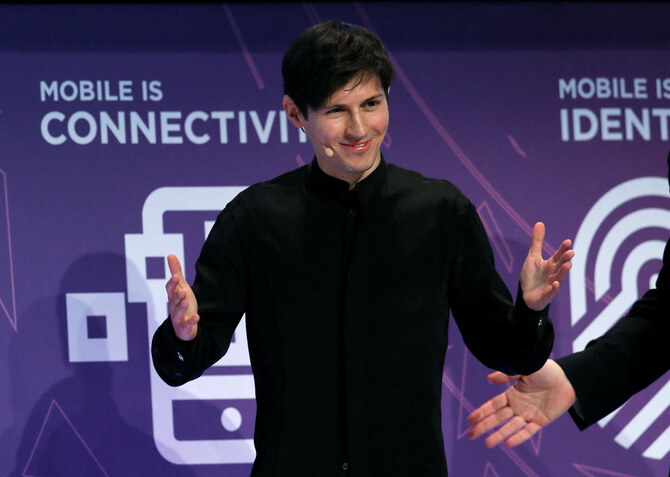
After years of pressure on Durov, Russia suddenly rallies behind him
Short Url
https://arab.news/cyzkn
After years of pressure on Durov, Russia suddenly rallies behind him
- Furor has provided Russia with an opportunity to pursue a favored line: that the West, while claiming to uphold values such as free speech, is driven by a vengeful desire to undermine Russia
- First tech venture VKontakte (VK) permitted forums for opposition activists to organize protests against Putin, and Durov refused to comply with demands to shut down Alexei Navalny’s blog


Latest updates


© 2026 SAUDI RESEARCH & PUBLISHING COMPANY, All Rights Reserved And subject to Terms of Use Agreement.