CAIRO/GAZA: Palestinians in Gaza were waiting on Thursday to see if there would be a pause in fighting to allow a polio vaccination campaign to begin, as the conflict raged across the besieged enclave, killing at least 20 people.
The United Nations is preparing to vaccinate an estimated 640,000 children in Gaza, where the World Health Organization confirmed on Aug. 23 that at least one baby has been paralyzed by the type 2 poliovirus, the first such case in the territory in 25 years.
The UN, which called for a humanitarian truce earlier this month, hopes to begin the vaccination campaign on Sept. 1, said Juliette Touma, communications director of UNRWA, the UN Palestinian refugee agency.
The World Health Organization named the baby as Abdul-Rahman Abu Al-Jidyan. He will turn one year old on Sept. 1.
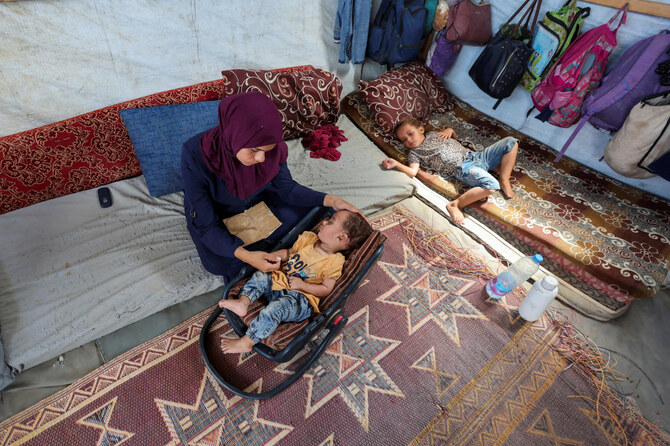
His mother Nivin Abu Al-Jidyan said she feared for her son after she was told by health officials they could do little to help him.
“I was shocked that my son got this disease amid the war and the closure of border crossings, under these conditions and lack of medicine for him, it’s a shock. Would he remain like this?” Abu Al-Jidyan said on Thursday.
“He is my only baby boy. It’s his right to travel and be treated; it’s his right to walk, run and move like before...It is unfair that he stays thrown in the tent without care or attention,” she said from a tent in Deir Al-Balah in the central Gaza Strip.
At Nasser Hospital, in the southern city of Khan Younis, Umm Eliane Baker fears her 19-month-old daughter may be vulnerable to polio due to ill health brought on by malnutrition.
She hopes her baby will be vaccinated soon, but said she is worried about moving safely in an area where there have been repeated Israeli strikes.
“I cannot walk in the street and get bombed, or have something happen to my daughter, or have a targeted (attack). I need a truce, a ceasefire so I can give my daughter this injection (vaccine),” she said.
Israeli Prime Minister Benjamin Netanyahu this week denied media reports Israel was preparing for a generalized humanitarian truce, saying that a more limited plan had been presented.
“These are not pauses in the fighting to administer polio vaccines but only the allocation of certain places in the Gaza Strip,” he said in a statement.
Senior Hamas official Izzat El-Reshiq reiterated the group’s support for the UN and international organizations’ initiative for an urgent humanitarian truce across the enclave to allow the polio vaccination campaign.
He described Netanyahu’s statement as an attempt to thwart the process by refusing the UN call.
FAMILY ‘CONSUMED’ BY FIRE
On Thursday, Israeli forces continued to bombard areas across the Gaza Strip in their battle against Hamas-led militants. Palestinian health officials said Israeli military strikes have so far killed at least 20 people.
One strike on a house in Gaza City killed eight Palestinians, including children, they said, while three others were killed when an Israeli missile hit a motorcycle in Rafah, near the border with Egypt.
A neighbor of the bombed Gaza City house said they had managed to lower a ladder into the building to rescue a family trapped inside, but had only managed to extract one young girl.
“After that, the fire consumed them and we could not reach them,” he said.
The latest bloodshed in the decades-old Israeli-Palestinian conflict was triggered on Oct. 7 when Palestinian Islamist group Hamas attacked Israel, killing 1,200 and taking about 250 hostages, according to Israeli tallies.
Israel’s subsequent assault on the enclave has killed over 40,000 Palestinians, according to the local health ministry, while also displacing nearly the entire population of 2.3 million, causing a hunger crisis and leading to genocide allegations at the World Court that Israel denies.


![]()

Fighting rages in Gaza as Palestinians hope for a pause for polio vaccinations
Short Url
https://arab.news/mvp4h
Fighting rages in Gaza as Palestinians hope for a pause for polio vaccinations
- UN hopes to vaccinate 640,000 children in Gaza starting September 1
- Benjamin Netanyahu denies Israel plans for general humanitarian truce


Latest updates


© 2026 SAUDI RESEARCH & PUBLISHING COMPANY, All Rights Reserved And subject to Terms of Use Agreement.