

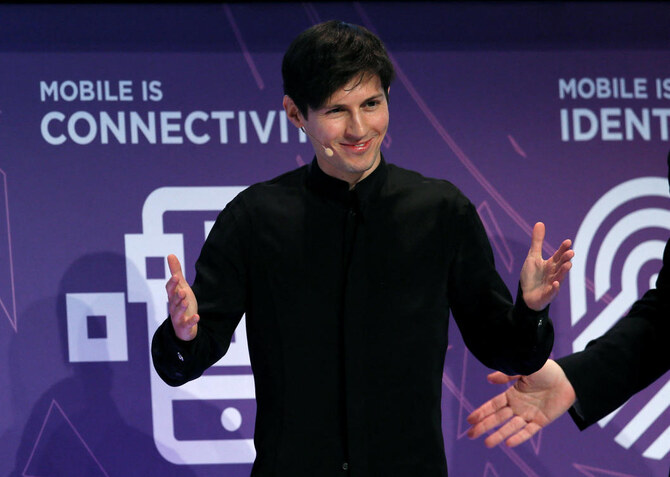

PARIS: French prosecutors on Wednesday freed Telegram CEO Pavel Durov from police custody after four days of questioning over allegations that the messaging app is being used for illegal activities.
Durov was detained on Saturday at Le Bourget airport outside Paris as part of a judicial inquiry opened last month involving 12 alleged criminal violations.
“An investigating judge has ended Pavel Durov’s police custody and will have him brought to court for a first appearance and a possible indictment,” a statement from the Paris prosecutor’s office said.
Allegations against the Russia-born Durov, who is a French citizen, include that his platform is being used for child sexual abuse material and drug trafficking, fraud and abetting organized crime transactions, and that Telegram refused to share information or documents with investigators when required by law.
Durov’s arrest in France has caused outrage in Russia, with some government officials calling it politically motivated and proof of the West’s double standard on freedom of speech. The outcry has raised eyebrows among Kremlin critics because in 2018, Russian authorities themselves tried to block the Telegram app but failed, withdrawing the ban in 2020.
In Iran, where Telegram is widely used despite being officially banned after years of protests challenging the country’s Shiite theocracy, Durov’s arrest in France prompted comments from the Islamic Republic’s supreme leader. Ayatollah Ali Khamenei weighed in with veiled praise for France for being “strict” against those who “violate your governance” of the Internet.
French President Emmanuel Macron said Monday that Durov’s arrest wasn’t a political move but part of an independent investigation. Macron posted on X that his country “is deeply committed” to freedom of expression but “freedoms are upheld within a legal framework, both on social media and in real life, to protect citizens and respect their fundamental rights.”
In a statement posted on its platform after Durov’s arrest, Telegram said it abides by EU laws, and its moderation is “within industry standards and constantly improving.”
“It is absurd to claim that a platform or its owner are responsible for abuse of that platform,” Telegram’s post said. “Almost a billion users globally use Telegram as means of communication and as a source of vital information. We’re awaiting a prompt resolution of this situation. Telegram is with you all.”
In addition to Russia and France, Durov is also a citizen of the United Arab Emirates and the Caribbean island nation of St. Kitts and Nevis.
The UAE Foreign Ministry said Tuesday that it was “closely following the case” and had asked France to provide Durov “with all the necessary consular services in an urgent manner.”
Kremlin spokesman Dmitry Peskov said he hoped that Durov “has all the necessary opportunities for his legal defense” and added that Moscow stands “ready to provide all necessary assistance and support” to the Telegram CEO as a Russian citizen.
“But the situation is complicated by the fact that he is also a citizen of France,” Peskov said.
Telegram, which says it has nearly a billion users worldwide, was founded by Durov and his brother after he himself faced pressure from Russian authorities.
In 2013, he sold his stake in VKontakte, a popular Russian social networking site which he launched in 2006.
The company came under pressure during the Russian government’s crackdown following mass pro-democracy protests that rocked Moscow at the end of 2011 and 2012.
Durov had said authorities demanded that the site take down online communities of Russian opposition activists, and later that it hand over personal data of users who took part in the 2013-2014 popular uprising in Ukraine, which eventually ousted a pro-Kremlin president.
Durov said in a recent interview that he had turned down these demands and left the country.
The demonstrations prompted Russian authorities to clamp down on the digital space, and Telegram and its pro-privacy rhetoric offered a convenient way for Russians to communicate and share news.
Telegram also continues to be a popular source of news in Ukraine, where both media outlets and officials use it to share information on the war, and deliver missile and air raid alerts.
Western governments have often criticized Telegram for a lack of content moderation, which experts say opens up the messaging app for potential use in money laundering, drug trafficking and the sharing of material linked to the sexual exploitation of minors.
In 2022, Germany issued fines of $5 million against Telegram’s operators for failing to establish a lawful way to reporting illegal content or to name an entity in Germany to receive official communication. Both are required under German laws that regulate large online platforms.


