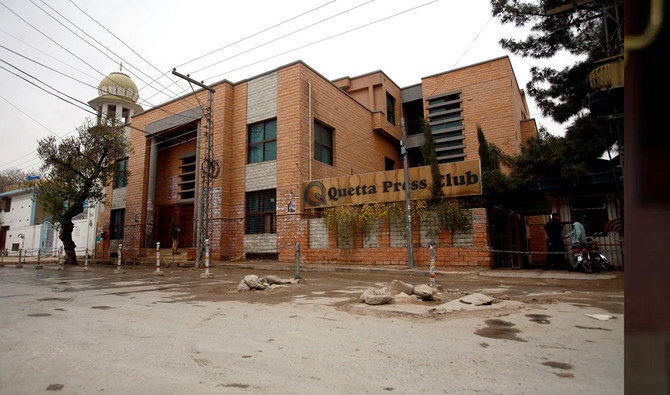
QUETTA: Journalist bodies in Pakistan’s southwestern Balochistan province on Wednesday criticized a decision by authorities to restrict the Quetta Press Club from holding “long-form events and seminars” without the government’s permission, amid a deteriorating law-and-order situation in the restive province.
The decision was announced by the Quetta deputy commissioner days after deadly assaults by an ethnic Baloch separatist group, the Baloch Liberation Army (BLA), killed more than 50 people, including 19 security officials, in several districts across Balochistan.
Balochistan, which borders Iran and Afghanistan, has been the site of a low-level insurgency for the last two decades, with separatist militants intensifying attacks on Pakistanis from neighboring provinces working in the region as well as foreigners, including Chinese citizens, in recent years.
Journalist bodies strongly condemned the restriction on the Quetta Press Club, describing the directives as an attempt to “curb free speech and press freedom” in the province and demanding its immediate withdrawal.
“The law-and-order situation has not been created due to speeches and freedom of expression, but rather is a result of denial of rights, injustice in the society and authoritarian behavior of the establishment and crippled state machinery,” Afzal Butt, president of the Pakistan Federal Union of Journalists (PFUJ), said in a statement.
Similar statements were issued by the Karachi and Lahore press clubs, calling the decision a “blatant attack” on fundamental rights.
The Quetta Press Club and the Balochistan Union of Journalists (BUJ) have also summoned a joint meeting today, Thursday, to deliberate over the move. “The QPC and BUJ will sit together to decide a future plan,” Banaras Khan, the QPC secretary-general, told Arab News on Wednesday.
Quetta Deputy Commissioner Saad bin Asad told Arab News the decision does not apply to press conferences, and was only meant for “long-form events and seminars.”
“The decision was not made for press conferences, but we have put new restrictions on long-form events and seminars. This is a similar practice being implemented in other cities of Pakistan,” he said.
“Before holding any event or seminar in Quetta Press Club, Non-Government Organizations (NGOs) or political parties have to get government’s permission and we will review the content before allowing them.”
In May, authorities had also locked down the gate of the Quetta Press Club and stopped members of an ethnic Baloch rights organization, the Baloch Yakjehti Committee (BYC), from entering it after BYC leader Dr. Mahrang Baloch was invited to address a seminar there on human rights abuses in Balochistan.
Balochistan is also currently in the grips of civil rights protests by young ethnic Baloch who are calling for an end to what they describe as a pattern of enforced disappearances and other human rights abuses by security forces, who deny the charge.


![]()

Journalist bodies criticize restriction on Quetta Press Club from holding events without government permission
Short Url
https://arab.news/yv2v5
Journalist bodies criticize restriction on Quetta Press Club from holding events without government permission
- The decision came days after deadly attacks claimed by a Baloch separatist group killed over 50 people in Pakistan’s Balochistan
- Quetta deputy commissioner says decision doesn’t apply to pressers, only ‘long-form events and seminars’ have been restricted
Latest updates




Recommended


© 2026 SAUDI RESEARCH & PUBLISHING COMPANY, All Rights Reserved And subject to Terms of Use Agreement.