Drying lakes and thirsty trees: In drought-hit Greece, water trucks are keeping crops alive

1 / 3
Haroula Psaropoulou, checks her dried flowers in the village of Nea Potidea, at Halkidiki peninsula, northern Greece, Aug. 19, 2024.(AP)
2 / 3
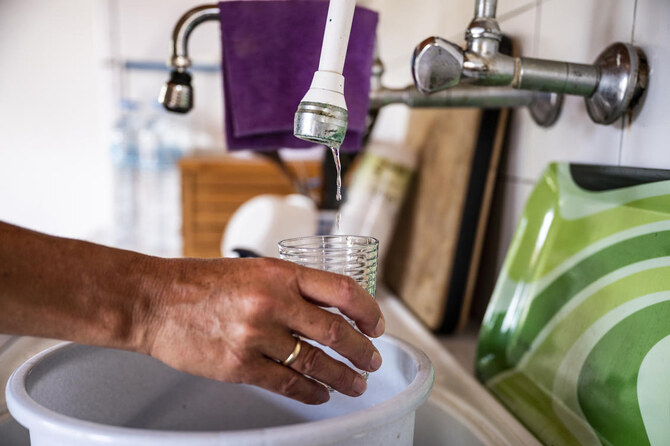
Haroula Psaropoulou, tries to fill a glass with water that drip from a faucet, in the village of Nea Potidea, at Halkidiki peninsula, northern Greece, Aug. 19, 2024. (AP)
3 / 3
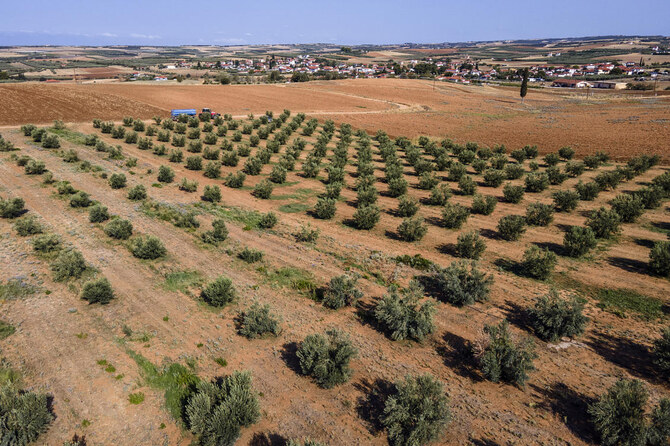
The olive grove of Dimitris Papadakis is seen from above in the village of Nea Silata at Halkidiki peninsula, northern Greece, Aug. 19, 2024. (AP)
Short Url
Updated 28 August 2024
Follow

Drying lakes and thirsty trees: In drought-hit Greece, water trucks are keeping crops alive

  • Southern Europe has been hammered by successive heat wave
  • The water crisis has been exacerbated by a booming tourist season

NEA SILATA: Six weeks before harvest, there’s no water left in the ground for farmer Dimitris Papadakis’ olive grove in northern Greece, so he has started a new morning routine.
Joined by his teenage son, he uses a truck to bring water from nearby areas. Using a small generator, he connects the vehicle to irrigation pipes to save what’s left of his thirsty crop.
“Our boreholes have almost dried up ... We now depend on tankers to irrigate our fields,” says Papadakis, who heads an agricultural cooperative in a village in Halkidiki, a three-fingered peninsula in northern Greece which is popular with tourists.
This summer, southern Europe has been hammered by successive heat waves, following on from below-average rainfall for up to three years. Drought spots on the map of the region have expanded. In Greece, the effects include water shortages, dried-up lakes, and even the death of wild horses.
The groundwater beneath Papadakis’ 270 olive trees is dwindling and becoming brackish, with the drought expected to cut his expected yield in half.
The water crisis has been exacerbated by a booming tourist season.
In Kassandra, the westernmost finger of the peninsula, the year-round population of 17,000 swells to 650,000 in the summer, placing unsustainable pressure on water resources.
“We’ve seen a 30-40 percent reduction in water supply following three consecutive winters with almost no rainfall,” says local mayor Anastasia Halkia.
Haroula Psaropoulou owns a home in the area, in the seaside village of Nea Potidea. She says it’s hard to cope with frequent household water cuts that may last up to five days during the searing heat.
“I recycle water from the bathroom sink and from washing, and I use it for the plants,” the 60-year-old Psaropoulou says. “I’ve also carried water from the sea for the toilet.”
According to the European Union’s Emergency Management Service, acute drought conditions currently exist around the Black Sea, stretching westward into northern Greece.
Along the Evros River, which divides Greece and Turkiye, severe drought means the delta now has higher levels of seawater. The extra salt is killing the wild horses that depend on the river for drinking water.
“If the horses go without water for a week, they die,” says Nikos Mousounakis, who is leading an initiative to create freshwater drinking points for the horses. “Some of them are still in bad shape, but we hope that with continued help, they’ll recover.”
Until recently, Lake Picrolimni in northern Greece was a popular destination for mud baths, but this summer it’s a shallow basin of cracked earth, dry enough to hold the weight of a car.
“It hasn’t rained for two years now, so the lake has totally dried up,” says local municipal chairman Costas Partsis. “It used to have a lot of water. People came and bathed in the muddy water. The clay has therapeutic properties for many ailments. No one came this year.”
Nearby, Lake Doirani straddles Greece’s northern border with North Macedonia. The shoreline has receded by 300 meters (yards) in recent years. Local officials are pleading for public works to restore the river’s water supply, echoing calls from experts who argue that major changes in water management are needed to mitigate the damaging effects of climate change.
“We’re experiencing a prolonged period of drought lasting about three years now, due to lower rainfall and snowfall, a result of the climate crisis and poor water management,” says Konstantinos S. Voudouris, a professor of hydrogeology at the University of Thessaloniki. “The solution lies in three key words: conservation, storage, and reuse.”
Voudouris argues that outdated water networks are losing too much water and that infrastructure improvements must focus on collecting and storing rainwater during the wet season, as well as reusing treated wastewater for agriculture.
“These drought phenomena will return with greater intensity in the future,” Voudouris said. “We need to take action and plan ahead to minimize their impact… and we must adapt to this new reality.”


Former Bolivian President Arce arrested in corruption investigation a month after leaving office

Updated 7 sec ago
Follow

Former Bolivian President Arce arrested in corruption investigation a month after leaving office

LA PAZ: Bolivian law enforcement officials on Wednesday arrested former President Luis Arce as part of a corruption investigation, opening an uncertain chapter in the country’s politics a month after the inauguration of conservative President Rodrigo Paz ended 20 years of socialist rule.
A senior official in Paz’s government, Marco Antonio Oviedo, told reporters that Arce had been arrested on charges of breach of duty and financial misconduct related to the alleged embezzlement of public funds during his stint as economy minister in the government of charismatic former leader Evo Morales (2006-2019).
A special police force dedicated to fighting corruption confirmed to The Associated Press that Arce was in custody at the unit’s headquarters in Bolivia’s capital of La Paz.
Officials described Arce’s arrest as proof of the new government’s commitment to fighting graft at the highest levels in fulfillment of its flagship campaign promise.
“It is the decision of this government to fight corruption, and we will arrest all those responsible for this massive embezzlement,” Oviedo said.
But underlining the country’s polarization, Arce’s allies said his arrest was unjustified and smacked of political persecution.
Accusations of theft from a fund for rural peasants
Authorities accused Arce and other officials of diverting an estimated $700 million from a state-run fund dedicated to supporting the Indigenous people and peasant farmers who formed the backbone of Morales’ Movement Toward Socialism party. As Bolivia’s first Indigenous president, Morales transformed the country’s power structure and gave Indigenous peoplemore sway than ever.
Serving on the board of directors of the Indigenous Peasant Development Fund from 2006 to 2017, Arce was in charge of allocating funds to social development projects in rural areas. During that time, officials allege, Arce siphoned off some of that money for personal expenses.
“Arce was identified as the main person responsible for this vast economic damage,” said Oviedo.
Bolivia’s attorney general, Roger Mariaca, told local media that Arce had invoked his right to remain silent during police questioning.
He said Arce would remain in police custody overnight before being brought before a judge to determine whether he will remain detained pending trial. The charges against Arce carry a maximum sentence of 4-6 years in prison.
An ex-president allegedly grabbed from the street
Arce’s key ally and former government minister, Maria Nela Prada, insisted on the ex-president’s innocence and denounced the corruption scandal as a case of political persecution.
Although the prosecution said it issued an arrest warrant, she said Arce was not notified of the case before he was bundled into a minivan with tinted windows in an upscale La Paz neighborhood on Wednesday and brought in for interrogation.
Arce had been walking along the cafe-lined streets of Sopocachi after teaching an economics class at a major public university, Prada said, and managed to tell her of his arrest before losing communication. A police spokesperson did not immediately respond to a request for comment on that account of events.
“This is a total abuse of power,” Prada said, banging furiously on the doors of the police headquarters where Arce was being held.
Mariaca, the prosecutor, promised the case was about nothing more than tackling graft in Bolivia.
“This is not persecution, nor is it a political act,” he said.
Paz swept to victory in October elections on a wave of public outrage over the unmitigated shambles that Arce’s administration bequeathed its successors, including sky-high inflation, a shortage of fuel and empty state coffers.
Critical to his popularity was his running mate, the straight-talking, TikTok-savvy former police Capt. Edman Lara, who achieved celebrity status when he denounced high-ranking police officers for corruption.
Courts not neutral arbiters
Experts long have noted that Bolivia’s brittle institutional framework fosters corruption, and that its politicized judiciary often lets those in power off the hook — whether on the left or right of the political spectrum.
Morales, who guided the country through an era of economic growth and shrinking inequality before his fraught 2019 ouster, was accused of stacking the constitutional court and bending the laws to stay in power.
When he resigned in the wake of mass protests over his disputed reelection to a fourth term, the right-wing interim government that took over issued arrest warrants for Morales and his officials on charges ranging from terrorism to corruption.
Then Arce won the 2020 elections and went on to target his own political rivals.
Former interim president Jeanine Añez was sentenced to 10 years in prison on charges tied to her 2019 takeover and other right-wing opposition leaders landed in jail. Judges even went after Morales, Arce’s mentor-turned-rival, who remains hunkered down in Bolivia’s remote tropics evading an arrest warrant related to statutory rape.
Shifting political winds
With the pendulum now swinging back to the right, Añez and many of her allies have walked free from prison. President Paz has set to work undoing the leftist policies of Arce and Morales.
Celebrating Arce’s arrest on social media, Vice President Lara warned that the ex-president was just the first felled by what would become a wave of anti-corruption cases against former officials.
“Those who have stolen from this country will return every last cent,” Lara said, ending his message by wishing “death to the corrupt.”