BINMAR, Chad: When Milla Nemoudji, a 28-year-old from a village in southern Chad, divorced her husband following years of physical abuse, she found herself without means for survival. Though raised in a farming family, she struggled to get by in a community where access to land is customarily controlled by men.
With little support for women in her situation, divorce being relatively rare in Chad, she fought for economic independence. She sold fruits and other goods. During the rainy season, she plowed fields as a laborer. Last year, however, a women’s collective arrived in her village and she decided to join, finally gaining access to land and a say over its use. She farmed cotton, peanuts and sesame, making enough money to cover basic needs.
The village, Birman, is on the outskirts of Chad’s second-largest city, Moundou, in the densely populated Logone Occidental region. Thatched-roof homes stand amid fields where women traditionally harvest the land but, like Nemoudji, have little or no say over it.
In Chad, land access is often controlled by village chiefs who require annual payments. Women are often excluded from land ownership and inheritance, leaving them dependent on male relatives and reinforcing their secondary status in society.
The struggle for land rights is compounded by the dual legal system in Chad where customary law often supersedes statutory law, especially in rural areas. While recent legal reforms mean laws recognize the right of any citizen to own land, application of those laws is inconsistent.
For women like Nemoudji who seek to assert their rights, the response can be hostile.
“There’s no one to come to your aid, although everyone knows that you are suffering,” Nemoudji told The Associated Press, criticizing the traditional system of land rights and urging local leaders to take domestic violence seriously. “If women weren’t losing access to farmlands, they would dare to leave their husbands earlier.”
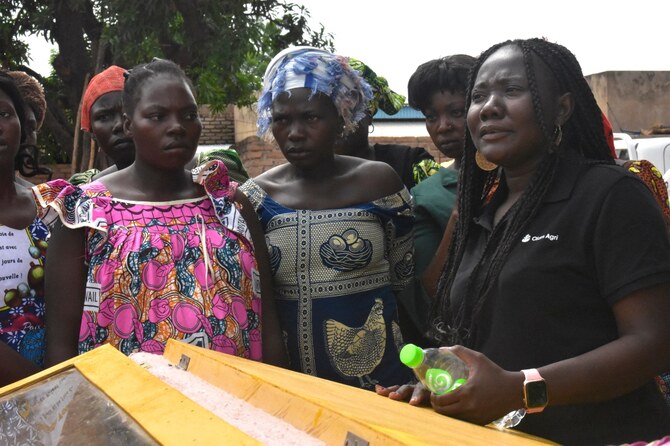
Initiatives like N-Bio Solutions, the collective Nemoudji joined, are challenging those norms. Founded by Adèle Noudjilembaye in 2018, an agriculturist and activist from a neighboring village, the collective is a rare initiative in Chad negotiating on behalf of women with traditional chiefs, who then seek out residents with available land willing to lease it.
So far, Noudjilembaye runs five such collectives with an average 25 members. Although these initiatives are slowly gaining popularity, they are limited by financial resources and some women’s hesitancy to risk the little they have.
Noudjilembaye told the AP that “despite the violence and neglect, many women stay (in situations) because of financial dependency, fear of societal judgment or lack of support.”
The efforts of such collectives have broader implications for both gender equality and sustainable agriculture in Chad. Women of Binmar have adopted sustainable farming practices including crop rotation, organic farming and the use of drought-resistant seeds, which help preserve the soil and increase productivity.
In general, women who gain access to land and resources are more likely to implement sustainable agricultural practices and improve local food systems, according to the United Nations.
But in Chad, life for women who attempt to assert their rights is especially challenging.
Chad is ranked 144th out of 146 countries, according to the 2024 Global Gender Gap Indicator Report compiled by World Economic Forum. , over three times the global average, according to the United Nations. Only 20 percent of young women are literate.
For Nemoudji, her family’s response to her plight was mostly passive. They offered her a place to stay and provided emotional support but did little to confront her abuser or seek justice on her behalf.
“The system failed me when I sought help after my husband burned down my house,” Nemoudji said. When she reported the incident to the village chief, “nothing was done to solve my dispute.”
Village chief Marie Djetoyom, a woman in the hereditary role, told the AP that she was afraid to take action and risk being imprisoned in retaliation. She asserted that she must act within the customary land laws.
Despite the lack of support from traditional leaders and local authorities, women in the village of around 120 people have found strength in the collective.
“As cultural practices do not favor access to land for many women individually, the community alternative remains the best possibility to achieve the objective,” said Innocent Bename, a researcher at CEREAD, a N’Djamena-based research center.
Marie Depaque, another village woman who struggled to get by after her second husband refused to financially support her children from her first marriage, added that “our fight for land rights is not just about economic survival but also about justice, equality and the hope for a better future.”
Nemoudji dreams of better educational opportunities for the children in her community so they can break the cycle of poverty and violence. She advocates in the community for changes in the land ownership system.
“Knowing my rights means I can seek help from authorities and demand justice,” she said.


![]()

Women in Chad defy discrimination and violence to assert their rights to own and control land
Short Url
https://arab.news/29tkq
Women in Chad defy discrimination and violence to assert their rights to own and control land
- The village, Birman, is on the outskirts of Chad’s second-largest city, Moundou
- The country’s maternal mortality rate is high at 1,063 deaths per 100,000 births in 2020


Latest updates


Recommended


© 2026 SAUDI RESEARCH & PUBLISHING COMPANY, All Rights Reserved And subject to Terms of Use Agreement.