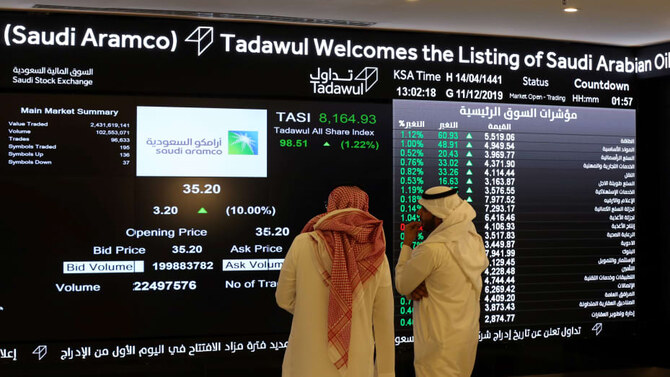

RIYADH: Saudi Arabia’s Tadawul All Share Index dipped on Tuesday, losing 78.98 points, or 0.64 percent, to close at 12,182.20.
The total trading turnover of the benchmark index was SR8.42 billion ($2.24 billion), as 79 stocks advanced, while 143 retreated.
The MSCI Tadawul Index decreased by 11.85 points, or 0.77 percent, to close at 1,524.59.
The Kingdom’s parallel market Nomu also dipped, losing 42.82 points, or 0.16 percent, to close at 26,391.09. This comes as 28 stocks advanced, while as many as 37 retreated.
The best-performing stock of the day was Red Sea International Co., with its share price surging 7.53 percent to SR41.40.
Other top performers included Allianz Saudi Fransi Cooperative Insurance Co. and Zamil Industrial Investment Co., with share prices rising by 5.54 percent to SR17.14 and 4.51 percent to SR26.65.
Najran Cement Co. and Savola Group also recorded positive trajectories today.
The worst performer was Al-Baha Investment and Development Co., with its share price falling by 7.69 percent to SR0.12.
Miahona Co. and Sustained Infrastructure Holding Co. also saw significant declines, with their shares dropping by 4.67 percent and 3.42 percent to SR31.65 and SR33.85, respectively.
On the announcement front, Saudi Networkers Services Co. announced its interim financial results for the first six months of this year.
The company’s net profit surged by 19.2 percent in this period, reaching SR19.7 million compared to SR16.5 million in the similar period for the previous year.
Its sales rose by 2 percent from SR276.4 million in the first half of 2023 to SR282.2 million in 2024 due to increase in business activities with the existing customers and addition of new customers.
Molan Steel Co. also announced its financial results for the same period with net losses easing by 21 percent to SR2.4 million in 2024 from SR3.1 million in the first six months of 2023.
In a statement on Tadawul, the firm said that the main reason for the decrease in net losses is due to not having provisions related to inventory and customers because of the efficient operating cycle for the inventory and customers.
The company’s sales dropped by 9.3 percent reaching SR39.8 million this year down from SR43.9 million last year, driven by a decrease in the selling price of products by 7.5 percent.
For the first half of this year, Sure Global Tech Co.’s net profits edged up by 1.5 percent to reach SR16.1 million, up from SR15.9 million in the same period in 2023.
This upward trajectory was attributed to the company obtaining new projects during the first half of 2024, as part of those projects were completed during the current period of 2024, as revenues increased by 23.89 percent and by a value of SR102.4 million compared to the same period of the previous year.
The company’s sales also surged, reaching SR102.4 million, up by 23.8 percent from SR82.6 million in 2023. This was mainly due to an increase in the cost of revenues and a decrease in other revenues.
Starting Aug. 27, trading of Altharwah Albashariyyah Co.’s shares began on the parallel market at a price of SR62 per share, under the ticker symbol 9606.
The company offered 705,700 shares to qualified investors, representing 15 percent of its total capital, which amounts to SR23.5 million after the offering, divided into 4.71 million shares with a nominal value of SR5 per share. The offering was oversubscribed by 107.9 percent, according to Al-Ekhbariya.