

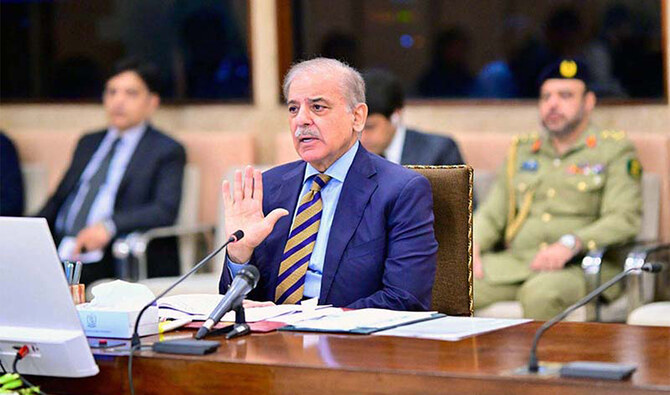

ISLAMABAD: Militants in Pakistan want to stop development projects that are part of the multi-billion-dollar China-Pakistan Economic Corridor (CPEC), Prime Minister Shehbaz Sharif said on Tuesday, a day after over 50 people were killed in a series of coordinated attacks in the country’s restive southwestern province of Balochistan.
Balochistan — a key region bordering Iran and Afghanistan and host to major China-led infrastructure projects such as a strategic port and a gold-copper mine — faces a decades-old separatist insurgency, with ethnic Baloch militants fighting for independence, alleging exploitation of the province’s mineral and gas resources by the central government. The Pakistani state denies this and says it is working for the uplift of the region through various development schemes.
Beijing is investing over $65 billion in energy and infrastructure projects in Pakistan as part of CPEC, a major segment of China’s Belt and Road infrastructure initiative. The corridor will connect China to the Arabian Sea and help Pakistan expand and modernize its economy through a network of roads, railways, pipelines and ports built in the country with Chinese loans. A flagship of the Chinese corridor is a deep-sea port at Gwadar in Balochistan.
Separatist militants, who usually attack Pakistani security forces, have also targeted Chinese interests and citizens, accusing Beijing of helping Islamabad exploit the province. Major attacks include a suicide bombing in March in which five Chinese nationals working at a hydropower plant were killed, and assaults on Beijing’s consulate in Karachi and on the Gwadar port.
“The sole objective of these impure objectives is to put an end to the journey of progress in Pakistan, to stop the projects that are part of the China-Pakistan Economic Corridor in Balochistan and other parts of Pakistan,” PM Sharif said in a televised address to members of his federal cabinet.
In Beijing, China condemned the attacks and vowed to keep up firm support for Pakistan in counter-terrorism efforts.
“China is ready to further strengthen counter-terrorism security co-operation with the Pakistani side in order to jointly maintain regional peace and security,” Lin Jian, a foreign ministry spokesperson, told a regular news briefing.
On Monday, Pakistan’s Interior Minister Mohsin Naqvi had blamed a nexus of the Pakistani Taliban and separatist Baloch outfits for the latest attacks, saying they were getting help from Pakistan’s enemies, a veiled reference to neighbors India and Afghanistan.
“I want to reiterate that terrorists have no place here and whatever happens, they will be completely eliminated from this country,” Sharif said. “And people who believe in dialogue and want to see Pakistan’s green flag fly high and have complete faith in its constitution, for them the option for talks is always open.”
In the violence that began on Sunday evening, 23 passengers were taken off their vehicles in Musa Khel, a district in Balochistan’s northeast, and shot dead. In another attack, the Pakistan Army said it had killed 21 militants during a clearance operation in which 14 soldiers and police also died.
Separately, 10 people, including five security forces personnel, were killed when militants stormed a paramilitary force station in Kalat, while militants also blew up a railway bridge in Bolan in Balochistan’s Kachhi district. Six as yet unidentified, bullet-riddled bodies were also found near the bridge, with the circumstances of the killings unclear.
The latest eruption of violence poses a major challenge for the weak coalition government led by PM Sharif, which is battling an economic crisis and political instability as well as a rise in militant violence by religiously motivated and separatist groups across the country.
Balochistan is also currently in the grips of civil rights protests by young ethnic Baloch people, who are calling for an end to what they describe as a pattern of enforced disappearances, extrajudicial killings and other human rights abuses by security forces, who deny the charge.


