

Biden, Modi discuss Ukraine war after PM’s visit, situation in Bangladesh

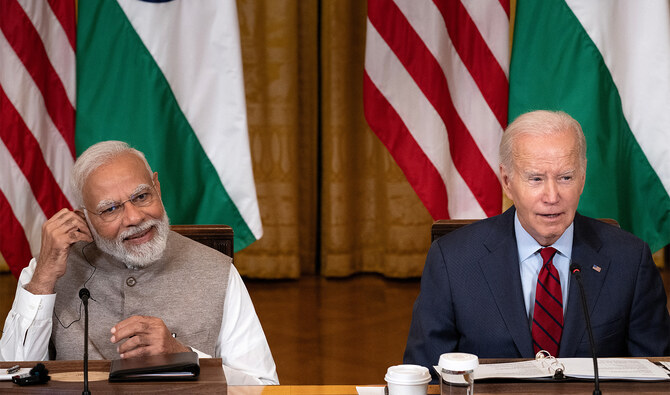
US President Joe Biden and India's Prime Minister Narendra Modi wait for a meeting with senior officials and CEOs of American and Indian companies, in the East Room the White House in Washington, DC, on June 23, 2023. (AFP/File)
Short Url
Updated 27 August 2024
Follow

Biden, Modi discuss Ukraine war after PM’s visit, situation in Bangladesh

  • Last week, Modi visited Ukraine in the first visit by an Indian prime minister in modern Ukrainian history
  • Modi urged President Zelensky to sit down for talks with Russia to end the war and offered to help bring peace

WASHINGTON: US President Joe Biden and Indian Prime Minister Narendra Modi on Monday discussed the Russia-Ukraine war following Modi’s visit to Ukraine, along with the situation in Bangladesh where protests led to the ousting of former leader Sheikh Hasina earlier this month.

Modi posted online that he discussed the situation in Ukraine with Biden over the phone and “reiterated India’s full support for early return of peace and stability.” 

He also said the two leaders stressed “the need for early restoration of normalcy, and ensuring the safety and security of minorities, especially Hindus, in Bangladesh.”

The White House issued a separate statement, saying Biden commended Modi’s recent visit to Poland and Ukraine, and that both leaders expressed “support for a peaceful resolution of the conflict in accordance with international law, on the basis of the UN Charter.”

Last week, Modi visited Ukraine in the first visit by an Indian prime minister in modern Ukrainian history. It came at a volatile juncture in the war launched by Russia in February 2022. Moscow is making slow gains in eastern Ukraine as Kyiv presses a cross-border incursion.

Modi urged President Volodymyr Zelensky to sit down for talks with Russia to end the war and offered to help bring peace.

Modi’s Ukraine visit followed a visit he made to Russia in July where he embraced President Vladimir Putin on the same day that a deadly Russian missile strike hit a children’s hospital. That visit angered Ukraine and the US State Department said it raised concerns with India about ties with Russia.

Moscow has been a large weapons supplier to India since the Soviet Union days. Washington in recent years has looked to woo New Delhi to counter China’s influence.

Modi said the two leaders also discussed the situation in Bangladesh where about 300 people, many of them university and college students, were killed during protests that began in July with students agitating against quotas in government jobs before the events spiraled into demonstrations to oust long-serving former Prime Minister Hasina.

An interim government headed by Nobel Peace Prize winner Muhammad Yunus was sworn in after Hasina fled to India. Attacks were reported against Muslim-majority Bangladesh’s minorities, especially Hindus, amid the protests.

Hindu nationalist Modi’s own government in Hindu-majority India has faced criticism over the years over attacks on minorities, especially Muslims.


Taiwan says reached ‘general consensus’ with US on trade deal

Updated 6 sec ago
Follow

Taiwan says reached ‘general consensus’ with US on trade deal

  • Taiwan has reached a “general consensus” with the United Sates on a trade deal, the democratic island’s negotiators said Tuesday, after months of talks
TAIPEI: Taiwan has reached a “general consensus” with the United Sates on a trade deal, the democratic island’s negotiators said Tuesday, after months of talks.
Taiwan and the United States began negotiations in April to hash out a trade deal after US President Donald Trump slapped a 32 percent tariff on Taiwanese exports, which was later lowered to 20 percent, as part of his sweep of measures against dozens of trade partners.
Taiwanese President Lai Ching-te has pledged to boost investment in the United States and increase defense spending as his government tries to further reduce the levy on its shipments, as well as avoid a toll on its semiconductor chip exports.
“The goal of the US-Taiwan tariff negotiations has always been to seek reciprocal tariff reductions without stacking tariffs, and to obtain preferential treatment under Section 232 for semiconductors, semiconductor derivatives, and other items,” the Office of Trade Negotiations said in a statement, adding there was a “general consensus” on these issues.
Section 232 refers to part of the US Trade Expansion Act that allows tariffs to be imposed when national security is found to be at risk.
“Both sides are currently discussing the schedule for a concluding meeting, and an announcement will be made once it is confirmed,” the statement said.
Taiwan’s trade officials also vowed to provide “a complete explanation of the negotiations and the agreement” to the opposition-controlled parliament and the public.
American soil
Taiwan is a powerhouse in the manufacturing of semiconductor chips, which are the lifeblood of the global economy, as well as other electronics.
Trump has previously accused Taiwan of stealing the US chip industry and his administration had made clear it wants more of the critical technology made on American soil.
The US government launched investigations under Section 232 into semiconductors and chip-making equipment last year.
Taiwan’s trade surplus with the United States was the seventh highest of any country in 2024, reaching $73.9 billion.
More than half of its exports to the United States are information and communications technology products, including semiconductors.
Lai has been at pains to find favor with Trump, vowing to raise defense spending to more than three percent of GDP this year and five percent by 2030.
TSMC, which is the world’s largest contract chip maker, also has pledged to invest an additional $100 billion in the United States.
But Taiwanese Deputy Foreign Minister Francois Chih-chung Wu told AFP recently that Taiwan planned to keep making the “most advanced” chips on home soil.