

Denmark to close its embassies in Mali, Burkina Faso

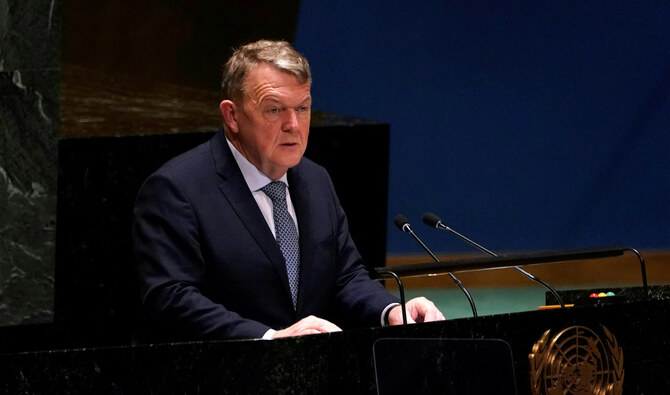
Danish Foreign Minister Lars Loekke Rasmussen speaks during the Eleventh Emergency Special Session of the General Assembly on Ukraine, at UN headquarters in New York City on February 23, 2023. (AFP/File)
Short Url
Updated 27 August 2024
Follow

Denmark to close its embassies in Mali, Burkina Faso

COPENHAGEN: Denmark will close its embassies in Mali and Burkina Faso after a series of military coups over the past few years, the Danish Foreign Ministry said on Monday, as it formally launched a new strategy for its cooperation with the African continent.

Ruled by a military junta since 2020, Mali has been battling ethnic Tuareg rebels in its north alongside Russia’s Wagner mercenary group after it cut military cooperation ties with Western powers including EU countries.

Since then, relations between Mali, Niger and Burkina Faso and Western powers have deteriorated as the three turn to Russia for support.

Frustrations over authorities’ failure to restore security have contributed to coups in Mali and Burkina Faso, which the ministry said had created very limited room for maneuver in the Sahel region.

At the same time, the Danish ministry said it would open embassies in Rwanda, Senegal and Tunisia, and increase its diplomatic workforce in its embassies to Egypt, Kenya, South Africa, Nigeria and Ghana.

Separately, at least 100 villagers and soldiers were killed in central Burkina Faso during a weekend attack on a village by Al-Qaeda-linked terrorists, according to videos of the violence analyzed by a regional specialist, who’s described the assault as one of the deadliest this year in the conflict-battered West African nation.

Villagers in the Barsalogho commune which is 80 kilometers from the capital city were helping security forces dig trenches to protect security outposts and villages on Saturday when fighters with the Al-Qaeda-linked JNIM group invaded the area and opened fire on them, said Wassim Nasr, a Sahel specialist and senior research fellow at the Soufan Center security think tank.

Al-Qaeda claimed responsibility for the attack on Sunday, saying in a statement that it gained “total control over a militia position” in Barsalogho in Kaya, a strategic town security forces have used to fight off terrorists that have over the years tried to close in on the capital, Ouagadougou.


Tanzania opposition says 2,000 killed in election violence

Updated 6 sec ago
Follow

Tanzania opposition says 2,000 killed in election violence

  • Opposition party Chadema’s deputy chairperson John Heche said Tanzania witnessed “mass killings of more than 2,000 people and over 5,000 injured in the space of just one week“
  • The violence was carried out “with direct involvement of the state“

DAR ES SALAM: Tanzania’s main opposition party on Thursday said more than 2,000 people were killed in a week of election violence, calling for sanctions against officials it accused of crimes against humanity.
President Samia Suluhu Hassan was declared the winner of October 29 polls with 98 percent of the vote, but her government was accused of rigging the polls and overseeing a campaign of murders and abductions of her critics that sparked nationwide protests and riots.
Opposition party Chadema’s deputy chairperson John Heche told reporters that Tanzania witnessed “mass killings of more than 2,000 people and over 5,000 injured in the space of just one week.”
He said the violence was carried out “with direct involvement of the state” and that it amounted to “crimes against humanity.”
Previous opposition counts had put the deaths at more than 1,000. The government has not given a death toll.
Heche urged the international community to “impose sanctions on all individuals involved in planning and executing these acts of criminality and crimes against humanity.”
In a live online broadcast, he said those responsible should be subjected to travel bans, including restrictions on their families.
Heche also said the unrest triggered a surge of people fleeing the country, alongside “the abduction and enforced disappearance of hundreds of civilians.”
Chadema further accused security units of carrying out rapes, torture and “gruesome killings,” and of engaging in widespread looting and arbitrary arrests.
The party urged authorities to return the bodies of those killed so families could bury them.
Authorities have continued to stifle dissent, with planned protests earlier this week seeing empty streets and a significant security presence.
Hassan last week justified the killings, saying it was necessary to prevent the overthrow of the government.
“The force that was used corresponds to the situation at hand,” she said in a speech.
Hassan has formed an inquiry commission into the violence, which the opposition says includes only government loyalists, instead calling for an independent investigation.