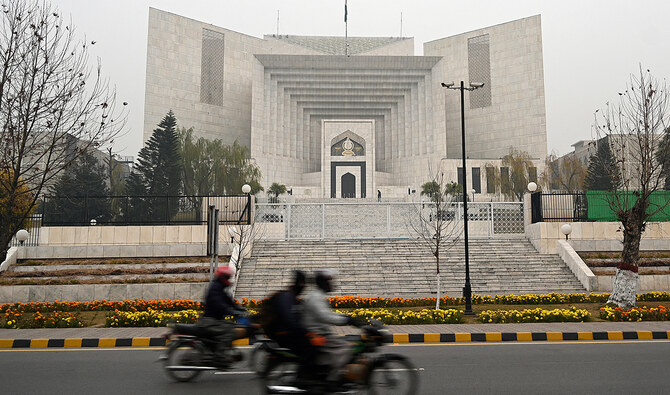
ISLAMABAD: Former prime minister Imran Khan’s Pakistan Tehreek-e-Insaf (PTI) party on Monday approached the Supreme Court of Pakistan seeking implementation of its verdict that declared the party eligible for reserved seats in parliament, according to a PTI petition.
The July 12 verdict in favor of Khan’s PTI party dealt a blow to the ruling coalition of Prime Minister Shehbaz Sharif, which may lose its two-thirds majority in Pakistan’s parliament. PTI candidates contested the Feb. 8 national election in Pakistan as independents after the party was barred from polls on the technical grounds that it did not hold genuine intra-party polls, which is a legal requirement.
Subsequently, they won the most seats in the election, 93, but the Election Commission of Pakistan (ECP) said independents were ineligible for their share of 70 reserved seats — 60 for women, 10 for non-Muslims. The reserved seats were then distributed among other parties, mostly those in the ruling coalition, a decision appealed by the Sunni Ittehad Council (SIC) that was joined by Khan-backed independents to claim their share of reserved seats.
In its petition, the PTI has requested the top court to direct the ECP to accept the affiliations or confirmations of party members signed by PTI Chairman Gohar Khan and General Secretary Omer Ayub, and implement the directions issued through the short order on July 12.
“Such other relief as is deemed just and fit in all the circumstances of the case may also graciously be granted,” Khan’s party requested in its petition.
Last month, the government also filed a petition seeking review of the Supreme Court’s ruling that declared the PTI eligible for reserved seats, noting that the issue of granting reserved seats to the PTI was not even in the pleadings of the SIC before the election commission, the Peshawar High Court and the Supreme Court.
“SIC and PTI are two separate political parties and two separate entities. The Order under Review, it seems has treated them as one party with different names which cannot be permissible under the Law,” the government petition read.
“It is submitted and reiterated here that PTI neither filed any case before the ECP, nor before Peshawar High Court, nor before the Supreme Court, hence it is not entitled to any relief, let alone a relief which was not even pleaded.”
All candidates of Khan’s PTI party were forced to contest the February polls as independents after the party was stripped of its election symbol of cricket bat by the ECP on the grounds that it did not hold intra-party elections, a prerequisite for any party to take part in polls.
The PTI is currently entitled to around 78 reserved seats in the national and provincial assemblies.
The July 12 verdict also bolstered the political position of Khan’s supporters, whose rallying cry has been that the election commission and a pro-military caretaker government that oversaw the polls indulged in “electoral fraud” to deprive it of a victory. The ECP denies this.


![]()

Ex-PM Khan party approaches top court seeking implementation of verdict on reserved seats
Short Url
https://arab.news/wwsqu
Ex-PM Khan party approaches top court seeking implementation of verdict on reserved seats
- The Supreme Court on July 12 ruled that Khan’s Pakistan Tehreek-e-Insaf party was eligible for reserved seats in parliament
- The verdict dealt a blow to the ruling coalition of Prime Minister Shehbaz Sharif, which may lose its parliamentary majority
Latest updates





© 2026 SAUDI RESEARCH & PUBLISHING COMPANY, All Rights Reserved And subject to Terms of Use Agreement.