

Taliban vice and virtue laws provide ‘distressing vision’ for Afghanistan — UN envoy

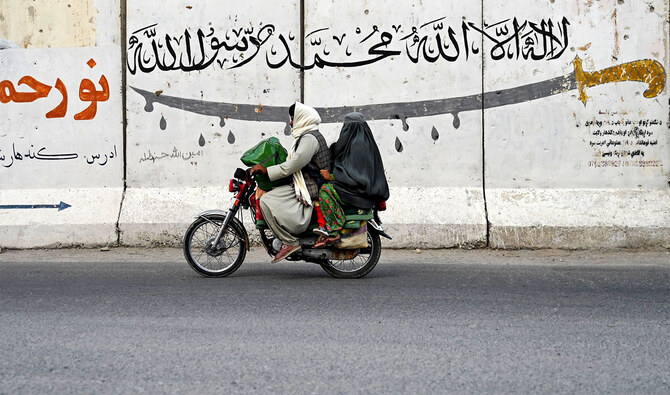
An Afghan man and a burqa-clad woman ride a motorcycle along a street on the outskirts of Kandahar on August 24, 2024. (AFP)
Short Url
Updated 26 August 2024
Follow

Taliban vice and virtue laws provide ‘distressing vision’ for Afghanistan — UN envoy

  • New rules include a requirement for a woman to conceal face, body and voice outside the home
  • Kabul’s Taliban rulers say “committed to assure all rights of women based on Islamic law”

ISLAMABAD: The Taliban’s new vice and virtue laws that include a ban on women’s voices and bare faces in public provide a “distressing vision” for Afghanistan’s future, a top UN official warned Sunday.

Roza Otunbayeva, who heads the UN mission in the country, said the laws extend the ” already intolerable restrictions ” on the rights of women and girls, with “even the sound of a female voice” outside the home apparently deemed a moral violation.

Afghanistan’s Taliban rulers last Wednesday issued the country’s first set of laws to prevent vice and promote virtue. They include a requirement for a woman to conceal her face, body and voice outside the home.

The laws empower the Vice and Virtue Ministry to be at the front line of regulating personal conduct and administering punishments like warnings or arrest if its enforcers allege that Afghans have broken the laws.

“After decades of war and in the midst of a terrible humanitarian crisis, the Afghan people deserve much better than being threatened or jailed if they happen to be late for prayers, glance at a member of the opposite sex who is not a family member, or possess a photo of a loved one,” Otunbayeva said.

The mission said it was studying the newly ratified law and its implications for Afghans, as well as its potential impact on the UN and other humanitarian assistance.

Taliban officials did not immediately respond to requests for comment on the UN criticism.

In remarks broadcast Sunday by state-controlled broadcaster RTA, Vice and Virtue Minister Mohammad Khaled Hanafi said nobody had the right to violate women’s rights based on inappropriate customs.

“We are committed to assure all rights of women based on Islamic law and anyone who has a complaint in this regard will be heard and resolved,” he added.

Taliban supreme leader Hibatullah Akhundzada said last year that Afghan women are provided with a “comfortable and prosperous” life, in spite of decrees barring them from many public spaces, education and most jobs.

The UN has previously said that official recognition of the Taliban as the legitimate rulers of Afghanistan is nearly impossible while restrictions on women and girls remain.

Although no country recognizes the Taliban, many in the region have ties with them.

Last Wednesday, the United Arab Emirates accepted the credentials of the Taliban’s ambassador to the oil-rich Gulf Arab state.

A UAE official said the decision reaffirmed the government’s determination to contribute to building bridges to help Afghans. 

“This includes the provision of humanitarian assistance through development and reconstruction projects, and supporting efforts that work toward regional de-escalation and stability.”

Otunbayeva is scheduled to report to the UN Security Council on the situation in Afghanistan on Sept. 18, three years after the Taliban stopped girls’ education beyond sixth grade.

Acting Higher Education Minister Nada Mohammed Nadim said religious scholars were researching female education and it was their findings that would determine if schools and universities will reopen.

“Nobody should make himself a cleric or tell us if education is permitted for women,” he told a news conference in Kabul on Sunday. 

“We have proven that any decision won’t be against Islamic law or Afghan culture. This is a very sensitive issue so deciding in weeks or months is not possible. We can’t say exactly that, on this date, this will be solved.”


Zelensky blasts EU's lack of political will against Putin

Updated 57 min 42 sec ago
Follow

Zelensky blasts EU's lack of political will against Putin

  • Ukrainian president says he reached agreement with Trump around post-war US security guarantees for his country
  • In a fiery speech, he slammed his main political backers in Europe over their 'inaction'

DAVOS: Ukrainian President Volodymyr Zelensky on Thursday blasted the EU’s lack of “political will” in countering Russian leader Vladimir Putin, in a fiery address criticizing some of Kyiv’s top allies at the World Economic Forum.
The speech to the Davos elite came minutes after Zelensky had met with US President Donald Trump, a conversation he said had brought agreement about what post-war US security guarantees for Ukraine would look like.
Zelensky did not say what they included, only that they were “done” and were ready to be signed by the leaders and ratified by the Ukrainian parliament and US Congress.
But in a marked departure from his usual warm rhetoric toward the European Union, Kyiv’s main political and financial backers, Zelensky slammed what he cast as inaction.
“What’s missing: time or political will?” he said at one point, referencing delays over the establishment of a European war crimes tribunal on the Russian invasion.
He also said Europe, without mentioning any single country, was failing to agree on how to address global problems.
“There are endless internal arguments and things left unsaid that stop Europe from uniting and speaking honestly enough to find real solutions,” Zelensky told the forum.
“Instead of becoming a truly global power, Europe remains a beautiful but fragmented kaleidoscope of small and middle powers,” he added.

Fresh talks

“Europe looks lost trying to convince the US President to change,” said Zelensky.
“But he will not change. President Trump loves who he is, and he says he loves Europe, but he will not listen to this kind of Europe,” he said.
Trump had hailed a “good” meeting with Zelensky in the Swiss ski resort, hours before his envoy Steve Witkoff and son-in-law Jared Kushner were due in Moscow for talks with Putin.
“This war has to end,” Trump told reporters including AFP when asked what message he was sending to the Russian leader.
Zelensky said the question of territory was the one outstanding issue in the talks to find an end to the war.
“It’s all about the eastern part of our country. It’s all about the land. This is the issue which we (have) not solved yet.”
He also said the United Arab Emirates would host “trilateral” talks on the Ukraine war Friday and Saturday with Ukrainian, US and Russian negotiators.
“It will be the first trilateral meeting in the Emirates,” said Zelensky, without elaborating on the format of the talks.
“Russians have to be ready for compromises,” he added.
Russia, which occupies around 20 percent of Ukraine, is pushing for full control of the country’s eastern Donbas region as part of a deal — but Kyiv has warned ceding ground will embolden Moscow.