

35 killed in separate road accidents in Pakistan’s Azad Kashmir, Balochistan 

Rescue personnel inspect the site of a bus accident that killed 23 people after it plunged into a ravine at Soon village near Kahuta, Punjab province on August 25, 2024. (AFP)
Short Url
Updated 25 August 2024
Follow

35 killed in separate road accidents in Pakistan’s Azad Kashmir, Balochistan 

  • Twenty-three killed, several injured as coach enroute to Rawalpindi fell into ditch in Azad Kashmir
  • Bus with pilgrims returning from Iran falls into ditch in southwestern Pakistan, killing 12 people 

KARACHI: At least 35 people were killed and several injured in two separate road accidents in Pakistan’s Azad Kashmir and southwestern Balochistan areas on Sunday, state-run media reported. 

In the first incident, twelve people were killed and 35 injured in Balochistan after a pilgrim bus returning from Iran to Karachi fell into a ditch, state television PTV and a police official confirmed. 

In another incident, at least 23 people were killed and several injured when a coaster coming from Hawaili Kahuta in Azad Kashmir to Rawalpindi fell into a ditch near Azad Pattan in the Pakistan-administered area, state broadcaster Radio Pakistan said. 


People look at the wreckage at the site of a bus accident that killed 23 people after it plunged into a ravine at Soon village near Kahuta, Punjab province on August 25, 2024. (AFP)

“President Asif Ali Zardari has expressed deep grief and sorrow over the loss of precious lives in the Azad Pattan bus accident near Kahuta,” Radio Pakistan reported.   

“In his statement, he extended condolences to the bereaved families of those who died in the accident.”

About the Balochistan bus incident, PTV reported that the accident took place on the Makran Coastal Highway when the pilgrim bus fell into a ditch near the Buzi Top area.
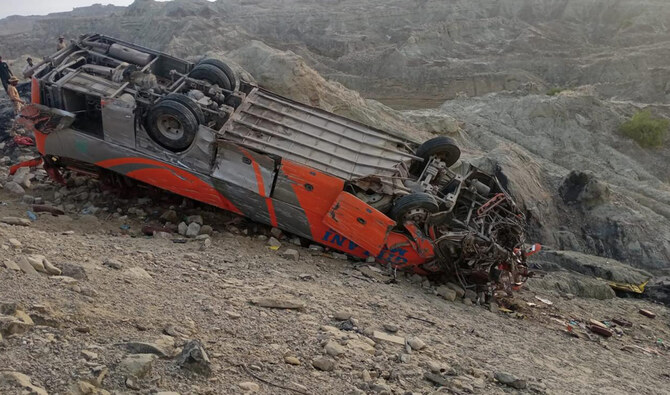


A view of a pilgrim bus that fell into a ditch on the Makran Coastal Highway in Balochistan, Pakistan on August 25, 2024. (Photo courtesy: SSP Labella)

“The bus was carrying pilgrims from Iran to Pakistan,” PTV said. “It is said that the deceased hail from Lahore and Gujranwala cities.”

Senior Superintendent Police Lasbela Naveed Alam told Arab News that police received information about the incident at 06:45 am.

“The accident occurred due to brake failure of the vehicle,” Alam disclosed, adding that the Rescue 1122 teams of Rasmalan, Ormara as well as the Edhi Lasbela are engaged in the operation to shift the injured to the hospitals along with police. 


Security personnel inspect the bus that fell into a ditch on the Makran Coastal Highway in Balochistan, Pakistan on August 25, 2024. (Photo courtesy: SSP Labella)

Millions of Shiite Muslims are currently partaking in the Arbaeen pilgrimage in Iraq’s Karbala Governorate. The event marks the 40th mourning following the martyrdom of Imam Hussein bin Ali, a central figure in Shiite Islam and the grandson of Prophet Muhammad (peace be upon him). 

This is the second accident involving Pakistani pilgrims in one week. A bus carrying Shiite pilgrims from Pakistan to Iraq crashed in the central Iranian province of Yazd on Tuesday night, killing 28 people and injuring 23 more. 

Fatal accidents are common in Pakistan, where traffic rules are rarely followed and roads, particularly in many rural and mountainous areas, are in poor condition.

Such incidents are particularly common in Balochistan where single carriage roads connect various cities and even some highways lack modern safety features.


Pakistan approves $713 million to ease power sector’s cash flow constraints

Updated 5 sec ago
Follow

Pakistan approves $713 million to ease power sector’s cash flow constraints

  • Finance minister chairs Economic Coordination Committee meeting to approve grants, review economic situation
  • Pakistan is grappling with a ballooning “circular debt,” or unpaid bills and subsidies, that has choked its power sector

KARACHI: Pakistan’s top economic body this week approved a grant of $713 million to ease the power sector’s cash flow constraints, the Finance Division said in a statement, as Islamabad looks to reform its priority sectors. 

The development took place as Finance Minister Muhammad Aurangzeb chaired a meeting of the Economic Coordination Committee (ECC) to approve grants for various projects and review the overall economic situation of the country. 

“[ECC approved] another Technical Supplementary Grant amounting to Rs200 billion ($713 million) under the head of Government of Pakistan investment in DISCOs’ equity to address cash flow constraints in the power sector,” the Finance Division said on Thursday. 

DISCOs, which handle billing, recoveries and grid maintenance, have long suffered from corruption and political interference. 

Pakistan has attempted to privatize its loss-making state-owned enterprises to raise funds and reform them as envisaged under a $7 billion International Monetary Fund (IMF) program secured last year. 

Prime Minister Shehbaz Sharif’s government plans to privatize three DISCOs, the Islamabad Electric Supply Company (IESCO), Faisalabad Electric Supply Company (FESCO) and Gujranwala Electric Power Company (GEPCO) in the months ahead. 

The Pakistani government, which owns or controls much of the power infrastructure, is grappling with a ballooning “circular debt,” or unpaid bills and subsidies, that has choked the power sector and weighed on the economy.

The liquidity crunch has disrupted supply, discouraged investment and added to fiscal pressure, making it a key focus under Pakistan’s IMF program.

The ECC also approved, on the interior ministry’s proposal, a provision of Rs 4.775 billion [$17.19 million] as payment to 945 families of “missing persons” as identified by the Commission of Inquiry on Enforced Disappearances. 

“The disbursement will be made under the supervision of the Commission in accordance with approved procedures,” it added. 

Taking stock of the economic situation, the ECC noted that cumulative inflation for the period July–November averaged 5 percent, which it said was “significantly lower” than the 7.9 percent figure recorded during the corresponding period of the previous year. 

It attributed this improvement to prudent fiscal management, effective price stabilization measures and close market monitoring by the government.