

Blast kills three, injures 13 others in Pakistan’s restive southwest

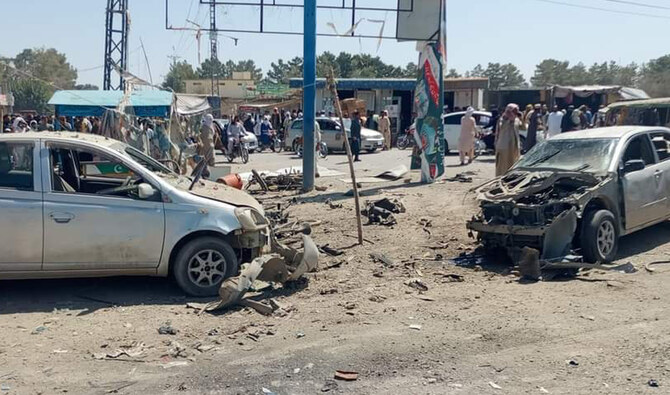
In this handout photo, taken and shared with Arab News by Balochistan Police, people gather at the site of a bomb blast near the Deputy Commissioner Complex in Pishin on August 24, 2024. (Handout/AN)
Short Url
Updated 24 August 2024
Follow

Blast kills three, injures 13 others in Pakistan’s restive southwest

  • The blast occurred near Deputy Commissioner Office in Pishin in Pakistan’s Balochistan
  • No group claimed responsibility for the attack which targeted traffic police personnel

QUETTA: At least three people were killed and 13 others sustained injuries in the wake of a powerful blast in Pakistan’s southwestern Balochistan province, police said on Saturday.
An improvised explosive device (IED) targeted traffic police near the Deputy Commissioner Complex in Pishin, a city located some 55 kilometers from the provincial capital of Quetta, according to police officials.
No group immediately claimed responsibility for the attack.
“An IED fitted inside a motorbike targeted the traffic police soldiers standing at the Surkhab Chowk near Deputy Commissioner Complex on Saturday morning,” Mujeeb-ur-Rehman Kakar, in-charge of the Pishin police station, told Arab News. “Two children were killed and 14 others, including two policemen, were injured in the attack.”
Wakeel Sherani, medical superintendent at the Pishin district headquarters hospital, confirmed receiving bodies of a boy and a girl, and said five of the injured, including a woman and two policemen, were referred to Quetta for better medical care.


In this handout photo, taken and shared with Arab News by Balochistan Police, people gather at the site of a bomb blast near the Deputy Commissioner Complex in Pishin on August 24, 2024. (Handout/AN)

However, the injured woman died during treatment at Civil Hospital in Quetta, according to Dr. Ishaq Panezai, medical superintendent of Civil Hospital.
“A 25-year-old woman succumbed to injuries while being treated in the Trauma Center,” he told Arab News. “Four other critically injured persons are undergoing surgeries.”
Balochistan, which borders Iran and Afghanistan, has been the site of a low-level separatist insurgency for the last two decades. The ethnic Baloch insurgents say they are fighting what they see as the unfair exploitation of the province’s mineral wealth by the federation. The Pakistani government says it is working for the uplift of the impoverished province.


Injured victims of roadside bomb blast in the southwestern Pakistani town Pashin, are treated at a hospital in Quetta on August 24, 2024. (AP)

The province has also witnessed some deadliest attacks by religiously motivated groups like the Tehreek-e-Taliban Pakistan, which has claimed a number of attacks in Pishin and nearby areas in the past, and Daesh (Islamic State).
Shahid Rind, a provincial government spokesman, condemned the attack and directed health officials to ensure best treatment of the injured persons.
“Terrorists have been targeting innocent citizens of Pakistan to achieve their vicious agenda,” he said in a statement. “Enemies of the state will not be spared.”

Pakistan stocks close at record high over current account surplus, falling bond yields

Updated 9 sec ago
Follow

Pakistan stocks close at record high over current account surplus, falling bond yields

  • KSE-100 index gains 1,646.79 points or 0.97% to close at new high of 171,960.64 points
  • Pakistan’s central bank posted a current account surplus of $100 million in November

KARACHI: Pakistani stocks closed at an all-time high of 171,960.4 points on Thursday, with financial analysts attributing the surge to increasing investor confidence stemming from a current account surplus reported in November and a drop in government bond yields.

The benchmark KSE-100 index gained 1,646.79 points or 0.97% to close at an all-time high of 171,960.64 points on Thursday. The previous day, Pakistani stocks surged to 170,313.85 points at close of business. 

Ahsan Mehanti, chief executive officer at Arif Habib Commodities, said the optimistic mood at the stock exchange was fueled by the $100 million current account surplus reported by the central bank in November.

“Speculations ahead of year-end close and fall in government bond yields up to 70 basis points after the SBP (State Bank of Pakistan) policy easing played the catalyst role in bullish activity at PSX,” Mehanti told Arab News. 

The surplus was a welcome development for Islamabad as Pakistan’s central bank reported a $291 million deficit in October.

Topline Securities, a Pakistani brokerage firm, said in its daily market review that strong buying by local funds followed a drop in Pakistan Investment Bond (PIB) yields, which boosted investor confidence.

PIB yields are the returns on bonds or government-backed securities that pay fixed semi-annual interest, with rates influenced by market demand and SBP auctions.

“Strength in ENGRO (Engro Corporation), FFC (Fauji Fertilizer Company), UBL (United Bank Limited), LUCK (Lucky Cement) and BAHL (Bank AL Habib) underpinned positive momentum, collectively contributing 1,504 points to the index,” the brokerage firm wrote on X. 

“This upside was partly offset by declines in PIOC (Pakistan International Oil Company), DHPL (D.H. Corporation Limited) and MLCF (Millat Tractor Limited), which together subtracted 176 points.”

The sustained rise in equities comes amid improving liquidity conditions and continued investor participation, with market participants focusing on corporate earnings, sector-specific developments and broader macroeconomic signals.

Earlier on Monday, Pakistan’s central bank cut its key policy interest rate by 50 basis points to 10.5%, a move that surprised analysts and followed four consecutive policy meetings where rates were held unchanged.

The cut came despite an International Monetary Fund staff report earlier this month cautioning against premature monetary easing.

Inflation eased to 6.1% in November, remaining within the SBP’s target band, though analysts have warned that price pressures could resurface later in the fiscal year as base effects fade and food and transport costs remain volatile.