

Pakistani singles search for spouses in person on marriage app for Muslims

Uzma chats with another attendee during a matchmaking event organised by Muzz matrimony app at a cafe in Lahore, Pakistan, on August 18, 2024. (REUTERS)
Short Url
Updated 24 August 2024
Follow

Pakistani singles search for spouses in person on marriage app for Muslims

  • Muzz gives option of blurring pictures except for specific matches and allows for chaperones to oversee meetings
  • Muzz, launched in Britain in 2015, has over 1.5 million users in Pakistan, its second-largest market after Morocco

LAHORE: Dozens of young singles gathered this week to meet potential marriage partners in Pakistan’s eastern city of Lahore, the first attempt by a UK-based matrimonial app to help people find spouses in person in the conservative Islamic country.

Typically, marriages in Pakistan are arranged by parents who look for suitable matches for their children from within their communities or the extended family. Dating apps are generally stigmatized and gender segregation socially and at work remains common in the country of 240 million people.

The Lahore event was organized by Muzz, formerly Muzzmatch, which says its app is based on Islamic etiquette. The app is restricted to Muslim users, and, in a nod to traditional values, gives the option of blurring pictures except for specific matches and allows for chaperones to oversee meetings.

Other smaller events are also emerging in the country to challenge traditional matchmaking norms.

Despite criticism online in the past for the app, the Muzz event was attended by about 100 people.

Aimen, a 31-year-old woman who did not want to be further identified, said she used the app on the recommendation of her US-based brother.

“I used the app for two weeks, but then I saw an ad for this event and thought, why not meet people in person?” she told Reuters.
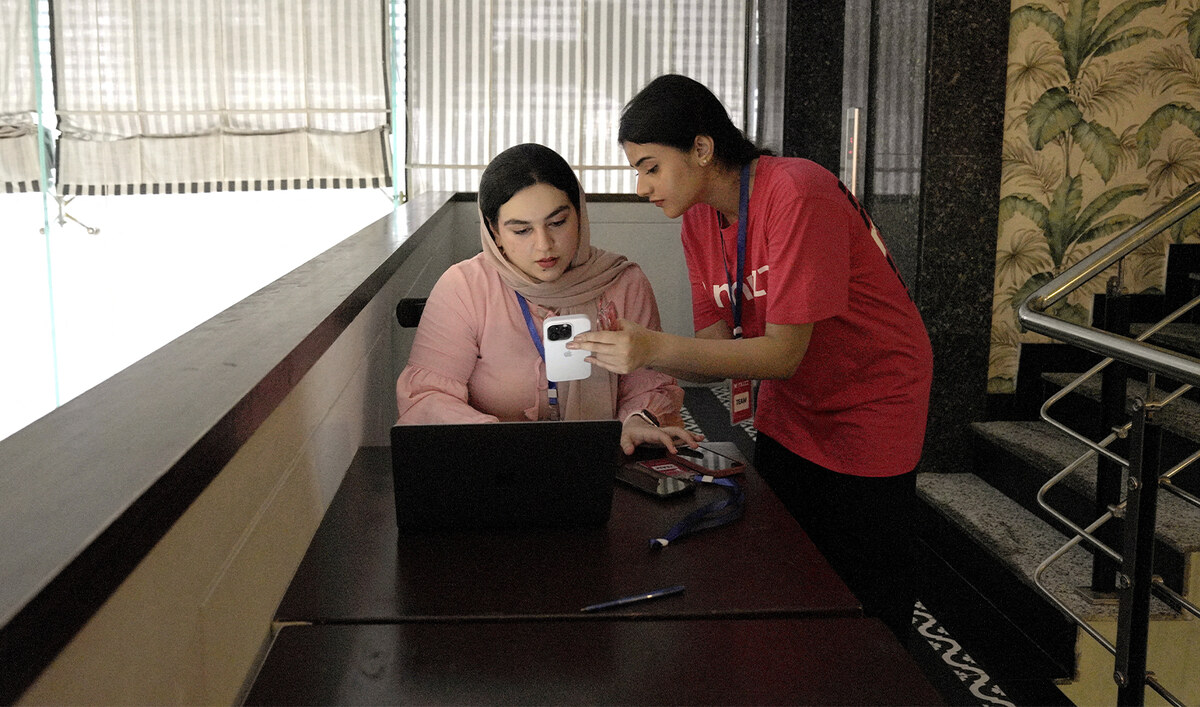


Nayab and Aymen, event organisers for Muzz matrimony app, work during a matchmaking event at a cafe, in Lahore, Pakistan, on August 18, 2024. (REUTERS)

She said that her mother would have accompanied her as a chaperone but couldn’t attend because of ill-health.

Muzz, launched in 2015 in Britain, which also has a sizeable Muslim population, has over 1.5 million users in Pakistan, its second-largest market after Morocco.

Moaz, a 27-year-old man, said he has been using Muzz for a year and that he was hopeful of finding a wife through the app.

“I do get matches, but they have different priorities,” he said adding that girls on the app expect him to involve his parents from the beginning.

“That is not (immediately) possible,” he said, stressing the need of getting to know someone before taking the next big step.

Annie’s Matchmaking Party, another Lahore event last week, used an algorithm to match 20 young professionals after a selection process and invited them to the meet.

Noor ul Ain Choudhary, the 30-year-old organizer, faced criticism online that her event promoted a “hookup culture.” She countered that it aimed to provide a safe space for singles to meet and connect.

“In Pakistan, we’ve had two options: biased arranged marriages or time-consuming dating apps with no guarantees. Safety during meetings is also a concern,” she said.

Abdullah Ahmed, 22, was bullish about in person events and said he was convinced he may have found his perfect match at the Muzz gathering.

“The highlight was meeting an amazing girl,” he said, beaming with excitement, adding that they instantly clicked and swapped social media handles.

“We’re both Marvel fans! We’re already planning to catch the new Deadpool & Wolverine together,” he said.


Pakistan army chief says future warfare will rely on technology over battlefield maneuvers

Updated 8 sec ago
Follow

Pakistan army chief says future warfare will rely on technology over battlefield maneuvers

  • Asim Munir cites drones, electronic warfare and surveillance as central to future war operations
  • Remarks follow Pakistan’s 2025 military conflict with India that highlighted role of technology

ISLAMABAD: Pakistan’s army chief said on Thursday future conflicts would be shaped more by technology than traditional battlefield maneuvers, as the military accelerates its shift toward drone warfare, electronic systems and networked command structures, according to a statement issued by the Pakistan military.

Field Marshal Syed Asim Munir, who also serves as Chief of Defense Forces, made the remarks while visiting the Bahawalpur Garrison in southern Punjab, where he observed a high-intensity field exercise focused on integrating new technologies into conventional military operations, the Inter-Services Public Relations (ISPR) said.

The exercise, titled Steadfast Resolve, involved unmanned aerial systems, advanced surveillance assets, electronic warfare capabilities and modern command-and-control mechanisms, reflecting what the military described as a move toward “technology-enabled multi-domain operations.”

“Character of war has evolved massively, with technological advancements driving the evolution, dictating huge mental transformation at all tiers,” Munir said while addressing troops, according to the ISPR statement.

“In future, technological maneuvers will replace physical maneuvers and will fundamentally alter the way offensive and defensive operations are undertaken,” he added.

Militaries worldwide are reassessing combat doctrine as drones, electronic warfare and real-time data increasingly shape outcomes on modern battlefields. In South Asia, those shifts gained renewed attention following military exchanges between Pakistan and India in May 2025, when both sides employed surveillance, electronic countermeasures and precision capabilities alongside conventional forces, underscoring the growing role of non-kinetic domains.

Munir said the Pakistan army was “embracing and absorbing technology at a rapid pace,” adding that “innovation, indigenization and adaptation shall remain fundamental” as the military prepares for future battlefield and security challenges.

The army chief also reiterated that Pakistan’s armed forces remained prepared to defend the country’s sovereignty and territorial integrity, while emphasizing the need to maintain readiness as warfare increasingly expands across physical, cyber and electronic domains.