



RAWALPINDI: Bangladesh opener Shadman Islam missed a fighting hundred by just seven runs but still guided Bangladesh to an impressive 316-5 at close on day three of the first Test against Pakistan in Rawalpindi on Friday.
The left-hander scored a patient 183-ball 93 to keep the visitors’ chances of fighting out for a draw or pulling off a first-ever win over Pakistan in 14th Test match between the two oppositions.
At close, veteran batter Mushfiqur Rahim was 55 not out while Litton Das was 52 not out to further Bangladesh’s progress, having added a solid 98 runs for the unfinished sixth wicket stand.
Bangladesh trail Pakistan’s total of 448-6 declared by 132 runs with five wickets in hand as Rawalpindi stadium pitch proved unresponsive to bowlers — nearly quashing Pakistan’s hopes of a big lead.
Rahim hit Shaheen Shah Afridi for his seventh boundary to reach his 28th Test half-century. Das also completed fifty with three boundaries and a six in one Naseem Shah’s over after Pakistan took the second new ball.
But Bangladesh’s resistance was led by Shadman.
The 29-year-old left-hander was defiant and approaching his second hundred just before tea but was bowled by a sharp delivery from Pakistan pacer Mohammad Ali in the last over before tea.
Pakistan also dismissed Shakib Al Hasan for 15 as the ace all-rounder played a loose shot against Saim Ayub as the part-time spinner got a maiden wicket in his first-ever Test over.
Pacer Khurram Shahzad was the pick of bowlers with 2-47 while Naseem Shah, Mohammad Ali and Ayub had a wicket each. Spearhead Shaheen Shah Afridi failed to get one in 18 overs.
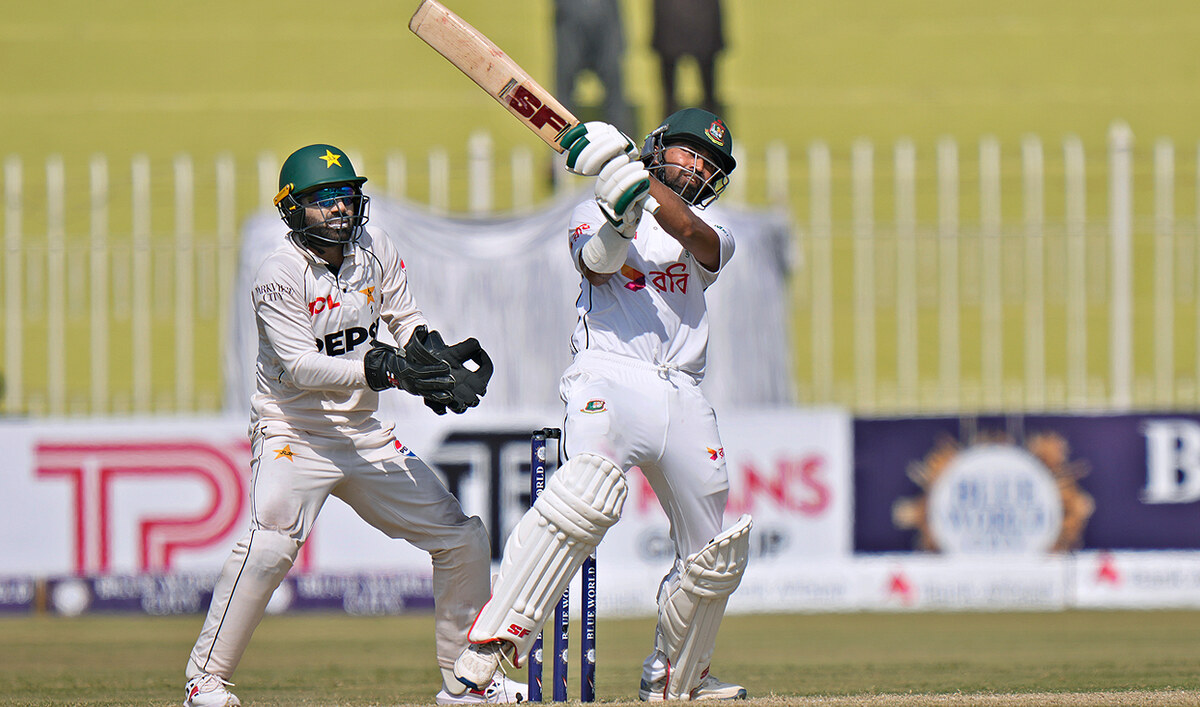
Bangladesh’s Shadman Islam, center, follows the ball after player a shot for boundary as Pakistan’s Mohammad Rizwan wathces during the third day of first cricket test match between Pakistan and Bangladesh, in Rawalpindi on August 23, 2024. (AP)
Earlier, it was Shadman who added 52 runs for the fourth wicket with Rahim following his stubborn 94-run stand with Mominul Haque (50) in an earlier wicket stand.
Shadman hit 12 boundaries in his fighting five-hour 29-minute stay at the crease.
Haque was the only batter dismissed in the post-lunch session when he missed a delivery from Shahzad and was bowled. He hit five boundaries in his 76-ball innings.
It was Shadman who anchored his team’s fight as Pakistan’s pace attack looked less effective on a Rawalpindi stadium pitch that has slowed down considerably.
The Shadman-Haque stand led the recovery after Pakistan removed Zakir Hasan (12) and skipper Najmul Hossain Shanto (16) in the extended three-hour session due to Friday prayers.
Pakistan employed all four pacers but were missing the services of a frontline spinner.
Part-time slow bowler Agha Salman had Shadman leg-before wicket on 57 but the decision was overturned on review.
Resuming at 27-0, Bangladesh lost Zakir to a smart catch by wicketkeeper Mohammad Rizwan, diving to his left to take a one-handed catch in Shah’s fifth over of the day.
Shanto looked good during his short knock but was bowled between bat and pad by Shahzad, leaving the visitors on 53-2.
The second and final Test will also be played in Rawalpindi from August 30 — the series part of the nine-team World Test Championship’s third cycle (2023-2025).


