CHICAGO: Leaders of an “Uncommitted” movement, which garnered hundreds of thousands of votes in Democratic primaries across the nation in protest of the Israel-Hamas war, have been negotiating for weeks to secure a speaking slot for a Palestinian American at the Democratic National Convention this week.
The negotiations stalled late Wednesday when leaders with the Uncommitted National Movement say a Democratic National Committee official called and delivered a firm response: “The answer is no.”
The leader, Abbas Alawieh, an “Uncommitted” delegate to the convention and co-founder of the movement, described the call as shocking after weeks of talks that he felt were positive. In response, he and other delegates decided to stage a sit-in outside Chicago’s United Center, where the convention is being held. They spent the night on the sidewalk on Wednesday, and vowed to remain until their request was granted or the convention ended Thursday night.
“When we ran out of options — doing everything we can and working from the inside, when we ran out of options as uncommitted delegates, we just sat down,” Alawieh said in an interview Thursday.
The Harris campaign declined to comment.
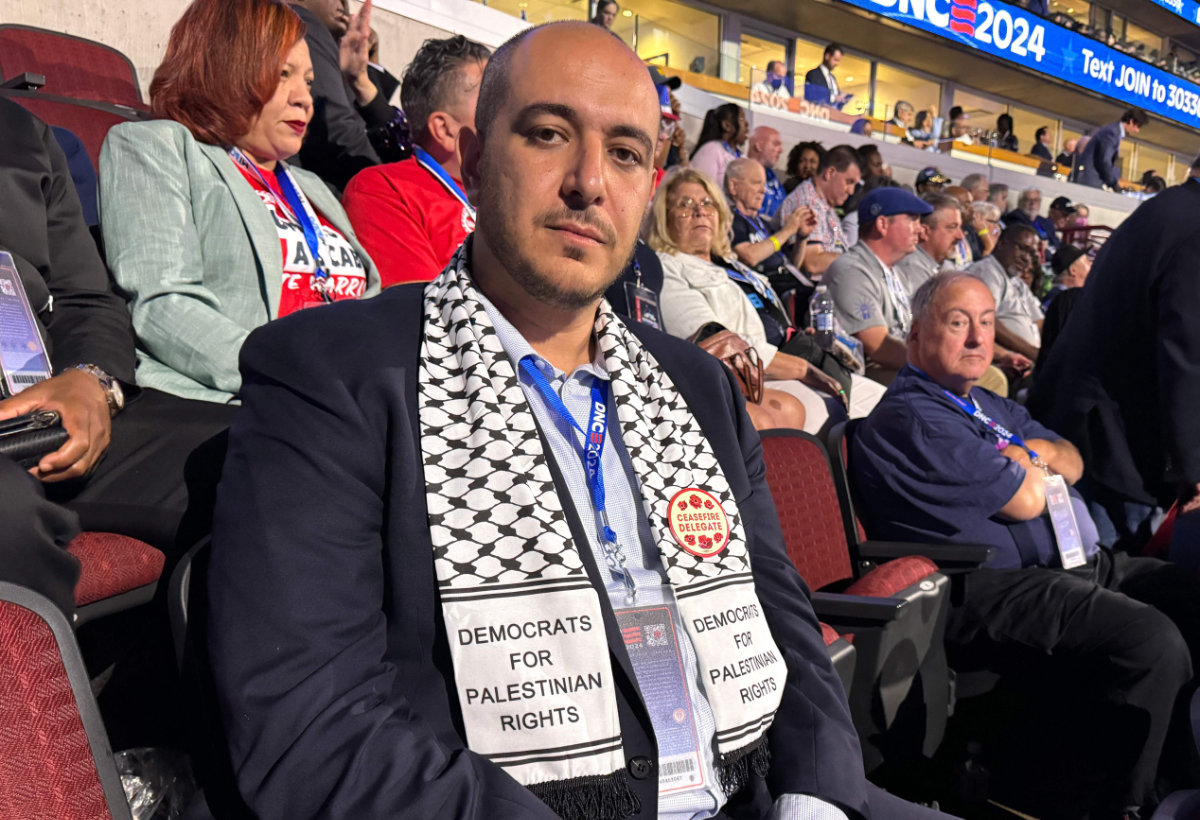
Arab American Abbas Alawieh, Michigan delegate, wears a "Democrats for Palestinian Rights" scarf as he attends the first day of the Democratic National Convention (DNC) at the United Center in Chicago, Illinois, on August 19, 2024. (AFP)
The sit-in outside the United Center has exposed cracks in a Democratic Party that otherwise has rallied around the Harris campaign that has energized the vast majority of party members this week.
The news that the DNC had denied the request of a Palestinian American speaker, just a day after featuring the parents of an Israeli American hostage held by Hamas, ignited fresh criticism from some on the left. The politically powerful United Autoworkers Union, which has endorsed Vice President Kamala Harris’ presidential campaign, said the party “must allow a Palestinian American speaker to be heard from the DNC stage tonight.”
Cook County, where Chicago and the convention is located, holds the largest population of Palestinian Americans in the country.
The party, however, has not budged. The Senate’s top Democrat shrugged off the potential political impact of the sit-in outside the convention. New York Sen. Chuck Schumer recalled Harris saying when protesters interrupted her at a recent rally in Michigan that their disruptions might be benefiting Republican Donald Trump.
“She said, ‘Be quiet unless you want to elect Trump,’” Schumer told a small group of reporters on Thursday, ahead of the convention’s final evening.
“We believe we need unity, and there’s overwhelming — I have never seen such unity,” he said. “A small handful of people does not represent close to even a sliver of where the Democratic Party is right now.”
Tensions over the war in Gaza have at times escalated outside the convention center this week, as thousands marched through Chicago demanding a ceasefire. A smaller group of activists clashed with police outside the Israeli Consulate on Tuesday night, leading to 56 arrests.
Minnesota Attorney General Keith Ellison, a Muslim Democrat, spoke Wednesday at the convention and praised Harris for saying “we need a ceasefire and an end to the loss of innocent lives in Gaza and to bring hostages home.” In an interview Thursday, he said that “not only is the content of the message important, the messenger is also important.”
“A Palestinian-American sharing his or her story, calling for ceasefire and release of all hostages, and calling everyone to support the ticket against fascism would be powerful,” Ellison said on social media Thursday.
Many other Democratic leaders urged the party to reconsider the request. In a statement, California Rep. Ro Khanna said that “the Democratic Party, which aspires to be the party of human rights, must not in 2024 perpetuate this erasure of the Palestinian story.”
When asked at a roundtable discussion Thursday whether he agreed with the “Uncommitted” delegates’ demand to add a Palestinian American speaker to the DNC lineup, Chicago Mayor Brandon Johnson said, “Yes, of course.”
“We’re talking about thousands of babies and elderly people being brutalized by an act of war,” said Johnson. “You have to have a voice that can call for peace as well as the releasing of hostages.”
According to Alawieh, the “Uncommitted” movement provided a number of potential Palestinian Americans who could speak at the convention, including Georgia State Rep. Ruwa Romman.
Romman on Thursday released a draft of the speech she said she planned to deliver if asked. In it, she calls for electing Harris, defeating Donald Trump — and outlines demands for a ceasefire and to “end the killing of Palestinians, free all the Israeli and Palestinian hostages.”
Earlier this week, activists were granted unprecedented space at the convention to hold a forum addressing the plight of Gaza residents, who have been under Israeli bombardment since Hamas’ Oct. 7 attack and its taking of hostages, as well as to share deeply personal stories about family members lost in the conflict. The panel was viewed as an olive branch from the Harris campaign, with hopes that other requests might be fulfilled later in the week.
The convention has officially made Harris the Democratic Party’s presidential nominee, with the vast majority of the nearly 4,000 delegates enthusiastically casting their votes for her.
But those calling for a ceasefire in the Israel-Hamas war — among other demands, such as an arms embargo on Israel — believe they will have an outsized influence in the November election, now just over 70 days away.
Michigan, one of the key swing states, has the largest percentage of Arab Americans in the country. The UAW, which hosted Harris at a union hall event earlier this month, also has its largest membership base in Michigan. In a statement, the leader of the state Democratic Party, Lavora Barnes, said “a Palestinian American should have a speaking role Thursday night so that their voices can be heard — all of our delegates are part of our Michigan Democratic Party family.”
Through Thursday, Democrats on their way into the convention stopped by the sit-in. Rep. Cori Bush, a member of the progressive congressional group known as the “Squad,” who lost her primary earlier this month, stopped to mingle with “Uncommitted” delegates.
“We are Democrats. We are a part of this party. And we are just saying, ‘hear us because it matters,’” said Bush.