

Pakistan’s army chief warns of ‘perils of fake news’ in meeting with Harvard students

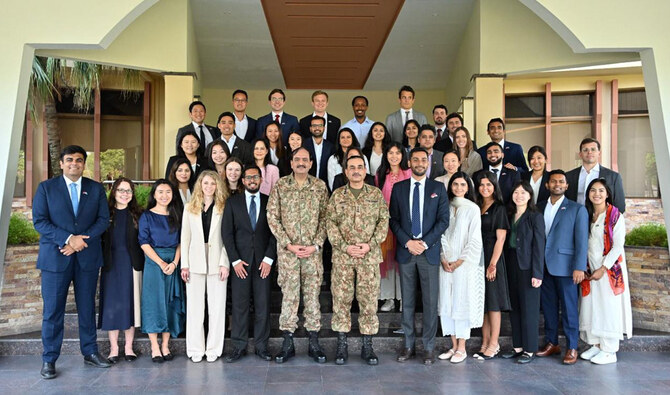
The group photo shows a delegation of 44 students from Harvard Business School Trek-2024, with the Pakistan army chief, General Syed Asim Munir, at the General Headquarters in Rawalpindi, Pakistan on August 22, 2024. (Photo courtesy: Military's media wing)
Short Url
Updated 22 August 2024
Follow

Pakistan’s army chief warns of ‘perils of fake news’ in meeting with Harvard students

  • Pakistan army chief discusses regional peace, stability and country’s efforts against militancy, says military’s media wing
  • Rights activists accuse Pakistani authorities of censoring digital media, including a move to install firewall to monitor online content

ISLAMABAD: Pakistan Army Chief General Syed Asim Munir met a delegation of Harvard Business School (HBS) students on Thursday to discuss militancy and Pakistan’s efforts in battling it, warning them against the “perils of misinformation and fake news” in today’s digital age, the military’s media wing said. 

Pakistan’s powerful army has toughened its stance against criticism on digital media, with its military spokesperson this month accusing “digital terrorists” of attempting to politicize its efforts against militancy. The term was a veiled reference to the party of former prime minister Imran Khan, whose leaders and supporters have attacked the military on digital media platforms since Khan’s ouster from office in a parliamentary vote in April 2022. 

Digital rights activists this month also spoke out against the government’s move to install a firewall that would allow it to monitor malicious content on social media, protect government networks from attacks, and allow authorities to identify IP addresses associated with what it calls “anti-state propaganda.” Rights activists have also criticized the government for its ban on social media platform X since February, which authorities say they imposed due to “national security” reasons. 

Munir met a delegation of 44 students of the HBS from nine countries at the army headquarters in Rawalpindi, the Inter-Services Public Relations (ISPR) said in a statement. It said discussions revolved around regional peace and stability, and Pakistan’s efforts to battle militancy. 

“The COAS also cautioned against the perils of misinformation and fake news in the digital age, urging the students to navigate this landscape with discernment,” the military’s media wing said. 

The army chief stressed the significance of education, critical thinking, and innovation in addressing contemporary security challenges during his interaction with the students, the ISPR said. 

“He highlighted Pakistan’s vast potential and encouraged the attendees to form their own opinions based on personal experiences,” the military’s media wing said. 

The ISPR said that the interactive session provided a platform for the army to share perspectives on Pakistan’s pivotal role in promoting regional peace and stability, its unwavering efforts against terrorism, and its commitment to upholding democratic values.

The students expressed their gratitude to the army chief for facilitating a “constructive and enlightening interaction,” the ISPR said. 

The government’s attempts to muzzle social media have also been sharply criticized by Khan’s political party. The former cricketer-turned-politician’s popularity, which persists even from behind bars, has been fueled by social media, including driving Pakistan’s young people to turn out to vote in Feb. 8 elections. 

Khan-backed candidates won the greatest number of seats in the polls despite having to contest as independents after the PTI was deprived of its iconic bat symbol by the election commission. 


Pakistani president arrives in Iraq to deepen trade, energy cooperation

Updated 20 December 2025
Follow

Pakistani president arrives in Iraq to deepen trade, energy cooperation

  • Visit follows recent high-level contacts as Islamabad seeks to expand limited commercial ties with Baghdad
  • Talks are expected to cover investment, manpower and facilitation of Pakistani pilgrims visiting holy sites in Iraq

ISLAMABAD: President Asif Ali Zardari arrived in Iraq on Saturday on an official visit aimed at expanding cooperation in trade, energy and investment, as Pakistan seeks to deepen ties with Baghdad after years of limited engagement.

Pakistan and Iraq established diplomatic relations in 1947 and have traditionally maintained cordial ties, though commercial links remain modest, with officials and business groups identifying scope for cooperation in construction services, pharmaceuticals, manpower and agricultural exports.

“President Asif Ali Zardari arrived in Baghdad on a four-day official visit to Iraq,” his office said in a post on X. “He was received by Culture Minister Dr. Ahmed Fakkak Al-Badrani. During the visit, meetings with senior Iraqi leadership are expected to advance cooperation and further strengthen Pakistan-Iraq relations.”

Zardari’s visit follows a series of recent high-level contacts between the two countries, reflecting efforts to broaden bilateral engagement beyond traditional diplomatic ties and explore collaboration across economic, political and people-to-people domains.

According to Pakistan’s foreign office, the president is expected to hold meetings with Iraq’s senior leadership to discuss cooperation in various areas such as trade and investment, energy, technology, education and manpower.

He is also expected to discuss regional and international issues with Iraqi officials.

Earlier this month, Pakistan’s Interior Minister Mohsin Naqvi met his Iraqi counterpart, Abdul Ameer Al-Shammari, on the sidelines of meetings in Brussels, where both sides agreed to enhance cooperation on security and facilitate travel for Pakistani Shia pilgrims to Najaf and Karbala.

The two officials discussed measures to ensure the smoother movement of these pilgrims and their compliance with visa regulations.