

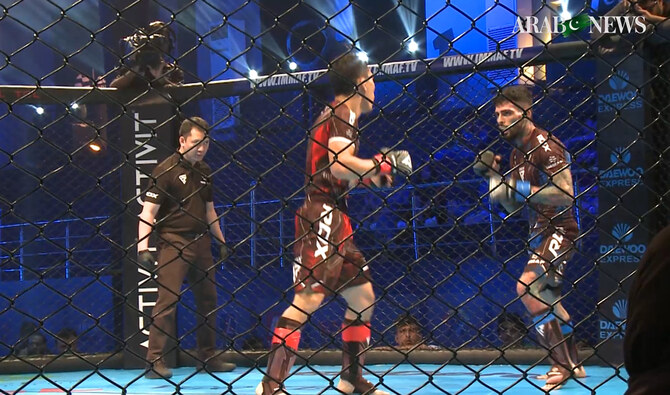

LAHORE: Over 180 athletes from 23 countries participated this week as Pakistan hosted the International Mixed Martial Arts Federation (IMMAF) Asian Championship for the first time, with the Pakistan MMA Federation calling it the “biggest sporting event in the country’s history.”
MMA is a full-contact combat sport that combines techniques from various martial arts disciplines, including boxing, wrestling, jiu-jitsu, Muay Thai and karate. Competitors use both striking and grappling techniques in a regulated environment, often within a cage or ring, to determine the most skilled fighter.
Pakistan is a late entrant to the sport though it has no shortage of fans, many of whom regularly train at MMA-dedicated gyms equipped with experienced coaches and specialized facilities. Gyms and training centers have been popping up all over the country in recent years as the youth of Pakistan embrace the world’s fastest growing sport.
The MMA Asia championship in Lahore also opened to a packed house on Sunday with a fight between Pakistani and Indian fighters, allowing the fierce cross-border rivalry to not only set the tone for the competition but also pique the interest of fans in other parts of the world.
The event, which was aired by American broadcasters and streamed on multiple platforms, has attracted participants from regions such as the Middle East and Central Asia and will run from Aug. 18-22.
“Since [Asian championship] is being broadcast in 180 countries, translated in 25 languages and hitting 10 million households, so for Pakistan, it’s the biggest sporting event in its history,” Omer Ahmed, the president of the Pakistan MMA Federation, told Arab News.
Pakistani fighters displayed impressive performances against their Indian counterparts with Zia Mashwani, a local fighter, winning the first-round submission over Bharat Khandare during the inaugural match on Sunday.
Pakistan’s 24-year-old Bano Butt also beat her Indian counterpart in the 47-kilogram atomweight category in the semifinal on Wednesday.
“I started MMA in 2019, and I’m undefeated in Pakistan, my record is 12-1 [with only one international defeat],” said Butt, who was an amateur boxer before training for MMA at a gym that provides combat training. “I thank my coaches and Mr. Omer Ahmed at the MMA Federation for supporting me.”
Ahmed is the driving force behind the tournament in Pakistan and forged global partnerships with entities like the International Mixed Martial Arts Federation to bring the first MMA Asian Championship to the South Asian nation.
“This is the only event in Pakistan’s history where 16 teams and 300 foreign nationals have shown up,” he said, giving a count of fighters, coaches and support staff and pointing out that even in cricket, the most popular game in the country, only about eight teams joined major tournaments.
“We’ve been winning medals in both the [MMA] Asian Championships and World Championships for the last three years [but] this has been somewhat of a silent revolution,” Ahmed added. “Because even though our Pakistani MMA federation is [globally] recognized, it is a self-funded federation. The best thing is that we’ve learned how to monetize our content.”
“BEAUTIFUL COUNTRY”
Visiting athletes and teams from Pakistan, Middle East, India and other nations praised the arrangements and hospitality at the event.
“This is the first time I’ve come to Pakistan,” Khushboo Nishad, an Indian MMA fighter, told Arab News. “There was a lot of [negative] hype about Pakistan, but I really enjoyed my time here.
“Coming here to Pakistan, I felt like I was back in my hometime, in India. It’s a beautiful country, Pakistan, it’s just like India.”
Another fighter visiting Pakistan for the first time was Nour Al Fliti from Lebanon.
“I have been a Lebanese flyweight MMA champion twice,” she told Arab News. “I have just finished my fight, and I won by decision after facing team Pakistan.”
Al Fliti said she was aiming for gold like her Lebanese compatriot, Mohammad Fakhreddine who won in the male 55-kg featherweight category.
From Bahrain, Ali Mahroon put in walkover performances on his way to the 77-kg welterweight final.
“I won today with two submissions,” he told Arab News. “Tomorrow [Thursday], let’s go [for] gold.”
Mahroon said he had a “wonderful” time in Lahore, praising Pakistani hospitality and the tournament arrangements.
Mohammad Ghorbani, Iran’s Head Coach, called Pakistan a “beautiful” country.
“The people are nice. It’s a great experience and I would like to be back in this country very soon.”
Ahmed from the MMA federation thanked Rana Mashood of the Prime Minister’s Youth Program and the foreign office for facilitating the event.
“The Ministry of Foreign Affairs gave us a desk through which we were able to get these 300 visas … [they] arranged all of these visas within a day or two,” Ahmed said. “The government has supported us in this event, through logistics, through security, through getting visas, but we have not taken any financial support from them.”
Relying mainly on brands and sponsors, the federation had been successful in supporting Pakistani athletes at events around the world, Ahmed said.
“In Abu Dhabi, Ismail Khan won a bronze medal. Bano Butt picked up a medal in Serbia, which was a big success being the first female [MMA] athlete from Pakistan. We won four medals, in two female and two male categories [3 silvers and a bronze] in Bahrain last December.”
“We will continue to win medals in [international] competitions and want people to watch this sport and make it even bigger than it already is,” the MMA Federation president said, saying hosting the Asian championship would go a long way in putting MMA on the sporting map in Pakistan.
“It’s a big deal, and hopefully if events like these continue to happen, you’ll also see the economy for this sport develop in Pakistan.”


