Floods swamp Bangladesh as nation finds its feet after protests

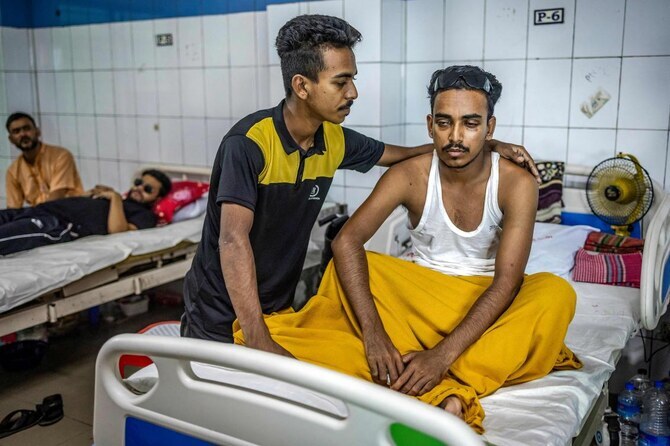
Omar Faruq (R) who lost his sight as he was wounded by shotgun pellets during the student-led uprising that ousted the 15-year rule of ex-premier Sheikh Hasina, sits on a bed at National Institute of Opthalmology and Hospital in Dhaka on August 20, 2024. (AFP)
Short Url
Updated 22 August 2024
Follow

Floods swamp Bangladesh as nation finds its feet after protests

  • At least two people have died and hundreds of thousands are stranded in the floods in at least eight districts
  • Around 2.9 million people have been affected and more than 70,000 people have been taken to shelters

DHAKA: Floods triggered by torrential rains have swamped a swath of low-lying Bangladesh, disaster officials said Thursday, adding to the new government’s challenges after weeks of political turmoil.
At least two people have died and hundreds of thousands are stranded in the floods in at least eight districts in southern and eastern areas.
“Around 2.9 million people have been affected and more than 70,000 people have been taken to shelters,” Mohammad Nazmul Abedin, senior official in the Ministry of Disaster Management and Relief, told AFP.
Long-time premier Sheikh Hasina quit as prime minister this month and fled to India after weeks of deadly student-led protests, ending her 15-year autocratic rule.
The South Asian nation of 170 million people, crisscrossed by hundreds of rivers, has seen frequent floods in recent decades.
It is among the countries most vulnerable to disasters and climate change, according to the Global Climate Risk Index.
The annual monsoon rains cause widespread destruction every year, but climate change is shifting weather patterns and increasing the number of extreme weather events.
The army and the navy have been deployed, with speedboats and helicopters rescuing those stranded by the swollen rivers.
Much of the country is made up of deltas where the Himalayan rivers the Ganges and the Brahmaputra wind toward the sea after coursing through India.
Neighbouring India’s foreign ministry rejected accusations it was to blame for the floods, denying it had deliberately released water from an upstream dam.
It said the catchment area had experienced the “heaviest rains of this year over the last few days,” and that the flow of water downstream was due to “automatic releases.”
Asif Mahmud, a key leader of the student protests that ousted Hasina, and now the sports minister in the interim cabinet, had accused India of not only hosting Hasina, but of “creating a flood” by deliberately releasing water from dams.
India said that was “factually not correct.”
“Floods on the common rivers between India and Bangladesh are a shared problem inflicting sufferings to people on both sides, and requires close mutual cooperation toward resolving them,” New Delhi’s foreign ministry said in a statement.
Hasina’s rule saw widespread human rights abuses, including the mass detention and extrajudicial killings of her political opponents.
But Indian Prime Minister Narendra Modi’s Hindu-nationalist government preferred Hasina over her rivals from the Bangladesh Nationalist Party, which it saw as closer to conservative Islamist groups.
Modi has offered his support to the new Bangladeshi leader Nobel laureate Muhammad Yunus, who is heading the caretaker administration.


Afghan government says Pakistan strikes Kabul and border provinces

Updated 4 min 47 sec ago
Follow

Afghan government says Pakistan strikes Kabul and border provinces

  • A Pakistani security official, speaking on condition of anonymity, confirmed that Pakistan struck overnight
  • Islamabad last month launched a wave of air strikes on its neighbor, an operation it says is targeting militancy

KABUL: Afghan authorities said on Friday that Pakistan had carried out new strikes on Kabul and border provinces, killing four people in the capital.

A Pakistani security official, speaking on condition of anonymity, confirmed that Pakistan struck overnight, adding their forces targeted the Pakistani Taliban militant group, known as TTP.

Islamabad last month launched a wave of air strikes on its neighbor, an operation it says is targeting militancy following growing attacks in Pakistan.

But the Taliban government has denied any involvement or the use of Afghan territory for militancy.

Khalil Zadran, the spokesman for Kabul police, said four people had been killed and 15 wounded in the bombardment that hit homes in the capital, with women and children among the victims.

Taliban government spokesman Zabihullah Mujahid posted on X that Pakistani strikes also hit the southern province of Kandahar, as well as eastern Paktia and Paktika, which border Pakistan.

In Kandahar, which is home to the administration’s supreme leader Hibatullah Akhundzada, air strikes hit a fuel depot for airline Kam Air, near the airport.

This company supplies fuel to civilian airlines and United Nations aircraft.

Pakistan insists it has not killed any civilians in the conflict. Casualty claims from both sides are difficult to verify independently.

Afghan and Pakistani forces have also clashed repeatedly at the border in recent weeks, hampering trade and forcing nearby residents to leave their homes.

‘Open war’

The United Nations’ mission in Afghanistan (UNAMA) has said that 56 civilians have been killed in Afghanistan, including 24 children, by Pakistani military operations between February 26 and March 5.

About 115,000 people were forced to leave their homes, according to the UN refugee agency.

Fighting between the two countries intensified on February 26, when Afghanistan launched an offensive along the frontier, in retaliation for earlier Pakistani air strikes targeting the TTP.

Pakistan then declared “open war” against the Taliban authorities, bombing the capital, Kabul, on February 27.

Since then, clashes have increased in border regions, including overnight Wednesday to Thursday that the Afghan authorities said killed four members of the same family in Khost province.

The Taliban government said on Thursday that four members of the same family, including two children, were killed by Pakistani artillery and mortar fire in eastern Afghanistan.

Seven people had been killed in Afghanistan since Tuesday as a result of cross-border clashes between the two sides, according to the authorities in Kabul.

Deputy government spokesman Hamdullah Fitrat said the latest deaths happened early Thursday in the village of Sadqo in Khost province, accusing Pakistan of deliberately targeting civilian homes and nomads’ tents.