

Pakistan Army major becomes first UN peacekeeper in Cyprus to win gender advocacy award

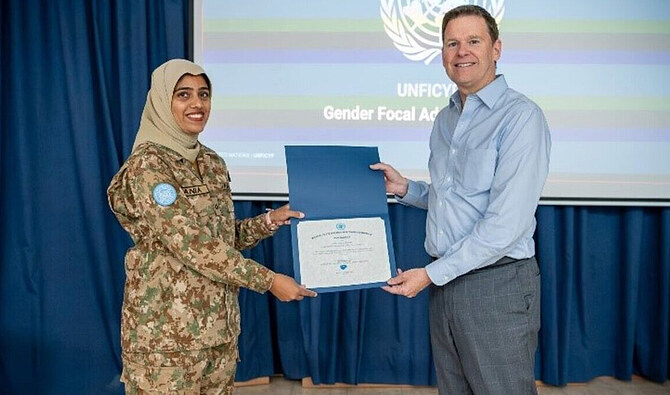
Pakistan Army’s Major Sania Safdar receives the 2023 ‘Certificate of Recognition’ for advocating gender equality in Cyprus on August 21, 2024. (Photo courtesy: United Nations Peacekeeping Force in Cyprus)
Short Url
Updated 21 August 2024
Follow

Pakistan Army major becomes first UN peacekeeper in Cyprus to win gender advocacy award

  • Major Sania Safdar serves as force signal officer at UN peacekeeping force in Cyprus
  • Her tasks in Cyprus involve overseeing communication systems, promoting gender equality

ISLAMABAD: Pakistan Army’s Major Sania Safdar on Wednesday became the first UN peacekeeper in Cyprus to win the 2023 ‘Certificate of Recognition’ for advocating gender equality, the United Nations Peacekeeping Force in Cyprus (UNFICYP) said. 

Major Safdar is currently serving as the mission’s force signal officer, the UNFICYP said in a post. The award, issued by the New York-based UN Department for Peace Operations, was presented to her by the special representative of the UN secretary-general in Cyprus, Colin Stewart. 

“Receiving this certificate as the first peacekeeper from UNFICYP is deeply meaningful to me and significant for our mission in Cyprus,” Safdar said in a statement. “It serves as a testament to our commitment to gender equality.”

Created in 2016, the “UN Military Gender Advocate of the Year Award” recognizes the dedication and efforts of an individual military peacekeeper in promoting the principles of UN Security Council Resolution 1325 on Women, Peace and Security (WPS). 

Her primary tasks in Cyprus involve overseeing communication systems and promoting gender equality within the military component. Since her deployment to the mission in Cyprus last year, she has proactively taken charge of several initiatives by focusing on integrating the Women, Peace, and Security Agenda into military components of the mission’s work, the UNFICYP said. 

“As the Mission’s Force Signal Officer serving in the Field Technology Section, she was also involved in strengthening the effectiveness of joint patrols by incorporating communication tools to enhance military operations on the ground while promoting gender representation in the military,” the UNFICYP said. 

Since 1960, Pakistan has been one of the main troops and police contributors to the UN peace operations, with more than 200,000 Pakistani men and women sent to 46 UN missions. The South Asian country is currently contributing over 4,000 troops to various international operations carried out by the UN and has lost 172 soldiers in total to UN peace missions. 


Pakistan warns India-Canada uranium deal could widen nuclear imbalance in South Asia

Updated 5 sec ago
Follow

Pakistan warns India-Canada uranium deal could widen nuclear imbalance in South Asia

  • Islamabad says assured uranium supplies could free India’s domestic reserves for military use
  • Foreign office calls for non-discriminatory nuclear cooperation framework for non-NPT states

ISLAMABAD: Pakistan on Thursday voiced concern over a uranium supply agreement and nuclear technology cooperation between India and Canada, warning the arrangement could expand India’s nuclear arsenal and undermine the global non-proliferation framework.

The statement came after Ottawa and New Delhi concluded a long-term deal covering uranium supplies and potential cooperation in advanced nuclear technologies, including small modular reactors.

The agreement was announced earlier this week as part of efforts by the two countries to deepen energy and economic ties. Canada has previously supplied uranium to India under a civilian nuclear cooperation framework first agreed in 2010 and implemented in 2013, with commercial supply contracts signed in subsequent years.

“Assured external uranium supplies effectively release India’s domestic reserves for military use, enabling the expansion of its fissile material stockpiles, accelerating the growth of its nuclear arsenal, and deepening existing asymmetries in South Asia’s strategic balance,” foreign office spokesperson Tahir Andrabi said in a statement while responding to media queries.

“The arrangement also undermines Canada’s commitment to the international non-proliferation regime and its corresponding obligations under that framework,” he added.

Andrabi said the agreement represents another country-specific exception in civilian nuclear cooperation, noting that India’s 1974 nuclear test — conducted using plutonium produced in a Canadian-supplied research reactor — led to the creation of the Nuclear Suppliers Group (NSG).

“A state whose actions necessitated the establishment of global export controls is now being granted preferential access under selective arrangements,” he added.

The foreign office spokesperson said India has not placed all of its civilian nuclear facilities under International Atomic Energy Agency safeguards and has not made binding commitments under the new arrangement to do so.

He also pointed out it was unclear what concrete non-proliferation assurances accompanied the agreement.

“Pakistan reiterates that civil nuclear cooperation must be governed by a non-discriminatory, criteria-based approach applicable equally to states that are not parties to the Nuclear Non-Proliferation Treaty (NPT),” Andrabi said.

“Selective exceptions diminish the credibility of the global non-proliferation framework and risk further destabilizing regional and global peace & security.”