‘It’s a marathon’: Pakistan allocates budget to fight rat infestation in parliament

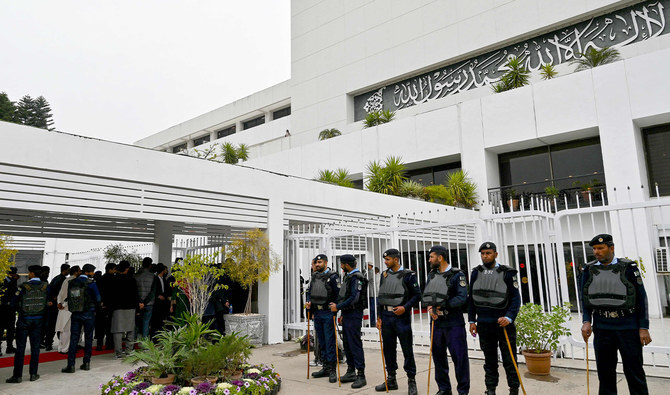
In this file photograph, taken on February 29, 2024, security personnel stand guard outside the parliament house building in Islamabad. (AFP)
Short Url
Updated 21 August 2024
Follow

‘It’s a marathon’: Pakistan allocates budget to fight rat infestation in parliament

  • Rat problem at National Assembly came to light after records of meetings from 2008 were found to have been badly gnawed 
  • “The rats are so huge that even cats might be afraid of them,” National Assembly spokesman Zafar Sultan tells the BBC

ISLAMABAD: Authorities in Pakistan’s federal capital have allocated Rs1.2 million ($4,320) to combat a rat infestation in the building of the country’s lower house of parliament, the BBC reported on Wednesday, with the pests having gnawed away at important official documents.
The rat problem at the National Assembly building came to light after an official committee asked to see the records of meetings from 2008, which were found to have been badly gnawed by rats.
“The rats on this floor are so huge that even cats might be afraid of them,” National Assembly spokesman Zafar Sultan told the BBC, saying most of the rats could be found on the first floor, which houses the building’s food hall, as well as the office of the senate opposition leader. Most meetings of political parties and standing committees also take place here.
Sultan said the rats generally kept themselves out of sight until people left the building. 
“When there are usually no people here in the evening, the rats run around in there like it’s a marathon,” the BBC quoted Sultan as saying. “The staff posted there are now used to this, but if someone comes here for the first time, they get scared.”
The BBC said Pakistani authorities had published newspapers advertisements to identify pest control companies and received interest from two firms. 
Pakistani TV channel Geo News reported that the Capital Development Authority was mulling employing hunting cats to catch rats in parliament.


Pakistan says defense pact with Saudi Arabia elevated brotherly ties to ‘new heights’

Updated 25 February 2026
Follow

Pakistan says defense pact with Saudi Arabia elevated brotherly ties to ‘new heights’

  • Pakistan, Saudi Arabia signed strategic defense pact last year pledging aggression against one will be treated as attack on both
  • Deputy PM Ishaq Dar says enduring bonds with Islamic and Arab nations form vital pillar of Pakistan’s foreign policy 

ISLAMABAD: Deputy Prime Minister Ishaq Dar said on Wednesday that Pakistan’s defense pact with Saudi Arabia elevated its brotherly ties with the Kingdom to “new heights,” stressing that close ties with Arab and Islamic nations form a key pillar of Islamabad’s foreign policy. 

Pakistan and Saudi Arabia signed a Strategic Mutual Defense Agreement on Sept. 17 last year, pledging that aggression against one country would be treated as an attack on both, enhancing joint deterrence and formalizing decades of military and security cooperation.

Both nations agreed in October 2025 to launch an economic cooperation framework to strengthen trade and investment ties. 

“In the Middle East, our landmark Strategic Mutual Defense Agreement with Saudi Arabia has elevated our brotherly ties to new heights,” Dar said while speaking at the Pakistan Governance Forum 2026 event in Islamabad. 

The Pakistani deputy prime minister was speaking on the topic “Navigating International Relations Amidst Changing Geo-Politics.”

Dar noted that Pakistan has reinforced partnerships with other Middle Eastern nations such as the UAE, Qatar, Jordan, Oman, Egypt and Bahrain. He said these partnerships have yielded “concrete agreements” in investment, agriculture, infrastructure, and energy sectors. 

“Our enduring bonds with Islamic and Arab nations form a vital pillar of our foreign policy, and we will continue to expand our partnerships across Asia, Latin America, and Africa,” he said. 

Dar pointed out that the presidents of Kazakhstan, Uzbekistan and Kyrgyzstan have undertaken visits to Pakistan in recent months, reflecting Central Asian nations’ desire to boost cooperation with Islamabad.

On South Asia, the Pakistani deputy PM said Pakistan has successfully transformed its fraternal ties with Bangladesh into “a substantive partnership.”

“Similarly, the trilateral mechanism involving China, Pakistan, and Bangladesh has been launched with a view to expanding and deepening regional cooperation and synergy,” the Pakistani minister said. 

He said Islamabad has strengthened its “all-weather” partnership with China via the second phase of the multi-billion-dollar China-Pakistan Economic Corridor agreement and “unwavering support” from both sides for each other’s core interests. 

Dar said Pakistan had also reinvigorated its partnership with the US, advancing cooperation in trade, technology, investment, and regional stability. 

“This calibrated approach has enhanced our ability to navigate complexity with skill and confidence, ensuring that our national interests are served without compromising our core foreign policy principles,” he said.