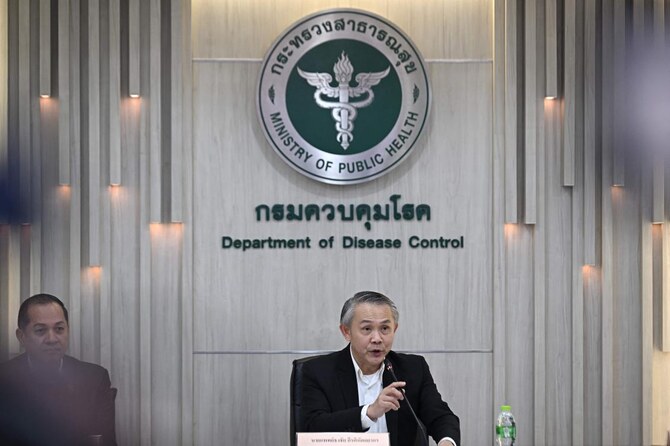
BANGKOK: Thailand has detected an mpox case in a European man who arrived from Africa last week and is awaiting test results to determine the strain, a disease control official said on Wednesday.
Thai authorities were treating the case as if it were the Clade 1 form of mpox, as the person, a 66-year-old European man with residency in Thailand had arrived on Aug. 14 from an African country where it was spreading, Thongchai Keeratihattayakorn, director-general of the Department of Disease Control, said.
“After he arrives from the flight there is very little time frame where he come into contact with others,” Thongchai said. “He arrives around 6 p.m. and on the next day, Aug 15, he went to see the doctor at the hospital.”
Thongchai said the man has undergone a test to determine whether the case was a Clade 1 variant, with the result expected by Friday. Authorities are also monitoring 43 people in the country who may come into contact with the patient, he said.
The director-general did not name the African country the man had been in. He said the man had transited in a Middle Eastern country, which he also did not name, before flying on to Thailand.
Thailand has detected 800 cases of mpox Clade 2 since 2022, but so far not detected a case of the Clade 1 or Clade 1b variants.

Thailand says mpox case recorded in traveler from Africa
https://arab.news/67we8
Thailand says mpox case recorded in traveler from Africa
- Thai authorities were treating the case as if it were the Clade 1 form of mpox
- Thailand has detected 800 cases of mpox Clade 2 since 2022, but so far not detected a case of the Clade 1 or Clade 1b variants
Indonesia reaffirms Yemen’s territorial integrity, backs stability efforts amid tensions
- Statement comes after Saudi Arabia bombed a UAE weapons shipment at Yemeni port city
- Jakarta last week said it ‘appreciates’ Riyadh ‘working together’ with Yemen to restore stability
JAKARTA: Indonesia has called for respect for Yemen’s territorial integrity and commended efforts to maintain stability in the region, a day after Saudi Arabia bombed a weapons shipment from the UAE at a Yemeni port city that Riyadh said was intended for separatist forces.
Saudi Arabia carried out a “limited airstrike” at Yemen’s port city of Al-Mukalla in the southern province of Hadramout on Tuesday, following the arrival of an Emirati shipment that came amid heightened tensions linked to advances by the UAE-backed Southern Transitional Council in the war-torn country.
In a statement issued late on Wednesday, the Indonesian Ministry of Foreign Affairs said it “appreciates further efforts by concerned parties to maintain stability and security,” particularly in the provinces of Hadramout and Al-Mahara.
“Indonesia reaffirms the importance of peaceful settlement through an inclusive and comprehensive political dialogue under the coordination of the United Nations and respecting Yemen’s legitimate government and territorial integrity,” Indonesia’s foreign affairs ministry said.
The latest statement comes after Jakarta said last week that it “appreciates the efforts of the Kingdom of Saudi Arabia, as well as other relevant countries, working together with Yemeni stakeholders to de-escalate tensions and restore stability.”
Saudi Arabia leads the Coalition to Restore Legitimacy in Yemen, which includes the UAE and was established in 2015 to combat the Houthi rebels, who control most of northern Yemen.
Riyadh has been calling on the STC, which initially supported Yemen’s internationally recognized government against the Houthi rebels, to withdraw after it launched an offensive against the Saudi-backed government troops last month, seeking an independent state in the south.
Indonesia has also urged for “all parties to exercise restraint and avoid unilateral action that could impact security conditions,” and has previously said that the rising tensions in Yemen could “further deteriorate the security situation and exacerbate the suffering” of the Yemeni people.
Indonesia, the world’s biggest Muslim-majority country, maintains close ties with both Saudi Arabia and the UAE, which are its main trade and investment partners in the Middle East.


